
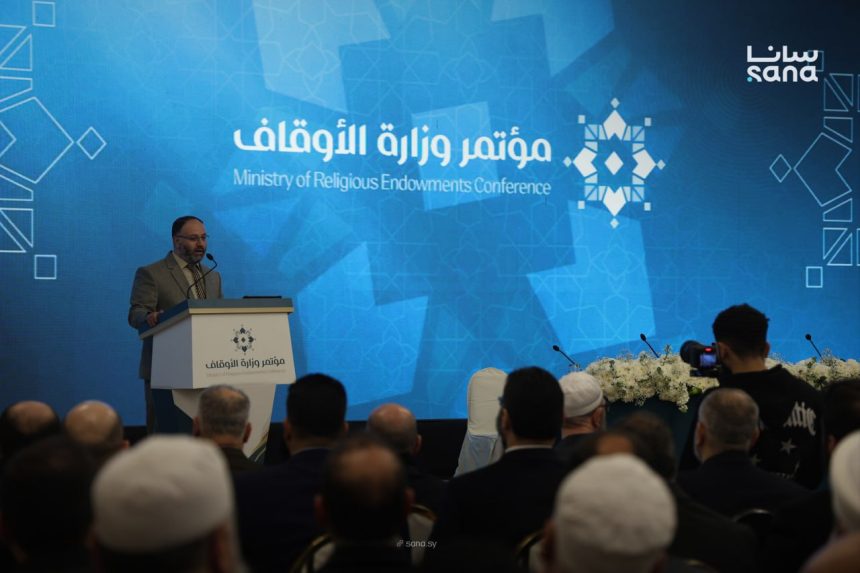
Syria’s Ministry of Awqaf convened its first “Conference on the Unity of Islamic Discourse” at the Damascus Conference Palace, gathering more than 150 scholars and religious officials. The event marked a significant step in rebuilding the country’s religious institution after decades in which the Assad regime had turned the pulpit into a political instrument. For years, sermons required security approval, preachers were vetted by intelligence agencies, and mosques became extensions of state propaganda—eroding public trust and making reform a national necessity.
The conference culminated in the announcement of the “Charter for the Unity of Islamic Discourse,” presented as a national framework to coordinate religious messaging, manage scholarly differences, and promote ethical, balanced interpretation of Islamic texts. Sheikh Anas Al-Mousa described the charter as a tool for unifying scholars, while Grand Mufti Osama Al-Rifai called it a long-term investment in moral and social cohesion. Minister of Awqaf Mohammad Abu Al-Khair Shukri emphasized that unity does not mean erasing diversity, but organizing it within a shared national framework rooted in moderation and coexistence.
President Ahmad Al-Shara’a, speaking on the second day, stressed that the pulpit is a public trust and that preachers must verify information and avoid importing unvetted content from social media. He acknowledged the heavy legacy of corruption and destruction—over 1.2 million homes damaged—and called for institutional integration across state sectors. He urged scholars to avoid abstract historical disputes and focus instead on community ethics and constructive engagement.
The charter emerged from a broad consultative process involving fourteen workshops across Syrian governorates and additional sessions in Damascus. It outlines principles for religious discourse, mechanisms for cooperation among different schools, and guidelines for moderation. The Ministry reaffirmed the four Sunni jurisprudential schools and the Ash‘ari, Maturidi, and Ahl al-Hadith theological traditions as the primary references for religious teaching.
Speakers underscored that Syria’s social fabric has always been diverse and that moderate discourse is rooted in Islam’s foundational values of coexistence. Presidential advisor Abdulrahim Atoun stressed that unity requires shared responsibility among state institutions and religious communities, while members of the Supreme Council for Ifta’ warned that unified discourse is essential to counter external threats and preserve national cohesion.
Some scholars expressed concerns that a charter endorsed by a government ministry could risk centralizing control over religious life, echoing past authoritarian practices. Yet these concerns coexist with broad agreement that Syria urgently needs a credible, unifying religious framework capable of dismantling the legacy of politicized religion.
Ultimately, the charter represents a shift from fragmentation to coordinated institutional action. While implementation will be complex, it marks an initial step toward rebuilding a religious sphere grounded in moderation, scholarly integrity, and national reconciliation.
This article was translated and edited by The Syrian Observer. The Syrian Observer has not verified the content of this story. Responsibility for the information and views set out in this article lies entirely with the author.