
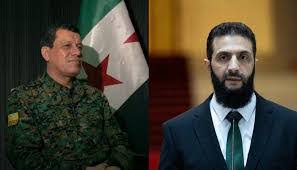
Eight months have passed since the signing of the March 10 Accord between Syria’s transitional president, Ahmad al-Sharaa, and the Syrian Democratic Forces (SDF) commander, Mazloum Abdi. Yet, this agreement—once hailed as a tentative step toward national reconciliation—remains unimplemented, its provisions left dormant and its promise unfulfilled. While multiple meetings have been held between the two sides, none has succeeded in establishing a mechanism to activate its clauses.
Now, the March 10 Accord re-emerges at the forefront of diplomatic engagement, reignited by President al-Sharaa’s recent visit to the United States and his meeting with President Donald Trump at the White House on Monday evening. The revival of the agreement also follows Damascus’s announcement of joining the US-led international coalition against the Islamic State (ISIS), signalling a deeper alignment with international stakeholders.
A New Round of Talks on the Horizon
A new round of negotiations between Damascus and the SDF is expected this week following President al-Sharaa’s and Foreign Minister Asaad al-Shibani’s return from Washington, according to Saudi outlet Al Arabiya. The report cites both a source within the Syrian government and an SDF insider.
According to these sources, the upcoming round will take place in the Syrian capital and aims to begin implementation of the March 10 Accord—a development mirrored in a statement released by the Syrian Foreign Ministry on Monday.
The negotiations had originally been scheduled for earlier this month but were postponed due to al-Sharaa’s overseas trip, the same sources explained.
American envoys are expected to attend the upcoming discussions between the SDF and Damascus, particularly in light of Syria’s accession to the anti-ISIS coalition—an alignment that ties bilateral and multilateral interests more closely than ever before.
The March 10 Accord comprises eight key provisions. Chief among them are the integration of all civil and military institutions in Syria’s northeast under the national administration; the formal recognition of Kurdish identity as an integral part of the Syrian fabric, with full constitutional rights and citizenship; prohibitions on separatist rhetoric; and a mutual ceasefire commitment—an effort to heal the divisions of a war-weary nation.
Integrating the SDF as a Unified Entity
A senior official within the Syrian Democratic Forces revealed that three SDF commanders have been selected for appointment to the Ministry of Defence, in line with the agreement’s clause that mandates the SDF’s integration into the national military as a unified force.
According to this source, the newly restructured Syrian Army is currently forming divisions and brigades. “The SDF will be incorporated as a single division and no fewer than two brigades,” the official stated.
“The SDF has nominated Luqman Khalil, Jiya Kobani, and Jamil Kobani to lead these divisions and brigades,” the source added.
Damascus has proposed a provisional framework for integrating the SDF into the military under the structure of one division and two brigades—a plan that may be adjusted following the adoption of a permanent constitution. That constitution is expected to define whether the country will embrace a centralised or decentralised system, as the SDF has long advocated.
On Monday, the Syrian Foreign Ministry announced that Minister al-Shibani had met with his American and Turkish counterparts, reaching an agreement to move forward with implementing the March 10 Accord.
This development coincides with Syria’s formal entry into the international coalition against ISIS, aligning with President al-Sharaa’s official visit to the United States.
On Tuesday, Syrian Information Minister Hamza al-Mustafa posted on the platform X: “Syria has signed a political cooperation agreement with the international coalition, affirming its role as a bulwark against terrorism and a cornerstone of regional stability.” He clarified that the agreement is strictly political for now, without any immediate military commitments.
This article was translated and edited by The Syrian Observer. The Syrian Observer has not verified the content of this story. Responsibility for the information and views set out in this article lies entirely with the author.