
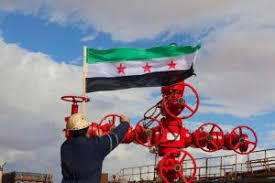
In the marbled antechambers of Damascus, where the ghosts of isolation still linger amid frescoes of renewal, a conclave unfolded yesterday that transcended technicalities to etch itself upon the parchment of sovereignty. President Ahmed al-Sharaa met with figures from the Syrian Petroleum Company (SPC) and the American energy giant Chevron, their discussions centring on Syria’s untapped coastal hydrocarbon reserves. For the first time, official channels have opened towards the black gold and blue gas slumbering beneath the Levantine seabed—a domain long veiled in speculation, from the suspected size of its reserves to the identities of those poised to claim extraction rights.
Described as “preliminary”, the meeting marks the first in a likely series of follow-ups, in which legal and geological teams will craft detailed agreements under the observation of US special envoy Tom Barak, Foreign Minister Asaad Hassan al-Shaibani, SPC director Yusef Qablawi, Chevron vice president for development Rank Mount and regional head Joe Kush, alongside the al-Khayyat family—Mu’taz as UCC chairman and Ramz in a supervisory role. Amid the promise of the Mediterranean coast, this is more than a simple exchange of blueprints; it is the inception of a partnership that could replenish Syria’s coffers and reorient its geopolitical bearings.
An Unfurled Horizon of Accord
Dr Ziyad Arabsh, an energy economics expert at Damascus University, described the summit as a critical step towards reviving Syria’s oil sector after decades of sanctions and conflict. “It marks the resumption of cooperation in a sector starved for over twenty-five years,” he remarked, pointing to the vast potential of the country’s littoral resources.
These synergies, Arabsh explained, rest upon offshore exploration: seismic surveys and subsea drilling to locate and exploit crude oil and gas along Syria’s coastline, possibly identifying new basins or enhancing output from known reserves. Beyond extraction, the agreement could cover vital infrastructure to connect new finds with export routes, as well as technology transfers to rehabilitate a system severely degraded by war. Syria’s coastal energy infrastructure, reshaped by conflict, requires not mere repairs but comprehensive reinvention.
Beyond the Sanctions’ Shadow
In an interview with Al-Madan, Arabsh framed Chevron’s arrival as a financial turning point, especially as the lifting of sanctions opens the floodgates for international tenders. “Agreements with major US companies like Chevron signal more than oil extraction—they herald a chain reaction,” he predicted, suggesting that this cooperation could extend to green energy ventures and advanced refinery construction, as outlined in SPC’s strategic documents. The sector, once sealed off by global isolation, now hints at wide-reaching opportunities where oil agreements may open the door to broader economic transformation.
Anticipated Accords
According to Arabsh, the meeting was a launching pad rather than a finalised deal—a preliminary round of planning and negotiation. “Weeks of detailed discussions are still required,” he noted, “to define the terms—technical, financial, and legal—before any formal agreements are signed.” Should the talks succeed, the outcomes could be substantial: increased oil and gas output for a country in dire need; greater revenue streams to support economic recovery; a signal of stability to attract foreign investors; and thousands of new jobs for skilled and unskilled workers alike. Syria’s coastal resources could, if properly harnessed, strengthen its economic foundations and energy security.
A Cadence of Strategic Surpluses
Dr Ihab Esmender, an economic analyst, viewed the gathering through the lens of Syria’s re-emergence from isolation—its technical systems depleted, its oil sector operating at just 6 per cent of capacity. “This represents Damascus’s declaration of détente with Washington,” he told Al-Madan, “and a doorway to exploration, development, and refinery renewal.”
If this Syrian-American partnership is realised, Esmender anticipates the following impacts:
- Transfer of US expertise in offshore exploration, drilling, and refining;
- Reconstruction of transportation infrastructure—pipelines and terminals—into modern, efficient systems;
- Job creation and skill development for the local workforce;
- Domestic energy gains: the potential to reduce Syria’s current daily reliance on 48,000 imported barrels of oil and 6 million cubic metres of gas;
- Stabilisation of electricity supply in Latakia and other regions;
- A shift in international perception: Chevron’s involvement seen as a symbol of Syria’s reacceptance in global markets;
- Attraction of further investment from regional powers, including the UAE and Turkey, spurred by American engagement.
This initial round of talks may evolve into signed agreements in the coming weeks. Syrian officials are eyeing the potential of their coastal reserves as a lever to lift the country from crisis, transforming years of hardship into a foundation for recovery. In these waters where Bashan meets the open sea, oil once again becomes a bridge—and Washington’s renewed presence whispers of prosperity on Damascus’s horizon.
This article was translated and edited by The Syrian Observer. The Syrian Observer has not verified the content of this story. Responsibility for the information and views set out in this article lies entirely with the author.