
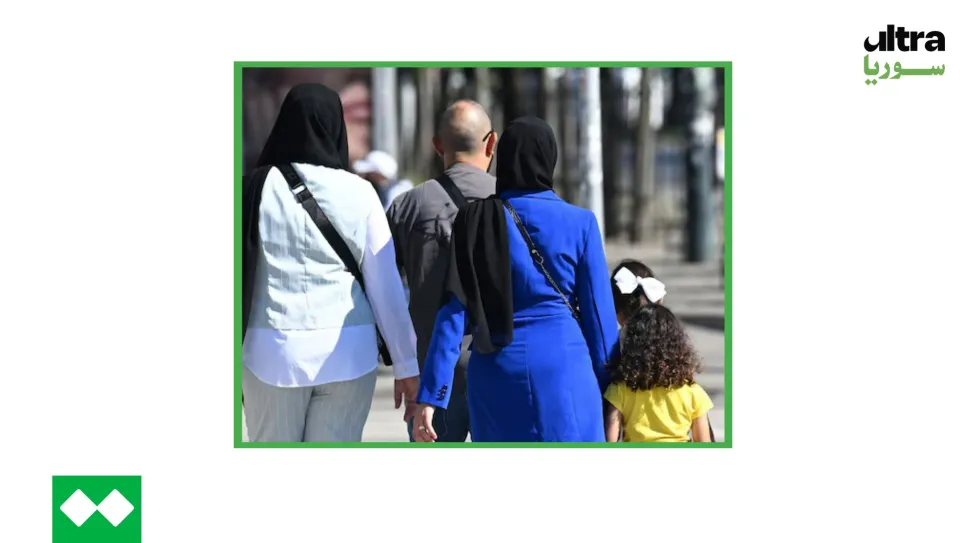
A recent report by the Austrian Public Employment Service (AMS) has found that the majority of Syrian refugees in Austria have no intention of returning to their homeland, citing economic and social factors—particularly family stability and Vienna’s comprehensive welfare system—as key reasons for their decision to remain. The findings reflect a shifting landscape in Austria’s integration and migration policies.
Entitled New Refugees from Syria in the Austrian Labour Market, the AMS report reveals that most Syrians residing in Austria show little to no interest in returning to Syria, despite financial incentives previously offered by the federal government. The widely cited report notes that the €1,000 repatriation grant has failed to influence their decision, a result researchers describe as unsurprising. It concludes that Syrian refugees “came to stay.”
One 39-year-old Syrian woman interviewed for the study stated, “No, we want to stay in Austria so my children can have stability.” Reflecting on her own experience of displacement, she added, “In our community, many Syrians think like us and don’t consider returning.” The report also notes that Syrians who arrived during the 2015 refugee wave demonstrate little inclination to leave Austria. It cites, for example, a woman who has lived in the country for ten years, is well integrated into society, and has three children—one of whom speaks only German.
Vienna’s generous welfare provisions are cited as a major factor in the city’s appeal. While some politicians, including Vienna’s municipal councillor for social affairs, Peter Hacker, have dismissed the idea that welfare drives migration, the report suggests otherwise. In a 2024 interview with Krone newspaper, Hacker asserted, “There is no migration to the welfare system.” However, the AMS report—specifically on page 85—highlights that Vienna offers full basic income support to individuals with “subsidiary protection” status, unlike seven other Austrian states that provide only basic care. One Syrian refugee remarked, “The services and financial support in Vienna are better than in other states,” adding, “Some states are nicer than Vienna, but families who moved from Upper Austria to Vienna say the financial aid is better.”
This disparity has led many Syrian refugees to settle in Vienna, even if they might prefer to live elsewhere. One refugee commented, “As someone with subsidiary protection, I came to Vienna because it offers better financial support.” Another added, “In Vienna, you also get financial aid under subsidiary protection, which you don’t get in other states.”
The report paints a clear picture of the motivations guiding Syrian refugees’ settlement choices—namely social integration, family stability, and robust financial and social support. These factors have made Vienna the most favoured destination among this demographic.
According to the 2025 Migration and Integration Statistical Report by Statistics Austria and the Austrian Integration Fund (ÖIF), Syrians submitted the highest number of asylum applications in 2024, with 13,909 requests. Roughly 12,500 Syrians were granted protection, making up the largest share of asylum approvals that year.
Nonetheless, challenges persist in the labour market. The report indicates that employment rates for Syrians, Afghans, and Iraqis remain low, with just 44.1 per cent participating in the workforce in 2024. The disparity is even more pronounced among women from these groups, with only 24.3 per cent of Syrian, Iraqi, and Afghan women in employment—a sharp decline from 32.3 per cent in 2023. Unemployment within this demographic rose to 31.3 per cent, one of the highest rates in Austria.
These findings underscore the complex interplay of factors influencing integration, as Syrian refugees navigate economic realities, social support networks, and the desire for family stability—factors that continue to shape Austria’s migration landscape.
This article was translated and edited by The Syrian Observer. The Syrian Observer has not verified the content of this story. Responsibility for the information and views set out in this article lies entirely with the author.