
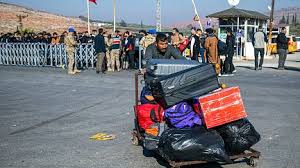
The challenges facing Syrian refugees constitute a complex and arduous journey, making the prospect of a “safe, voluntary and dignified return” a distant goal for many. These obstacles can be broadly categorised into five main areas:
- Legal and Administrative Barriers: The Documentation Gap
Many refugees face persistent difficulties in civil documentation, including marriage, birth, and death certificates. The absence of one often hinders access to the others, creating a vicious cycle. Syrian authorities impose fees of $25 per document for authentication—an unaffordable burden for large families with limited income. A significant number of refugees struggle to register their marriages due to irregular residency status or informal unions. This often requires complex legal proceedings and fines that can reach up to 1,000 Jordanian dinars (around $1,400). Thousands of Syrians are not officially registered with either UNHCR or Jordanian authorities, leaving them vulnerable to arrest or deportation if they attempt to cross the border. Palestinian refugees from Syria face compounded challenges, being excluded from Jordan’s asylum system and UNHCR protection, rendering their return to Syria legally near impossible.
- Economic Constraints: The Dilemma of Staying versus Returning to the Unknown
Two-thirds of Syrian families in Jordan live below the poverty line, and 93% of working-age individuals lack valid work permits, leaving them in a state of extreme economic vulnerability. Returning to Syria entails high expenses—rebuilding homes, securing shelter, and beginning anew in a collapsed economy, with no guarantees of employment or income. Dwindling international assistance adds further pressure, pushing some to consider return as the only option—though they lack the means to act on it.
- Lack of Reliable Information and Uncertainty
Refugees suffer from a lack of credible and accurate information regarding the security, legal, and economic conditions inside Syria, hindering their ability to make informed decisions. Surveys show fluctuating intentions to return—one in six families changed their minds within just four months—reflecting widespread hesitation and uncertainty.
- Social and Generational Challenges
Over 214,000 Syrian children have been born in Jordan since 2011. Many consider Jordan their primary home and have little to no emotional or practical connection to Syria. Women, in particular, fear insecurity, early marriage, and the loss of community support networks they have built in Jordan. Widows and female-headed households face greater difficulty envisioning a dignified return. Despite widespread destruction of homes in Syria, emotional attachment to the homeland remains strong for many—yet this sentiment alone is not enough to overcome the practical risks of return.
- Fear and Insecurity
The fear of instability and potential legal or political repercussions upon return remains a key deterrent. Unregistered refugees or those lacking documentation worry about being turned back at the border or facing detention.
Conclusion
The barriers to return cannot be reduced to a single factor—they stem from the complex interplay of legal, economic, social, and psychological challenges. Remaining in Jordan often means a life of chronic poverty and instability, while returning to Syria entails stepping into a perilous unknown with few guarantees of safety or basic livelihood. Unless these obstacles are addressed through comprehensive international cooperation and genuine political and economic reform within Syria, refugees will remain trapped in a painful dilemma: enduring an uncertain exile or risking a return to an unsafe homeland.
This article was translated and edited by The Syrian Observer. The Syrian Observer has not verified the content of this story. Responsibility for the information and views set out in this article lies entirely with the author.