
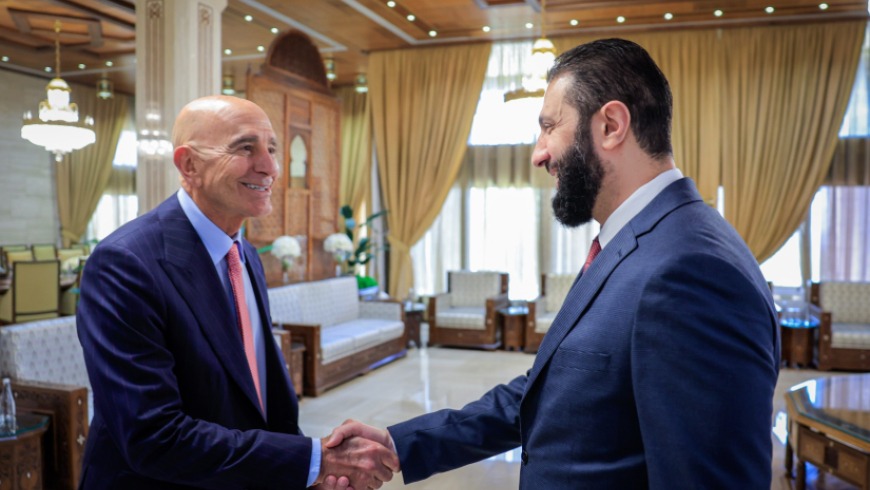
In a landmark policy shift, U.S. Special Envoy to Syria, Tom Barrack, announced the lifting of sanctions on Syria, framing it not as an act of charity but a strategic decision to catalyse the most significant reconstruction initiative since the Second World War.
Posting on X, Barrack lauded the U.S. Senate for its foresight in voting to repeal the Caesar Syria Civilian Protection Act — a sanctions regime he said had fulfilled its moral mandate against the former Assad government but now hinders a nation seeking to rebuild. He urged the House of Representatives to follow suit, restoring what he termed the Syrian people’s right to work, trade, and aspire.
The Caesar Act, enacted in 2019, targeted crimes committed by the previous regime through asset freezes, funding restrictions, and international isolation. However, Barrack highlighted that the Syria of today — following the establishment of a new government on 8 December 2024 — is markedly changed. The current leadership has initiated reconciliation efforts, restored diplomatic ties with Turkey, Saudi Arabia, the UAE, Egypt and Europe, and begun border negotiations with Israel.
On 13 May 2025, President Trump, speaking from Riyadh, announced a historic departure from coercive policy, committing to the removal of sanctions. That pledge was fulfilled on 30 June with an executive order repealing the majority of sanctions, effective from 1 July.
Barrack underscored that the shift signals a transition from punishment to partnership, sending a clear message to allies and investors that Washington now supports Syria’s reconstruction. The lifting of sanctions is intended to empower international actors to restore critical infrastructure, including electricity, water, schools and hospitals, in a reconstruction drive of unprecedented scale.
“Economic recovery is the most effective antidote to extremism,” Barrack stated, adding that commerce can bridge the divide between conflict and coexistence. The remaining sanctions, he argued, no longer target despots but penalise the teachers, farmers and traders tasked with Syria’s revival.
This decision, he said, reflects the new regional dynamics and aspirations for a fresh chapter. Notably, 26 Syrian Christian clerics appealed to Congress to lift sanctions, citing their detrimental impact on the Christian presence in Syria — a moral plea resonant with shifting regional sentiment.
Barrack praised President Trump and the Senate for what he called a courageous stance, and urged the House to complete the act of leadership. Repealing the Caesar Act, he concluded, does not erase history but seeks to rewrite it with a focus on renewal rather than retribution.
Lebanon’s Stalemate and Regional Shifts
Turning to Lebanon, Barrack discussed a U.S.-proposed “last-ditch” plan earlier this year involving phased disarmament under American and French supervision in return for economic incentives. The initiative was ultimately rejected due to Hezbollah’s entrenched influence within the Lebanese government, which remains paralysed by sectarian deadlock. Israel, Barrack added, regards Lebanese assurances as hollow.
As Damascus stabilises, Hezbollah finds itself increasingly isolated. Barrack argued that the group’s external affiliations erode Lebanese sovereignty, deter investment, weaken public confidence, and pose a persistent threat to Israel. Syria’s movement towards border agreements and potential future cooperation could secure Israel’s northern frontier — but only if Hezbollah is disarmed.
Lebanon now stands at a crossroads: it must either embrace national renewal or remain stuck in paralysis and decay. Barrack called on the U.S. to support Beirut in swiftly disentangling itself from Iran-aligned Hezbollah, in line with growing regional consensus against extremist organisations. Failure to act, he warned, risks triggering a major confrontation between Hezbollah’s military wing and Israel — a clash that could come at a moment of Israeli strength and Iranian vulnerability.
Meanwhile, Hezbollah’s political wing faces growing isolation in the lead-up to Lebanon’s parliamentary elections in May 2026. Should the group suffer military or political setbacks, it may seek to delay the vote under the pretext of “national security”, in a bid to consolidate its base. Such a move, Barrack warned, would risk deepening Lebanon’s internal rifts and sparking renewed unrest in a nation on the brink.
This article was translated and edited by The Syrian Observer. The Syrian Observer has not verified the content of this story. Responsibility for the information and views set out in this article lies entirely with the author.