
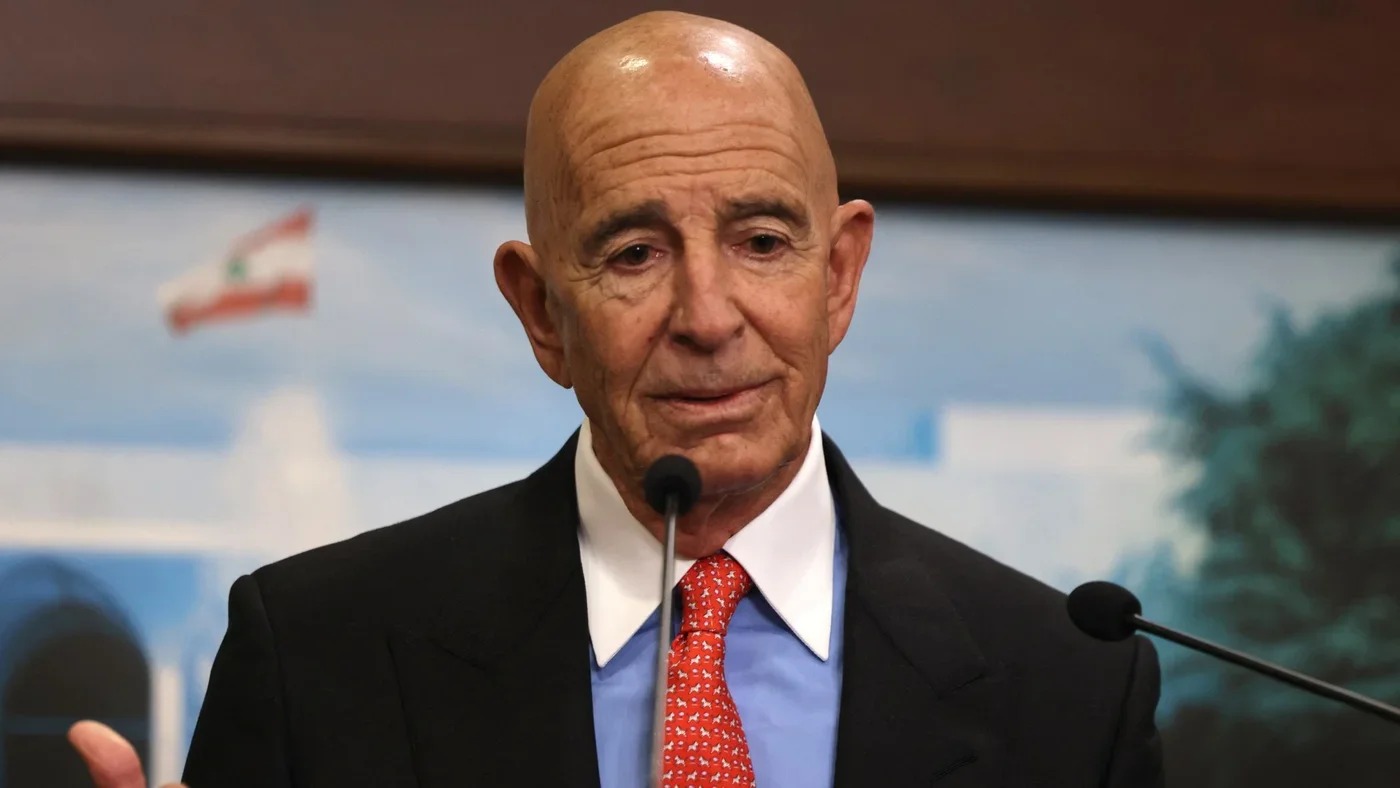
This man is, at this moment, the most powerful figure in the entire region. He is the one drawing Syria’s present—and scripting its future.
He is no politician. He is a dealmaker who despises routine, delays, bureaucracy, and diplomatic niceties. He believes only in results. For him, 1+1 must equal 2.
Tom Barrack—the billionaire businessman and Donald Trump’s friend of 45 years—is one of the very few who can reach Trump at any hour, and one of the even fewer whose advice Trump actively seeks. He criticizes Trump publicly without fear of being punished or cast aside. He ran Trump’s inauguration committee in his first term.
Their relationship began with a business deal in which Trump lost. Yet later, Barrack saved members of Trump’s family from bankruptcy, handing them tens of millions of dollars.
Trump appointed him ambassador to Turkey, then put him in charge of the Syria and Lebanon files—and, increasingly, the region as a whole.
Today, he is effectively the American High Commissioner in Syria.
His style irritates the U.S. State Department and the guardians of diplomatic protocol. But who dares say no?
Barrack, of Lebanese descent, does not hide his contempt for the region. He did not say it word for word, but the meaning was clear: he sees us as “a group living in a pre-state era.” What he did say, explicitly, was this: “There is no such thing as the Middle East. There are tribes and villages.” These tribes and villages, he argues, have never succeeded in building states—let alone democracies. “I don’t see democracy anywhere in the region,” he says.
He loathes Sykes and Picot, believing they founded the region on the wrong map. Perhaps he wants to try founding it again—this time with his own pen.
Today, Barrack is the one drawing what was—and what will be.
He never hid his position; we simply failed to notice. He repeats one idea in different forms:
No federalism that fragments the state. No regional armies. One state. One army.
- A year ago, he said: “Federalism doesn’t work in Syria,” adding, “There is only one road, and that road is to Damascus.”
- He added: There cannot be a Druze force, an Alawite force, and a Kurdish force… There will be one entity.
- He repeated: There will not be six states; there will be one Syria. And if that wasn’t enough, he added: We will not support a separatist outcome, and we will not remain forever as babysitters.
In short, Barrack rejects any attempt to carve cantons inside the state—any attempt to create a multi-headed “state,” whatever name it takes: federalism, decentralization, or anything else.
- On December 6, 2025, when asked whether decentralization was possible in Syria, he answered instantly: “Decentralization has not succeeded anywhere in this region.”
- The next day, he said: “Centralization, decentralization, federalism… all illusions.” He stopped just short of saying: “You are fundamentally incapable.”
Barrack—and the United States behind him—does not want to deal with militias, factions, or scattered groups. He wants stable, responsible entities capable of controlling territory and exercising accountability.
From this logic, the SDF was doomed to the fate it met. Now, Al-Hajri must sense the same end approaching. His turn is coming.
What kind of rule does Barrack want for Syria?
He admires the “benevolent monarchies” of the region, but he seems to want something different for Syria: a system built on a particular kind of decentralization—administrative and service decentralization.
The conditions are clear:
- Security and the army must remain in the hands of the state.
- No entities built on ethnic or sectarian foundations.
- No “extreme centralization” either. He wants local councils, municipal powers, and decentralized management of services and resources—so long as none of this becomes political or security sovereignty.
This vision will likely require the removal—or replacement—of all the hot-headed figures confronting the state today: Abdi, Al-Hajri, and others.
Barrack trusts no one. He said: “I don’t trust anyone in the Middle East. Our interests are not aligned, including Israel’s.” Yet, unusually, when asked whether he trusts Bashar al-Assad, he replied: “The answer is yes. I trust him. I believe him.” When asked why, he said: “I am certain his goals today align with our goals.” He emphasized “today.”
Barrack’s Will vs. Israel’s Will
For a time, a public rift appeared between the two sides over Syria: Israel wanted Syria fragmented; Barrack wanted it unified.
Later, the two sides reached an understanding in Paris, based on a vague American proposal: an economic zone would be created—one including wind farms, agriculture, the best skiing mountain in the Middle East, and the Druze community known for its hospitality. The agreement added: a joint “fusion cell” would be established between the United States, Israel, and Syria in Amman to oversee security in southern Syria and host further talks on disarmament and Israeli withdrawal.
Thus, when you hear of the committee forming in Amman or meetings beginning there, it will mean Israel has abandoned Al-Hajri—just as Washington abandoned the SDF.
After that, previously announced but unimplemented steps will return: new appointments, new structures, and an expanded local administration law granting broad service and administrative powers to regional officials, while politics, the army, and security remain fully centralized.
Barrack is in no hurry regarding politics. His obsessions are purely security-driven.
In the future, we may curse Barrack for creating a new dictator for us—or we may erect a statue in his honor for saving this country from fragmentation.
But today, he is the master of this land. And his word is the first word in it.