
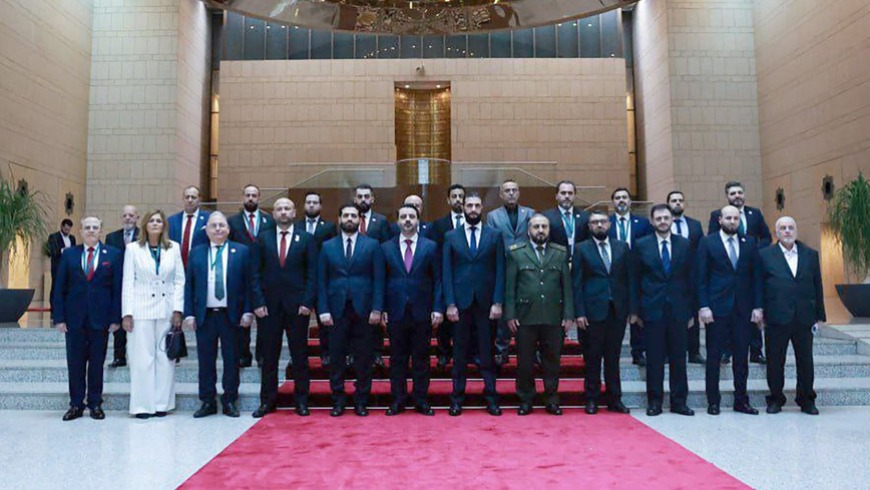
One year after its formation, Syria’s transitional government has consolidated its political presence but has yet to demonstrate that it can build a functioning system of governance. Analysts say the central question is no longer who holds power in Damascus, but whether the new authority can actually govern: how decisions are made, how institutions operate, how responsibilities are distributed, and whether the state is being rebuilt or merely managed on an improvised basis.
Ambitious Promises, Limited Delivery
When the government was announced on March 29, 2025, it presented itself as a broad coalition of technocrats and political figures, with limited representation from various constituencies. It pledged to fight corruption, rebuild institutions, revive the economy, reform monetary policy, support production, attract investment, and improve basic services such as electricity, fuel, and healthcare.
A year later, the gap between those promises and visible results remains wide. The question, analysts argue, is whether the challenges stem from the inherent burdens of a transitional period or from deeper shortcomings in administrative capacity and political method.
Decision-Making Concentrated in Narrow Circles
The article identifies the government’s internal decision-making structure as a core problem. What initially appeared to be a balanced formation has evolved into a system shaped by narrow circles of influence, where personal proximity, family ties, and informal networks often outweigh competence or expertise.
Under this arrangement, the government functions less like an institutional body with clear hierarchies and procedures and more like a structure in which key decisions pass through restricted channels of trust and access. Cabinet diversity, in this context, risks becoming largely symbolic. Representation exists on paper, but real influence remains concentrated elsewhere.
The weakness of collective governance reinforces this pattern. There is little evidence that the cabinet has met regularly in a structured, institutional manner. Official media often highlights bilateral meetings or protocol visits as proof of coordinated government work, a portrayal that analysts say masks the absence of a coherent executive process.
A Missing Prime Minister
The absence of a prime minister has become a major point of criticism. Researchers cited in the article argue that the lack of a central executive figure is not a minor administrative gap but a structural flaw. Without a dedicated official to coordinate ministries, follow implementation, and impose discipline on state administration, the government’s ability to translate political slogans into policy remains limited.
Partial Gains, Incomplete State
The government has achieved some notable advances. Diplomatic outreach has expanded, external relations have improved, a national dialogue has been launched, a constitutional declaration has been issued, and parts of Syrian territory have been unified under transitional authority. These steps have helped shift the government from the posture of a de facto authority toward that of a recognized state actor.
Yet the state itself remains unfinished. The absence of a legislative authority has created a legal vacuum at a moment when laws governing transitional justice, reconstruction, and public life are urgently needed. Emergency decrees have been issued quickly, but rapid action does not equal a coherent legal order. Some texts remain vague, implementation mechanisms are weak, and old bureaucratic habits continue to shape daily administration.
Security: Progress, but Still Reactive
Security conditions have improved in some areas, including operations against terrorist cells and criminal networks. But the broader pattern remains reactive. Agencies often respond after incidents occur rather than through coordinated, preventive work based on intelligence and early intervention. The widespread circulation of weapons continues to pose a major challenge, especially in a post-conflict environment marked by poverty, unemployment, and slow progress on transitional justice.
Economic Pressures Persist
Economically, the article is skeptical of official optimism. While inflation has slowed at moments, this has not translated into meaningful relief for ordinary Syrians. High prices remain entrenched, production is weak, agriculture and industry are diminished, and dependence on imports persists. Energy and transport costs remain high, and attempts to stabilize the currency have been temporary. Investment agreements, meanwhile, remain largely aspirational.
Representation Without Power
The article acknowledges symbolic progress in including different components within the government. But it argues that representation cannot be measured by the number of diverse faces alone. The key question is whether those figures hold real influence within decision-making centers. By that measure, representation remains limited.
Some appointees lack genuine social weight within the communities they are meant to represent, raising concerns that old patterns of exclusion are being reproduced under the guise of inclusion. At the same time, remnants of the old bureaucracy remain embedded in state institutions, creating a hybrid structure that is neither a clean break from the past nor a coherent new order.
Legitimacy: Present, but Fragile
The government retains several sources of legitimacy—political, popular, and international. But that legitimacy is conditional. It rests on hope, external recognition, and the absence of a credible alternative more than on demonstrated institutional performance. Public support has not disappeared, but it is increasingly vulnerable, especially among minorities, women, and educated sectors, and especially in the absence of visible improvements in services, security, accountability, and representation.
Between Consolidation and Drift
The article concludes that Syria’s transitional government has opened a political window and consolidated a degree of authority. What it has not yet done is convert that authority into a stable model of governance. The challenge ahead is not merely to survive the transition symbolically, but to institutionalize it in law, administration, security, and public trust.
After its first year, the government stands between two forms of legitimacy: one rooted in hope and temporary support, and another that can only be earned through institutions, accountability, and tangible achievement. It has not yet crossed that threshold.
This article was translated and edited by The Syrian Observer. The Syrian Observer has not verified the content of this story. Responsibility for the information and views set out in this article lies entirely with the author.