
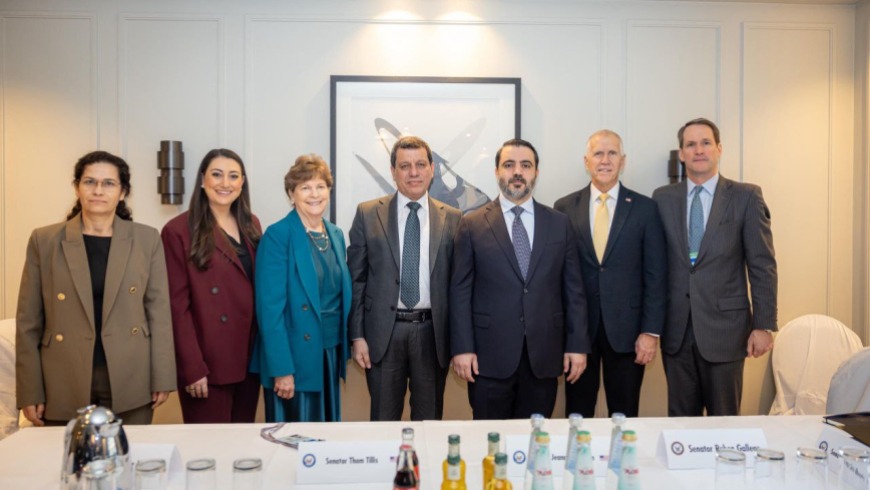
A single year can redraw the political map. At the 2025 Munich Security Conference, the only Syrian voice invited to the table was Foreign Minister Asaad al-Shibani. Twelve months later, the picture could not be more different. The 2026 conference featured not only the Syrian government but also a high-profile delegation from the Syrian Democratic Forces (SDF), signaling a notable recalibration in Europe’s approach to Syria.
While al-Shibani conducted his official meetings, the SDF delegation — led by foreign relations chief Ilham Ahmed — held its own round of high-level talks, including a prominent meeting with German Foreign Minister Johann Wadephul. Even more telling was Wadephul’s decision to meet separately with both al-Shibani and SDF commander Mazloum Abdi.
On the surface, this may look like routine diplomatic choreography. In reality, it reflects a deeper strategic divergence. According to Ahmed, the SDF’s participation in a joint meeting with U.S. Secretary of State Marco Rubio — a meeting formally headed by al-Shibani — occurred at Washington’s explicit request. The message is unmistakable: while the United States is pushing for a unified Syrian delegation, key European capitals are deliberately cultivating their own independent channels with the Kurds.
Europe’s Patience with Damascus Has Run Out
To understand Europe’s shift, one must revisit the expectations that followed the fall of the Assad government in late 2024. Germany and France were among the first to send their foreign ministers to Damascus. Their priority was clear: they wanted assurances that the new Syrian leadership would move to end Russia’s military presence.
For Europe, the prospect of a permanent Russian naval and air foothold on the Mediterranean — directly across from EU territory — is a strategic nightmare.
But a year later, that nightmare has only deepened. Instead of distancing itself from Moscow, the new Syrian administration has drawn closer. President Ahmad al-Sharaa’s January 2026 visit to Moscow was a turning point, marked by unusually warm praise for Russia’s historical role in defending Syria from foreign aggression — rhetoric that landed poorly in Berlin and Paris.
The coordination has since accelerated. Russian and Syrian military and intelligence delegations have held intensive meetings. Most strikingly, Moscow reduced its presence at the Qamishli airbase and refrained from supporting the SDF during the Syrian government’s January military campaign. The implication is clear: Russian bases in government-held areas are being repurposed to serve as advisory hubs for the new Syrian army, entrenching Moscow’s influence at Europe’s expense.
A Signal to the Trump Administration
Europe’s maneuver in Munich is not only about Syria — it is also a pointed message to Washington.
Since returning to the White House in 2025, President Trump has made it clear he intends to negotiate an end to the Ukraine war directly with Russia. By late 2025, U.S. military aid to Kyiv had stopped. Today, Washington and Moscow are discussing Ukraine’s future without European participation.
This exclusion has infuriated European leaders.
- French President Emmanuel Macron has called for an independent European security architecture.
- German Defense Minister Boris Pistorius has warned that sidelining Europe from negotiations affecting its own continent undermines NATO’s credibility.
Against this backdrop, Europe views Syria as one of the few arenas where it can still exert leverage. The Syrian government’s deepening alignment with Moscow is unlikely to be happening without at least tacit acceptance from the Trump administration. Washington may see Russian influence in Syria as a bargaining chip in broader negotiations over Ukraine.
Europe’s response? Elevate the SDF — a move that complicates Washington’s calculus and preserves a European foothold in Syria’s political future.
Pushback on the Ground
The impact of Europe’s message was visible almost immediately. In the days following the Munich conference:
- The SDF redeployed forces around Hasakah, reversing the pullback agreed upon in the U.S.-brokered January 29 agreement with Damascus.
- Public rallies featuring images of PKK leader Abdullah Öcalan resurfaced, despite prior commitments — also under American auspices — that PKK elements would withdraw from Syria.
These moves suggest that Europe’s engagement with the SDF was not symbolic. It reflects a desire, particularly from France, to maintain influence in Syria’s future political and economic landscape — including in the energy sector, where European companies fear being sidelined by U.S. and regional actors.
For now, Europe appears willing to empower the SDF as a counterweight. Should Damascus or Washington offer meaningful concessions, that support could be recalibrated. But the message from Munich is unmistakable: Europe refuses to be a spectator in Syria’s next chapter.
This article was translated and edited by The Syrian Observer. The Syrian Observer has not verified the content of this story. Responsibility for the information and views set out in this article lies entirely with the author.