
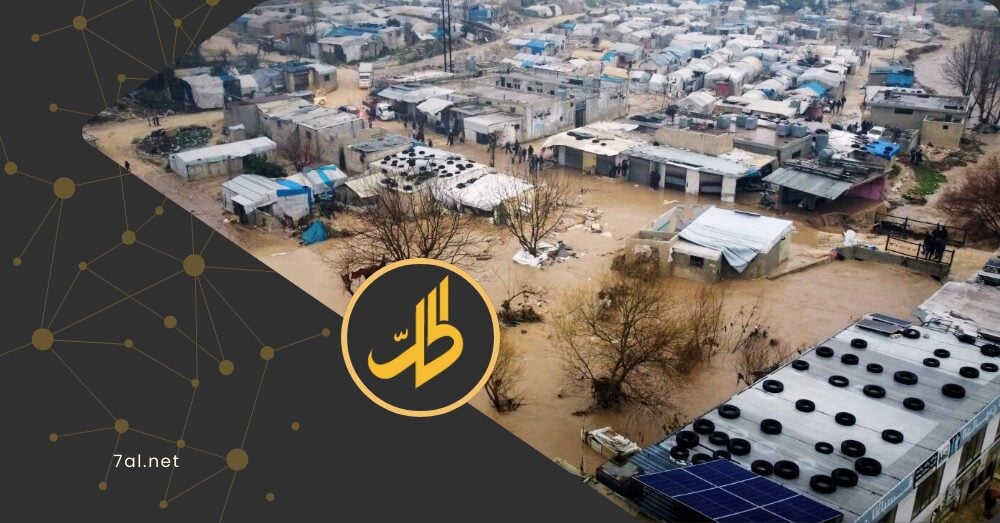
The torrential rains that swept through northwestern Syria and the eastern coast on Saturday evening delivered a stark test of the state’s and society’s ability to manage predictable risks—risks still approached with a short-term, emergency mindset rather than long-term planning.
The floods that inundated parts of rural Idlib and the Latakia countryside did more than expose the fragility of infrastructure in displacement zones. They revived urgent questions about the cost of ignoring the economic and social dimensions of the post-conflict phase, and about the credibility of repeated government pledges to close the file of displacement camps within a fixed timeframe.
The Gap Between Recovery Rhetoric and Reality
Despite escalating official promises to eliminate all camps by 2026, the scenes from Idlib and Latakia redrew the landscape in the harsh language of lived experience. The rains became a metric for measuring the widening gulf between “recovery rhetoric” and the entrenched “reality of economic vulnerability.”
The floods claimed the lives of two children and left others missing in the Latakia countryside. Fourteen camps—home to hundreds of civilians—were flooded or damaged. Roughly 300 families were directly affected as tents were submerged and belongings washed away, according to the Ministry of Emergency and Disaster Management. The scale of the damage places the Syrian state before a structural economic dilemma far beyond the capacity of civil defense teams to manage.
The issue now extends well beyond the emergency measures announced by Idlib Governor Muhammad Abdul Rahman or Minister of Emergencies Raed al-Saleh—such as opening temporary shelters in schools in western rural Idlib and coordinating a joint operations room among relevant ministries. At stake is the “opportunity cost” of keeping 1.2 million citizens—around 240,000 families—in a state of economic paralysis and prolonged displacement for nearly 15 years. This represents a profound hemorrhaging of human and social capital that undermines any realistic prospect for sustainable stability.
Failure of the Political and Social “Market”
From a financial perspective, economic researcher Dr. Rasha Serob views these disasters as the predictable outcome of what she calls a failure of the political and social “market.” She argues that successive governments have treated displacement as a relief burden rather than an investment file.
In a Facebook post, Serob stressed that statements from the Ministry of Finance and the Assistant Minister of Social Affairs about ending the camps within two years lack “structural depth” unless accompanied by a shift from an “economy of non-economy”—built on stopgaps—to an “economy of justice” that places compensation for harm at the center of the public budget.
She emphasized that transitional justice in Syria must expand beyond its narrow rights-based frame to become an “economic lever,” noting that justice not translated into housing security and purchasing power cannot withstand future shocks.
A Roadmap for Closing the Camps
Serob argues that any realistic plan to close the camps within one year must rest on two parallel tracks:
- Direct Compensation to Families
Providing displaced families with immediate cash liquidity—restoring dignity and enabling voluntary return.
- She proposes allocating $500 per family per month for one year, totaling roughly $1.5 billion.
- Far from an unbearable burden, she frames this as a stimulus package that would revive local demand in devastated areas and reduce dependence on relief aid.
- Compared to the financial waste in luxury imports or the losses from production disruptions in disaster zones, the “return bill,” she argues, is more economically rational in the long term.
- Injecting this monetary mass into local markets would act as a “financial stimulus,” revitalizing trade, construction, and service sectors in areas of origin.
- Zero-Interest Loan Programs
Launching zero-interest, no-fee loans for homeowners with partially damaged properties, enabling self-reconstruction and return. This would significantly reduce the state’s burden of constructing entirely new housing units.
Who Pays the Bill?
On funding, Serob argues that the recurring question—“Who will pay the bill?”—reflects a deficit of political will more than a shortage of resources.
She points to billions of dollars in recovered assets from former regime figures and “warlords,” describing them as usurped public funds. Redirecting these resources to resolve the camps file, she says, would constitute one of the clearest expressions of distributive justice.
She also calls for accelerating the use of donor pledges and local contributions announced at international conferences, away from the bureaucratic bottlenecks that have blunted their impact.
Serob warns that the sovereign risks of allowing camps to persist into 2026 extend beyond humanitarian concerns. They threaten the reputation of the Syrian economy and its ability to attract foreign direct investment. No rational investor, she notes, would commit capital to an environment lacking basic social stability, where 1.5 million people live in chronic insecurity. Closing the camps, therefore, is not optional—it is a prerequisite for economic recovery.
From Firefighting to a Developmental Vision
Serob describes the distribution of blankets and emergency relief as “firefighting”—a necessary but insufficient response that does not build a state. What is needed, she argues, is a forward-looking vision that links collective compensation to “economic decentralization,” directing public investment toward the areas from which populations were displaced. This would prevent their return to the margins of major cities, ease pressure on public services, and create new growth centers in devastated rural regions.
“Financial and housing compensation programs are not lost consumer spending,” she writes, “but direct investments in economic peace and social stability.”
She warns that justice not reflected in housing security and daily bread will remain fragile and prone to collapse at the first shock. If the government is serious about closing the camps by 2026, she argues, it must begin paying the “bill of justice” immediately.
As the Syrian state stands before two paths—either continuing the policy of “managing poverty” and waiting passively for 2026 with all the risks of social explosion, or beginning now to pay the “bill of justice” through a comprehensive national program for compensation and return—the camps file remains the ultimate test of the credibility of official promises and the state’s ability to rebuild the social contract on solid economic foundations, far from slogans that wash away with the first rain.
This article was translated and edited by The Syrian Observer. The Syrian Observer has not verified the content of this story. Responsibility for the information and views set out in this article lies entirely with the author.
