
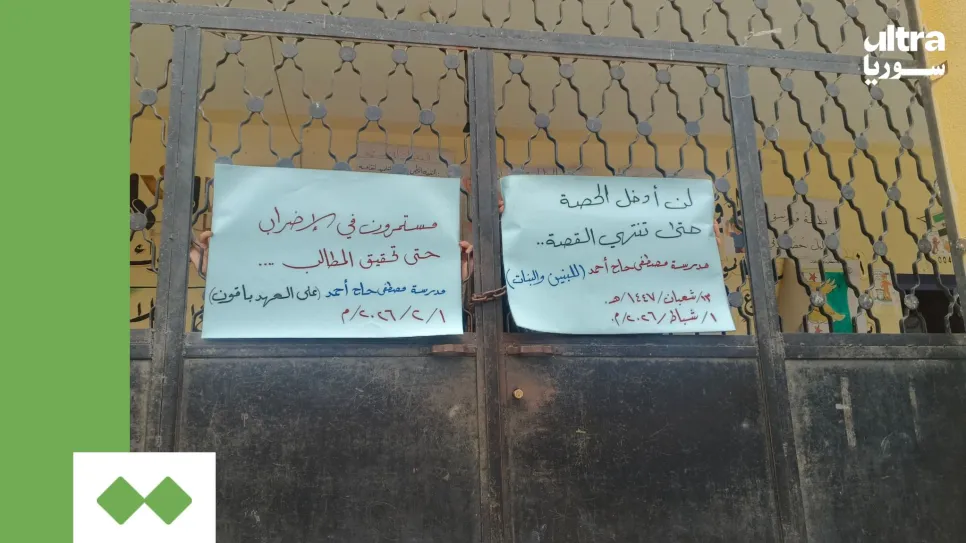
A sweeping teachers’ strike has shut down hundreds of schools across northwest Syria, marking one of the most significant education-sector protests in the region in years. The walkout, concentrated in Idlib province and parts of the Aleppo countryside, has halted classes for thousands of students.
Organizers have labeled the action the “Strike for Dignity,” framing it as a response to what they describe as a long chain of broken promises to raise salaries and improve working conditions. In a statement, the “Free Syrian Teachers” page said educators are demanding a 200% salary increase, noting that a previously announced 100% raise—scheduled for early this year—was never implemented, deepening frustration and eroding trust.
Roughly 1,100 schools across Idlib city, its countryside, and parts of Aleppo have closed their doors, with reports of solidarity actions emerging from Daraa and Hama countryside. Teachers say the strike is open-ended, and that they will not return to classrooms until salary commitments are honored and basic school supplies are provided.
Tensions with Administrators and a Rapidly Shrinking Workforce
The strike has triggered sharp confrontations with local education officials. Omar Latouf, Director of Education in Idlib, was removed from a teachers’ WhatsApp group after threatening administrative penalties—including dismissal—for any teacher absent for three consecutive days. His warnings sparked widespread anger among educators.
At Idlib’s Harun al-Rashid School, female teachers voiced outrage after being immediately replaced by a new group of substitutes following their participation in the strike, calling the move “unjust.”
The crisis highlights the severe economic strain on educators. Teachers on original contracts earn around $130 per month, while substitutes receive no more than $95—amounts widely described as insufficient amid soaring prices, chronic salary delays, and shortages of heating fuel, paper, books, and basic teaching materials.
These conditions have fueled an unprecedented exodus from the profession. Many teachers are seeking work in government ministries, taking on private tutoring, or turning to manual labor such as construction and tiling to make ends meet.
Voices from the Classroom: “We Need Someone to Give Us Our Due”
“The strike is a result of the tragic conditions teachers have reached,” said Mohammed al-Ismail, a teacher in Idlib, in comments to Ultra Syria. “Our return to teaching is conditional on implementing promises and raising salaries so a teacher can live with dignity. We are in pain over the state of our children, but we need someone to give us our due.”
Ghida al-Hussein, a teacher in western Aleppo countryside, described the walkout as an inevitable reaction to years of neglect. “A teacher works long hours… without respect or appreciation. Most of those who lecture teachers do not feel their suffering.”
Others, like Hamdou al-Mousa from Idlib countryside, have proposed a more gradual approach—such as striking only during the first class period—to send a message while reducing the impact on students.
Calls for Structural Reform
As the strike expands, educators stress that their core objective is to preserve their dignity and safeguard the continuity of the educational process. They argue that resolving the crisis requires a swift, concrete response to their demands, an end to unfulfilled promises, and meaningful improvements in working conditions to prevent further loss of skilled teachers.
Teachers insist that meeting their demands is not merely a sectoral issue but a societal one: education, they argue, is essential to rebuilding the future and addressing the region’s broader challenges. They are calling for clear, actionable steps to end what they describe as a policy of procrastination, support their livelihoods, and secure stable schooling for Syria’s next generation.
This article was translated and edited by The Syrian Observer. The Syrian Observer has not verified the content of this story. Responsibility for the information and views set out in this article lies entirely with the author.