
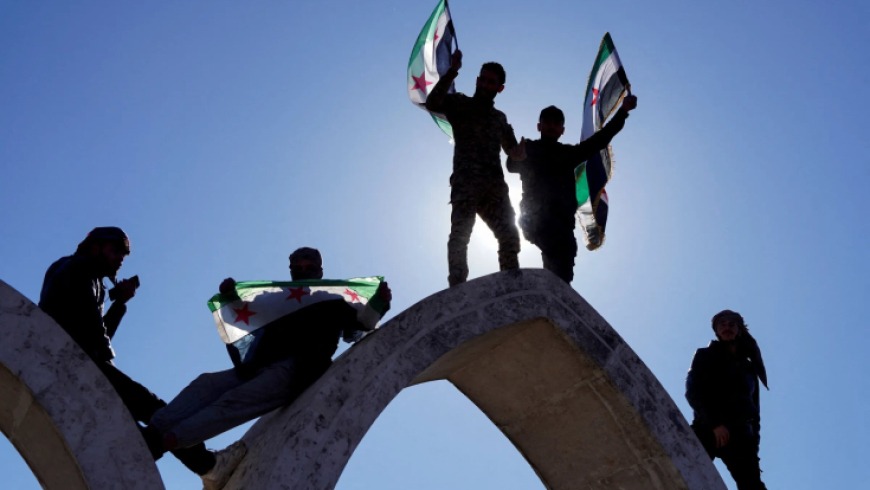
Foreign Affairs has cautioned that Syria’s post-Assad transition may be heading into a dangerous new stage if President Ahmed al-Shara does not expand political participation and ease the tight control exercised by former Hayat Tahrir al-Sham (HTS) figures over the state.
In an analysis published this week, researchers Jerome Drevon and Nanar Hawach argue that although Shara has secured striking diplomatic gains abroad, his consolidation of power at home risks undermining the very progress that enabled Syria’s international rehabilitation.
Shara — a former al-Qaeda commander who led HTS until its formal dissolution in January 2025 — shocked observers over the past year by toppling Bashar al-Assad’s regime and rapidly restoring Syria’s global standing. Western governments eased sanctions, Gulf states pledged billions in reconstruction funding, and Damascus joined the U.S.-led coalition against the Islamic State. In November, the UN Security Council removed Shara and Interior Minister Anas Khattab from its sanctions list, though HTS remains designated.
The authors describe Syria’s diplomatic turnaround as remarkable in both speed and scale. The new government reestablished ties with Russia, dismantled Iranian-aligned militias, curbed the influence of the Islamic Revolutionary Guard Corps, and avoided direct confrontation with Israel despite hundreds of Israeli airstrikes. Through coordinated outreach and regional lobbying by Qatar, Saudi Arabia, and Turkey, Damascus secured a phased easing of U.S. and European sanctions.
But the report warns that these foreign-policy achievements obscure growing internal pressures.
Former HTS Networks Tighten Grip as Reform Lags
According to the analysis, the same organizational traits that enabled HTS to seize Damascus in December 2024 — centralized command, pragmatic survival instincts, and a ruthless approach to rivals — have now produced a political system dominated by a narrow circle of former HTS leaders. While armed factions were formally dissolved and integrated into a national army without major resistance, political life has not opened in parallel.
All political parties were dissolved in January 2025, and no legal framework has been introduced to allow new ones to form. Although the transitional government and parliament include technocrats, civil-society figures, and diaspora representatives — including Christian activist Hind Kabawat and White Helmets leader Raed al-Saleh — real authority appears to remain concentrated in the hands of Shara and his closest allies.
The article notes growing unease among religious and ethnic minorities, as well as segments of the Sunni majority, who remain uncertain about their place in the emerging political order. Tensions have been especially sharp in northeastern Syria, where government forces recently reasserted control over areas previously held by the Kurdish-led Syrian Democratic Forces (SDF).
A new agreement signed last week between Damascus and the SDF outlines steps to integrate Kurdish fighters into the national army and fold local institutions into the state. While the deal represents progress and includes recognition of Kurdish cultural and citizenship rights, the authors argue that it still leaves unclear how political power will be shared.
Security challenges have further complicated the transition. In March, government-aligned forces killed roughly 1,400 Alawite civilians during operations against pro-Assad insurgents on the coast. In July, a poorly handled intervention in clashes between Druze and Bedouin militias in Sweida heightened sectarian tensions and deepened mistrust of central authorities. Although some soldiers have been prosecuted, questions persist about accountability and discipline within the newly formed army.
Criminal networks and nonstate armed groups continue to operate in several regions, fueling public anxiety. Minority communities are particularly vulnerable, but insecurity is widespread.
Drevon and Hawach argue that these security failures and communal tensions reflect a deeper issue: an incomplete political transition. Although a new constitution has been drafted and a parliament established, many Syrians remain unconvinced that the system allows meaningful participation or imposes real checks on executive power.
The authors contend that Syria’s long-term stability depends on genuinely opening the political system — empowering parliament, clarifying the role of political parties and social groups, integrating Kurdish communities on equal footing with others, and reducing the dominance of former HTS figures in decision-making.
They note that Sharaa has shown pragmatism before, allowing limited reforms in Idlib in response to protests prior to Assad’s fall. Whether he will take similar steps at the national level remains unclear.
The report concludes that Syria is at a crossroads. Concentrating power too tightly could erode domestic legitimacy and ultimately weaken the international recognition Damascus has worked to rebuild. Failure to broaden political participation risks creating a state rehabilitated abroad but contested at home — a scenario that could sow the seeds of renewed instability in the years ahead.
This article was translated and edited by The Syrian Observer. The Syrian Observer has not verified the content of this story. Responsibility for the information and views set out in this article lies entirely with the author.