
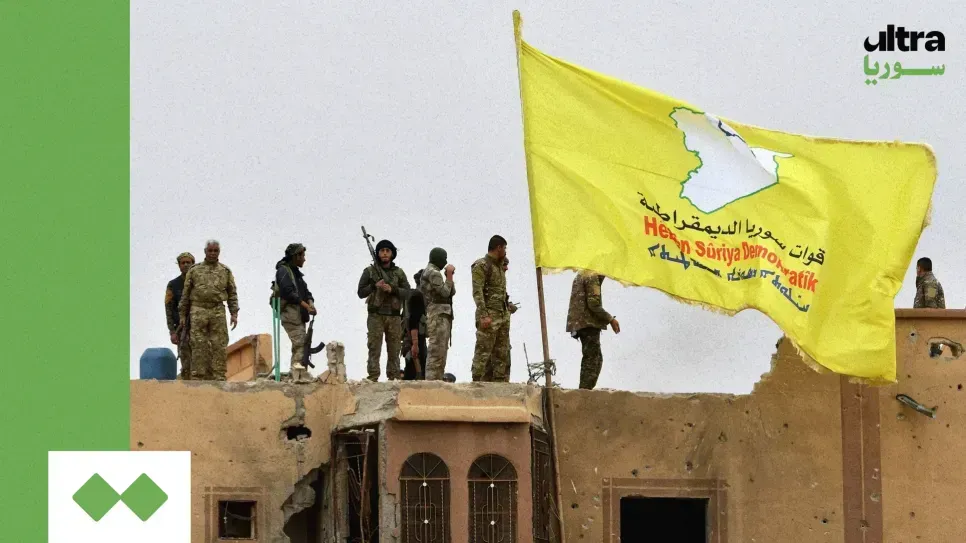
Over the past two weeks, northeastern Syria has witnessed rapid and dramatic developments. Government forces seized wide areas previously held by the Syrian Democratic Forces (SDF), effectively bringing an end to the decade-long Kurdish self-administration project. In response, many voices—particularly within Syrian Kurdish circles—have accused Washington of “betraying the Kurds and selling them out to others.”
What has unfolded will likely lead, in the near future, to the gradual disappearance of the SDF as an independent military structure, with its members integrated individually into state institutions rather than as a distinct entity.
In truth, what we are seeing is an attempt to evade responsibility by shifting blame onto external actors. This moment requires a sober reassessment of events and a clear, courageous reading of the facts—one that moves beyond the instinctive tendency to absolve oneself of accountability, a tendency encouraged by supporters of the Kurdish SDF leadership.
Although some Kurdish voices expressed concern about a potential “betrayal” following Donald Trump’s return to the White House last year, they did not ask themselves—or their leadership—what steps they took to prevent such an outcome.
The statement by U.S. Special Envoy to Syria Thomas Bruck that the SDF’s primary role “has ended” was not an offhand remark. It capped a political trajectory that began with the fall of the Assad regime and the arrival of the new administration in Damascus. Key milestones followed: President Ahmed Al-Sharaa’s visit to Washington and his meeting with President Trump, the lifting of U.S. and Western sanctions—including those tied to the Caesar Act—and Syria’s accession to the international coalition against terrorism. The Kurdish leadership neither engaged seriously with these developments nor acted upon them. As the saying goes, “they did not build upon what was required.”
The Need for Frankness and Honesty
To be even more direct, the SDF leadership and its supporters miscalculated politically over the past year and misread successive signals. Chief among these was the emergence of a new Syrian government seeking rapprochement with Washington, accompanied by Arab, regional, and international support for this government. Syria’s shift from the “Eastern axis” to the “Western axis”—including its entry into the U.S.-led coalition—fundamentally altered Washington’s relationship with the SDF. The United States no longer viewed the SDF as its exclusive Syrian partner against ISIS; continued support may even have become a political liability for the Trump administration.
Repeated statements by U.S. officials emphasized support for the new Syrian authority and for a unified Syrian state, including backing Syria’s economy, lifting sanctions, and reopening international channels. President Trump repeatedly stressed the need for a unified, stable, and economically viable Syria, alongside Syrian-American coordination on counter-narcotics and countering Iranian influence.
In this context, it must be acknowledged that the SDF overextended itself during the war against ISIS by controlling provinces with Arab majorities. What once appeared a source of strength became a vulnerability. Many Arab tribal members who had joined the SDF during the fight against ISIS—and who accepted its authority as a de facto power—quickly defected and seized key facilities, including oil and gas fields, as soon as government forces advanced into Raqqa and Deir ez-Zor.
The March 10 Agreement
It is important to recall that the United States mediated from the outset between the Kurds and the Syrian government, leading to the March 10 agreement between President Al-Sharaa and SDF commander Mazlum Abdi. The agreement aimed to integrate the civilian and military institutions of the self-administration into the Syrian state by the end of last year.
Washington’s objective was clear: dissolve the SDF and integrate it into the Syrian state, allowing the U.S. to claim it had not abandoned its ally while simultaneously reducing its commitments in Syria and preparing for troop withdrawal. Yet negotiations stalled, with each side accusing the other of lacking seriousness and unwilling to compromise.
If recent reports are accurate—that Damascus offered to integrate three SDF divisions and two brigades into the Syrian Army, while granting Mazlum Abdi the post of Deputy Minister of Defense—then the scale of the loss incurred by the Kurds becomes evident. What is now on the table, at best, is the individual integration of SDF members into state institutions, without any collective or special status. Political solutions remain possible, but within a narrow window and under Damascus’ firm insistence that “no military or security force outside state institutions will be tolerated.”
The Turkish Role
Turkey played a decisive role in this political and military shift. Ankara views the SDF as an extension of the Kurdistan Workers’ Party (PKK), designated a terrorist organization by Turkey, the United States, and several Western states. The alignment between Ankara and Washington—driven by the personal rapport between Presidents Trump and Erdoğan—and the convergence of Syrian, Turkish, and American interests on the Kurdish issue facilitated Damascus’ advance.
The United States cannot sacrifice its relationship with Turkey for the sake of the SDF, given its reliance on Ankara in matters such as the war in Ukraine, NATO’s future, and influence in the Black Sea and Caucasus.
The Kurdish leadership should have recognized this reality. Perhaps it should have built upon Abdullah Öcalan’s call for armed Kurdish factions to lay down their weapons, rather than assuming the appeal did not apply to them. A political initiative toward both the Syrian and Turkish states might have ended decades of internal conflict and opened new horizons—limiting the ability of regional powers, particularly Israel, to manipulate or influence the Kurdish question.
Toward a Different Future
Some may argue that assigning responsibility to the Kurdish leadership serves the Syrian government’s interests. This is not the concern of the author. What drives this analysis is a desire to move away from war and confrontation. Syrians urgently need to rebuild trust, foster dialogue, and explore political solutions capable of containing contradictions and preventing renewed conflict.
This approach places the exhausted Syrian people at the center of concern and lays the groundwork for a phase of security and sustainable stability. It also narrows the space for external manipulation and intervention—an objective that should unite all Syrians.
This article was translated and edited by The Syrian Observer. The Syrian Observer has not verified the content of this story. Responsibility for the information and views set out in this article lies entirely with the author.