
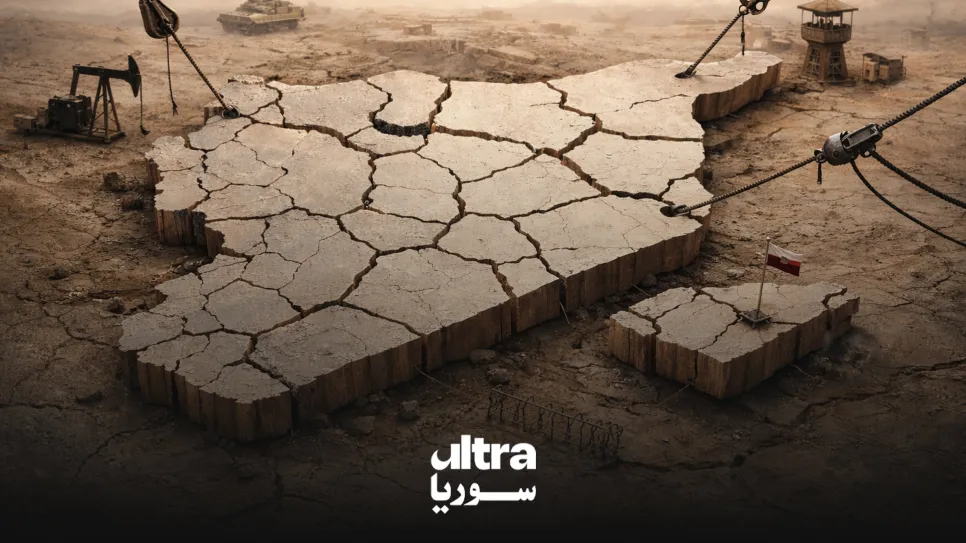
In Syrian political discourse since 2012, the concepts of federalism and political decentralization have been presented as technical solutions to a chronic governance crisis, or as “rational” exits for managing diversity and containing collapse. However, this framing, despite its superficial appeal, ignores the true context from which these projects emerged. It overlooks the fact that they were not born from an internal national response, but rather as geopolitical tools incorporated into active—sometimes silent, sometimes explicit—partition processes, driven by international powers and implemented by de facto authorities of a militiamen nature.
The Erosion of Sovereignty and Redistribution of Control
The structural problem in Syria was never the absence of a suitable administrative form, but rather the nature of the centralized security state where politics was hollowed out of substance and institutions became facades for power rather than tools of accountability. However, the collapse of this formula after 2011 did not lead to a sovereign reform path. Instead, it resulted in a sovereign vacuum exploited by external forces through the fragmentation of the Syrian domain into spheres of influence.
In this context, decentralization did not emerge as a constitutional choice stemming from national dialogue, but as a mechanism for managing areas outside central control, under the logic of “stability in exchange for delegation.” The outcome was not a transfer of powers within a single state, but rather a multiplication of decision-making centers, the fragmentation of sovereignty, and the transformation of geography into separate security-economic units.
Federalism as a Control Mechanism, Not a Political Pact
Federalism, as a constitutional concept, presupposes strict conditions: a pre-existing political unity, national consensus, guarantor institutions, and a unifying identity capable of accommodating plurality. What occurred in Syria was precisely the opposite. The term was invoked amidst war, institutional collapse, and direct military interventions, becoming a tool to lend political legitimacy to a coercive reality.
Thus, federalism transforms from a political pact into a geopolitical control mechanism: dividing territory, managing resources, preventing the return of a central state, and producing functional entities suitable for international negotiation. It is no coincidence that these projects are proposed in areas of oil significance or strategic borderlands, or that they are linked to rhetoric of “protecting components” in the absence of any real legal guarantees.
The SDF: From Local Actor to Executive Arm
Within this landscape, the Syrian Democratic Forces (SDF) played a pivotal role. It was not merely a local actor seeking to manage its own affairs, but a de facto authority with a military-security structure, relying on direct international support, and reproducing a supra-societal governance model based less on a social contract and more on power balances.
The rhetoric of “autonomous administration” promoted by the SDF conceals a fundamental contradiction: speaking of local democracy while monopolizing weapons, excluding other political forces, and managing resources without a national mandate. This contradiction is not incidental but structural; the project itself is not based on integration into a reconstructed Syrian state, but on entrenching a separate political-security entity adaptable to shifting international interests.
Cause – Effect – Long-term Impact
The primary cause was the absence of a comprehensive national path to rebuild the state after 2011, replaced instead by international security approaches prioritizing stability over justice. The direct result was the delegation of authority to armed local actors to manage entire areas outside any sovereign framework. The long-term impact is more perilous: the normalization of partition, transforming it into a legal and political fait accompli difficult to reverse.
This path does not produce stability but establishes the groundwork for deferred conflicts. When regions are managed based on sub-identities and resources are linked to military power, confrontation becomes a matter of time. After 2024, with shifts in international power balances or the reduction of certain protective umbrellas, these contradictions may erupt into sectarian-ethnic conflicts—not because Syrian society is inherently prone to them, but because the imposed structure fosters them.
The Gap Between Rhetoric and Reality
The most dangerous aspect of the federalism and decentralization projects proposed today is the gap between their rhetoric and their reality. They are marketed as solutions to avoid fragmentation while being practically implemented as mechanisms to deepen it. They are presented as guarantees for diversity while being managed by an exclusionary security logic. They are proposed as alternatives to the centralized state, without answering the crucial question: what state would remain if every region became a semi-independent entity?
The true question is not whether Syria needs decentralization or not, but rather: who has the right to define it, in what context, and for what purpose? Is it a tool for redistributing power within a unified state, or a soft cover for its dismantlement under constitutional labels? Unless this question is posed boldly, and unless any administrative discussion is reconnected to a comprehensive, sovereign national project, federalism and decentralization in Syria will remain not solutions to a governance crisis, but advanced stages in the crisis of the entity itself.
This article was translated and edited by The Syrian Observer. The Syrian Observer has not verified the content of this story. Responsibility for the information and views set out in this article lies entirely with the author.
