
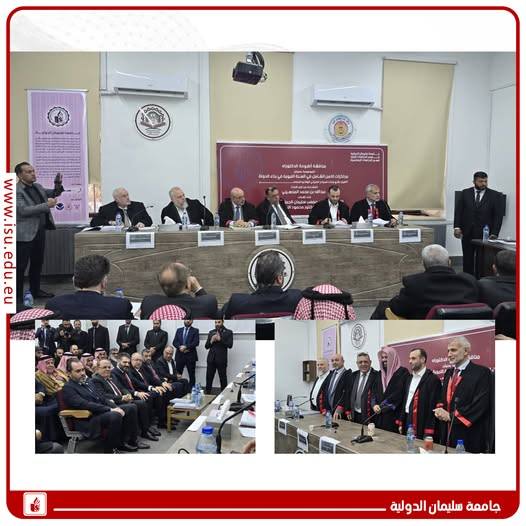
In a hall traditionally reserved for difficult questions and the slow cultivation of knowledge—rather than noise or symbolism—Abdullah al-Muhaysini defended his doctoral dissertation at the University of Damascus. Yet, the degree itself was issued under the name of a foreign institution: Suleiman International University in Turkey. At first glance, the name appeared innocuous; soon, however, it acquired a weight far beyond expectation. According to circulating reports in Turkish academic circles, the university is not officially recognized by the Turkish Higher Education Council. Thus begins a story that shifts from a routine academic announcement into a grey area—a space where everything seems in order, yet something feels unmistakably out of place.
The scene is strikingly paradoxical. Damascus University, with its storied past and the collective memory of professors, students, and theses composed under dim lights in difficult times, played host to a defense conducted on behalf of another institution—one that reportedly lacks the legal accreditation necessary for its degrees to carry formal weight in its home country. It is akin to placing an authentic painting within a forged frame. The painting remains genuine, yes, but the frame alters how it is perceived.
Abdullah al-Muhaysini is not a typical doctoral candidate quietly passing through university corridors. He is a public figure with a political and religious background, an audience, and a presence far removed from the calm, dispassionate world that academia is meant to inhabit. This does not inherently diminish the academic merit of his dissertation, but it renders the circumstances of its conferral more delicate. A doctoral title, when conferred upon a well-known figure, becomes a form of symbolic capital—something that can be wielded in public discourse, in rhetoric, and in shaping one’s image. The institution granting that title, whether it intends to or not, becomes part of the narrative.
This raises a question many would prefer to avoid: what does it mean for an unrecognized university to award a doctoral degree, and for that degree to be defended within a prestigious national university—under the gaze of ministers and officials? From one angle, the event resembles a political spectacle more than a rigorous academic exercise. It is as though the university momentarily functioned as a stage for a dual conferment: academic legitimacy for a university lacking legal recognition, and symbolic legitimacy for a high-profile individual.
Universities are not theatres. They are legal institutions before they are intellectual ones. Accreditation, quality control, and equal opportunity are not decorative slogans—they are safeguards against a system devolving into one where influence determines outcome. Once this door is even slightly ajar, closing it becomes near impossible. Today, it may be a dissertation; tomorrow, a full academic program; and eventually, a marketplace of qualifications whose worth is anyone’s guess.
In such circumstances, the Ministry of Higher Education cannot afford to be a passive observer. It is not a ceremonial body that merely dispatches delegates to events, but the ultimate custodian of academic integrity. To allow breaches under the guise of “exceptions” or “circumstantial allowances” is akin to leaving a crack in the wall of a dam—barely noticeable at first, but capable of unleashing a flood.
The purpose here is not to prosecute an individual, nor to cast aspersions on potentially sincere scholarly work. It is both simpler and more demanding: to seek clarity. To determine which institution awarded the degree, what its legal status is, and why the University of Damascus served as the venue for its defense. For when clarity in higher education is lost, the collapse is not immediate. Doubt begins to creep in, growing silently until students no longer know whether the certificate they hold is a passport to the future or merely a decorative piece of paper.
In a country strained by politics, conflict, and division, the university remains one of the last spaces intended to be neutral, robust, and beyond negotiation. Undermining this space—even in what appears to be a minor footnote in the news—is more dangerous than it seems. It does not simply challenge one institution; it casts a shadow over the very notion of merit. And that, in any society, is far more perilous than any fleeting crisis.
This article was translated and edited by The Syrian Observer. The Syrian Observer has not verified the content of this story. Responsibility for the information and views set out in this article lies entirely with the author.