
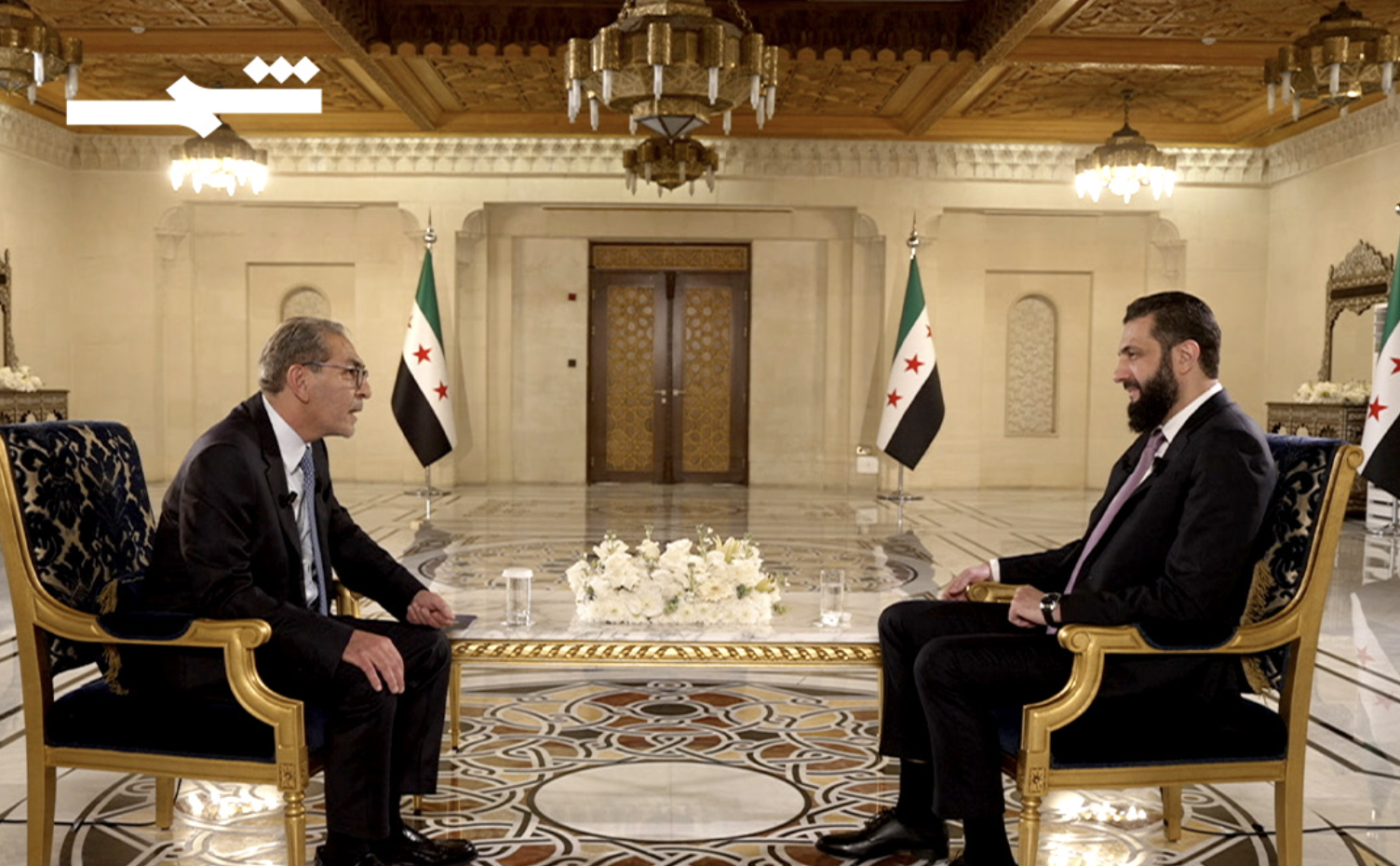
The Kurdish Arabic-language channel Shams, broadcasting from Erbil, has ignited a wide debate after deciding not to air a recorded interview with Syrian President Ahmad al-Sharaa. The interview, filmed in Damascus last Monday and initially slated for same-day broadcast, came at a moment of heightened tension following clashes between the Syrian Arab Army and the Syrian Democratic Forces (SDF) in Aleppo’s Sheikh Maqsoud and Ashrafiyah neighborhoods. The fighting ended with the withdrawal of Kurdish fighters, amid warnings of possible new confrontations in Maskana and Dayr Hafir in eastern Aleppo countryside.
Shams: Interview Would Escalate Tensions
Eli Nakouzi, Director-General of Shams and the interviewer himself, addressed viewers on Tuesday night to explain the decision. He said he had agreed to conduct the interview in hopes of “preventing further bloodshed” and sending “a reassuring message to the Kurds,” despite knowing that “public opinion in Erbil opposed this meeting.”
Nakouzi described President al-Sharaa as “charismatic and highly intelligent,” yet said the channel’s team felt that the President’s rhetoric toward the SDF was “intense and escalating.” Attempts to draw a calming message reportedly led al-Sharaa to “intensify his criticism,” even as he “intelligently expressed sympathy for the Kurds.” Nakouzi recalled telling the President: “This amounts to a declaration of war. This is a threat.”
He added that during the 53-minute interview he sensed that al-Sharaa had “run out of patience with the SDF and with Mazlum Abdi,” and would not offer further chances outside a return to the agreement previously signed between the two sides.
Nakouzi said that immediately after leaving the meeting he consulted political and media advisors, asking whether airing the interview would calm tensions or inflame them. “The unanimous answer was that it would escalate the problem, in Syria and in Erbil,” he said. He stressed that he would not allow Shams to become “a platform that stirs up strife or leads to clashes and killings paid for by innocent people, whether Syrian Arabs or Syrian Kurds.”
The channel had initially attributed the postponement to “technical and logistical reasons,” before announcing the final decision not to broadcast. Executive Director Tima Reza told Al-Araby Al-Jadeed that “the official position is what Eli Nakouzi announced,” adding that she had nothing further to add.
Security Threats Reported
A Kurdish security source told Al-Modon that Shams received a threat to target its headquarters if it aired the interview, attributing the threat to the Kurdistan Workers’ Party (PKK). The channel did not mention this publicly, and its earlier explanation made no reference to security pressures.
The channel had promoted the interview in recent days before announcing a special episode in which Nakouzi would explain the circumstances of the non-broadcast. This fueled speculation and debate, especially as unofficial reports circulated about direct threats.
Ministry of Information: No Justification for Withholding the Interview
In response to the controversy, Syria’s Ministry of Information issued a statement clarifying its position. It said the interview was conducted freely and professionally, and that President al-Sharaa answered all questions “with complete openness and without constraints.”
The Ministry emphasized that al-Sharaa’s choice of a Kurdish channel—despite the availability of many local and international outlets—reflected his desire to engage with diverse viewpoints and to underscore the status and rights of the Kurds “beyond organizational frameworks.”
The Ministry also rejected the notion that non-editorial pressures could justify withholding a completed journalistic interview. It asserted that the public has a right to access diverse opinions and that the Ministry “retains its full right to broadcast the interview through its official platforms,” since there is “no professional or editorial justification” for suppressing it.
Mixed Reactions
The decision not to air the interview has sparked divided reactions across social media. Some users accepted the channel’s explanation that the move was motivated by a desire to avoid escalation. Others argued that the decision was inseparable from political or security pressures, particularly in light of reports about explicit threats.
Shams, launched from Erbil in January 2025, positions itself as a Kurdish window to the Arab world, with programming focused on political, cultural, and social issues. Its handling of the al-Sharaa interview has now placed it at the center of a broader debate over media responsibility, political pressure, and the delicate balance of Kurdish-Syrian relations at a volatile moment.
This article was translated and edited by The Syrian Observer. The Syrian Observer has not verified the content of this story. Responsibility for the information and views set out in this article lies entirely with the author.
