
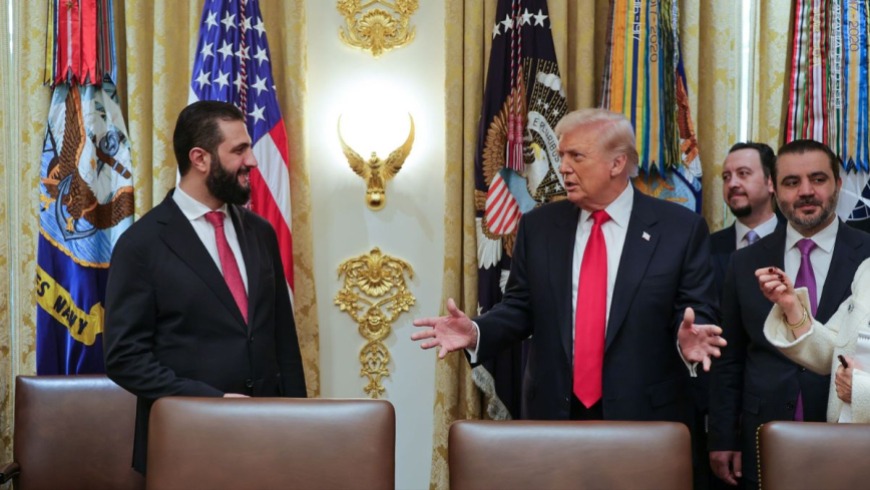
In a rare convergence of praise and censure, Washington has delivered its clearest signal yet that the political dynamics in the Levant are undergoing a significant shift. Within hours of President Donald Trump lauding Syria’s post-Assad transition as a “remarkable success”, a senior US official confirmed that the administration had formally requested Israeli Prime Minister Benjamin Netanyahu to cease incursions into Syrian territory, warning that continued provocations risk destabilising the fragile equilibrium taking shape along the Golan frontier.
Trump’s Statement: Commendation for Damascus, Caution for Jerusalem
Posting on Truth Social on Monday evening, Trump declared the United States “very pleased” with developments in Syria since President Ahmed al-Sharaa took office. He praised Sharaa’s leadership as “hard-working and determined”, describing the transitional period as a “historic opportunity” to foster a long-term, prosperous relationship between Syria and Israel.
Trump linked the swift diplomatic thaw and surge in humanitarian and investment support to his administration’s decision to lift “harsh sanctions” on Damascus—insisting that Syrians had “clearly appreciated” the gesture.
Yet embedded within his congratulatory remarks was a pointed rebuke, unmistakably directed at Netanyahu:
“Israel must maintain a strong and honest dialogue with Syria. Any action that obstructs Syria’s path to prosperity will be unacceptable.”
Though Trump did not explicitly mention Israel’s deadly raid on Beit Jan last week, the timing and tone of his statement left little doubt that Washington now views further escalation as a direct threat to its Syria policy.
A Quiet but Firm Message: Washington Urges Restraint
Hours after Trump’s post, an American official confirmed to Israel’s Channel 12 that the White House had urged Netanyahu to “cease destabilising manoeuvres” in Syria. The official warned that the Israeli leader’s cross-border operations risk transforming Syria’s new government from a potential partner into a long-term adversary.
“Syria harbours no designs upon Israel,” the official said, drawing a sharp contrast with the Lebanese theatre. “Netanyahu is seeing ghosts where none exist.”
The warning reflects growing concern in Washington that Israeli actions could undermine the diplomatic framework Trump is attempting to construct—one that hinges on a stable and cooperative relationship between Damascus and Jerusalem.
Beit Jan: Catalyst for Reassessment
The shift in US messaging follows Israel’s assault on Beit Jan on 28 November, during which helicopter gunships, drones and artillery fire killed 13 civilians and injured at least 25 others, as Israeli forces sought to capture three young men allegedly linked to an emergent armed faction.
Damascus condemned the attack as a “massacre” and a “grave violation of sovereignty”. International observers described it as one of the deadliest incidents since Israel expanded its military footprint in southern Syria in late 2024.
Israel currently maintains eight forward positions in Quneitra, a base in Deraa, and entrenched control over the summit of Mount Hermon. Netanyahu’s highly publicised visit to Syrian territory on 19 November—accompanied by his defence and foreign ministers—further strained ties with Washington, which viewed the move as a direct challenge to its Syria policy.
Trump’s post, coupled with the subsequent diplomatic outreach, is widely seen as a clear attempt to rein in further Israeli adventurism.
Syria’s Diplomatic Push, Netanyahu’s Strategic Dilemma
Syria’s Foreign Ministry has launched a coordinated diplomatic campaign urging global powers to enforce the 1974 Disengagement Agreement and pressure Israel to withdraw from newly occupied zones. Officials maintain that the transitional government seeks stability, not confrontation, and has “no intention of threatening Israel’s security”.
President al-Sharaa has reportedly stressed in recent discussions that Syria will not join the Abraham Accords, but poses “no military challenge” to Israel—reinforcing the view that Netanyahu’s escalatory posture is unnecessary and counterproductive.
A New Balancing Act in the Levant
At the heart of this evolving diplomatic choreography lies a clear recalibration by the United States. The Trump administration now regards a stable, sovereign Syria as a cornerstone of regional order—and a potential partner in its broader Middle East strategy.
For Netanyahu, the message could not be clearer. Trump’s team has linked the success of its Syria policy to a cessation of Israeli operations across the border. “Restraint,” the American official said, “is now a strategic requirement.”
In Trump’s newly envisioned regional map, Damascus is no longer an adversary to be contained but a partner to be engaged. And for the first time in decades, Washington’s tolerance for Israel’s security doctrine in Syria appears to be waning.
Whether Netanyahu alters course—or escalates further—will determine whether the Golan frontier enters a new era of calm or spirals into a confrontation neither side seems prepared to manage.
This article was translated and edited by The Syrian Observer. The Syrian Observer has not verified the content of this story. Responsibility for the information and views set out in this article lies entirely with the author.
