
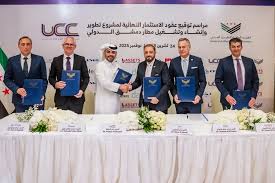
The Syrian General Authority of Civil Aviation has formally announced the signing of final contracts for the investment, development, construction and operation of Damascus International Airport. The agreement, concluded with an international consortium led by UrbaCon Holding, represents the most ambitious aviation project in Syria’s modern history, with investments exceeding four billion US dollars.
The signing ceremony took place in Damascus in the presence of Eng. Omar Hisham Al-Husri, President of the General Authority of Civil Aviation, his deputies Abd Al-Bari Al-Saj and Amjad Nakhkhal, and a number of senior departmental directors. Also participating were high-level representatives of the consortium, including Mr. Moutaz Al-Khayyat, Chairman of UrbaCon Holding; Mr. Ramez Al-Khayyat, Chief Executive of UrbaCon; Mr. Murad Arjunoğlu of the Turkish construction group Cengiz; Mr. Tufan Kuraz of Kalyon; Mr. Mohamed Arif Özuzan representing UrbaCon Concessions; and Mr. Mazen Al-Sbeiti of the American investment firm Assets.
Moutaz and Ramez Al-Khayyat, who lead the UrbaCon group, are among the most influential entrepreneurs operating in the Gulf today. Although widely known as Qatari businessmen, the brothers are originally of Syrian descent, belonging to a prominent family from the Damascus countryside that migrated to Qatar decades ago. Over the past fifteen years they have built one of the region’s most diversified business portfolios through Power International Holding, overseeing major ventures in construction, infrastructure, agriculture, food production and hospitality. Their flagship projects — including Qatar’s Baladna dairy empire and several World Cup-related infrastructure schemes — have established their reputation as key regional investors. Their renewed engagement in Syria marks one of the first large-scale returns of major diaspora capital following the country’s political transition.
The newly signed agreement aims to transform Damascus International Airport into a major regional hub capable of handling thirty-one million passengers annually. It will be upgraded to the highest international standards, reinforcing Syria’s strategic position within global aviation and restoring its historical role as a crossroads of regional connectivity.
Encouraging Signs of Recovery: Strong Performance at Damascus International Airport in September 2025
The General Authority of Civil Aviation has released its monthly operational report for September 2025, showing stable performance at Damascus International Airport despite persistent logistical and regional pressures affecting the wider air transport sector.
During the month, the airport handled 838 flights — a mix of scheduled passenger services, diplomatic movements and ad-hoc operations — while total passenger numbers reached 179,213, including 103,731 departures and 75,482 arrivals. Traffic levels remain consistent with previous reporting periods.
Fourteen airlines maintained regular services to regional and international destinations. In addition, 4,488 visas were issued on arrival, marking a modest but ongoing rise in inbound movement. Of all operations, 798 were commercial passenger flights, 24 diplomatic missions and 16 charters, underscoring the airport’s multifunctional role.
The Authority described the figures as evidence of steady progress in restoring air services, reaffirming its determination to improve operational efficiency, streamline passenger procedures and enhance infrastructure in line with global aviation standards.
As part of Syria’s wider reconstruction programme, the General Authority of Civil Aviation has announced a strategic master plan for the complete modernisation of the country’s aviation sector. The plan encompasses rehabilitating existing airports, converting selected military airfields for civilian use and preparing for the return of European carriers following the lifting of international sanctions.
A New International Airport for Damascus
Eng. Omar Hisham Al-Husri confirmed that the rehabilitation of Syria’s five existing airports is already underway. In parallel, a new international airport — entirely separate from the current one — will be constructed in Damascus with a projected capacity of thirty million passengers annually. The existing Damascus International Airport is also being expanded to handle five million passengers per year, while Aleppo International Airport will see its capacity doubled to two million. These projects constitute major investment opportunities for both domestic and foreign partners.
A notable addition to the national aviation map will be the conversion of Mezzeh Military Airport for civilian use. This transformation will add a strategically important facility to the capital’s air network, significantly boosting overall capacity.
Leadership and Reform in the Aviation Sector
President Ahmed Sharaa has issued Decree No. 136 of 2025 appointing Eng. Omar Hisham Al-Husri as President of the General Authority of Civil Aviation. The appointment forms part of the government’s comprehensive strategy to revitalise essential sectors damaged during the conflict.
Mr. Samih Arabi, Advisor to the Authority, announced plans to expand the national carrier’s fleet by five to six aircraft in the coming year, with potential for further expansion depending on evolving conditions. European carriers have begun preliminary assessments for a return to Syrian airspace but are taking time to verify airport readiness.
Mr. Arabi also confirmed that three tenders have been received from European firms to install an advanced radar system at Damascus International Airport, in addition to ongoing upgrades of navigational aids and landing-precision equipment. A Turkish technical delegation is currently training Syrian staff on the latest systems, while European specialists are scheduled to visit Damascus next week to finalise radar implementation.
Post-War Challenges and the Reopening of Syrian Skies
Following years of conflict and Western sanctions that restricted access to European and American airspace, Syrian airports continue to recover from the severe damage inflicted between 2011 and 2024.
After the political transition and the fall of the Assad regime, the prospects for aviation recovery improved dramatically. Former Authority President Eng. Ashhad Al-Salibi previously confirmed that international airlines had expressed interest in returning, though progress had long been hindered by the former regime’s neglect of airport infrastructure and staff development.
Regular international flights resumed from Damascus International Airport on 7 January 2025, beginning with a scheduled service to Sharjah. This marked the end of a prolonged shutdown caused by Israeli airstrikes and infrastructure damage. The new administration emphasises that it is committed to restoring national capabilities and rebuilding passenger confidence, viewing aviation as a cornerstone of Syria’s economic recovery.
This article was translated and edited by The Syrian Observer. The Syrian Observer has not verified the content of this story. Responsibility for the information and views set out in this article lies entirely with the author.
