
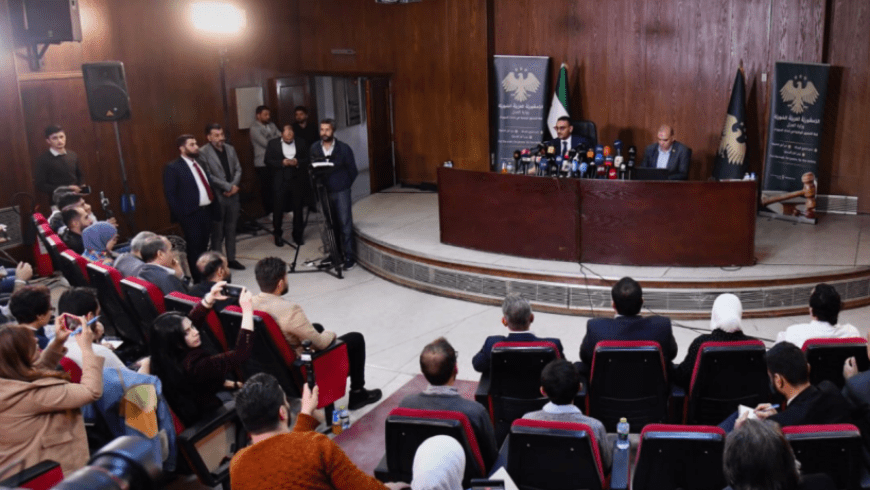
The National Investigation Committee into the Suweida Events has announced the detention of several individuals from Syria’s Defence and Interior Ministries, citing irrefutable evidence of their involvement in recent disturbances that engulfed the province. These officials have been referred to the competent judiciary to face legal proceedings.
The announcement was made during a press conference held at the Ministry of Information in Damascus on Sunday, where the committee presented its findings concerning the violent episodes that gripped Suweida in July 2025. These events were marked by serious violations, inflammatory rhetoric, and orchestrated displacements, according to the Syrian Arab News Agency (SANA).
Presiding over the briefing, Judge Hatim al-Naasan, chair of the committee, affirmed the independence of the inquiry, stressing that no interference from within the Syrian state had influenced the investigation. He commended the Ministries of Defence and Interior for their cooperation, which he described as crucial to the integrity of the process.
Judge al-Naasan further disclosed that Defence Minister Marhaf Abu Qasra had issued a directive forbidding any military personnel from entering Suweida without formal authorisation—an order intended to prevent further escalation.
Request for Extension to Complete Investigations
Naasan voiced the committee’s commitment to uncovering the full truth and preventing recurrence of the unrest. However, he noted that limited access to Suweida city and surrounding areas had hindered their work, prompting a formal request for a two-month extension to complete the investigation.
He emphasised the committee’s coordination with the International Investigation Commission, recalling a recent meeting during which international experts commended the Syrian team’s rigorous methodology. “The cooperation extended to the international committee,” he stated, “underscores Syria’s sincere commitment to accountability and justice.”
Naasan reaffirmed the committee’s impartial mandate, noting that its investigations extended across all parties involved. The inquiry covered locations in the Damascus suburbs—including Jaramana and Sahnaya—alongside Suweida itself.
The committee gathered extensive evidence, including testimony from unaffected residents, confessions from military personnel present during the events, and medical reports from forensic pathologists who examined the deceased.
No Evidence of Foreign Involvement
Addressing persistent rumours, Judge al-Naasan stated unequivocally that no foreign combatants were involved in the Suweida violence. This conclusion, he said, was supported by consistent testimonies from local residents who denied any such presence.
He added that a team of technical experts had been tasked with verifying the authenticity of widely circulated video footage, which in turn led to the identification and referral of individuals whose incitement contributed to the unrest.
This press conference, Naasan concluded, fulfils a legal obligation to bring transparency to the investigation, establish accountability, and provide justice for the victims and their families. He described the Suweida events as a tragic episode involving loss of life, destruction of both public and private property, forced displacement, and inflammatory discourse—an ordeal demanding thorough and apolitical redress rooted in legal standards.
Legal Foundations and Scope of Inquiry
The committee was established by Ministerial Decree No. 1287 of 2025, issued by the Minister of Justice, and operates under Syrian legal frameworks as defined in Article 51 of the Constitutional Declaration. Its mandate is further supported by international treaties and conventions ratified by Syria and integrated into national law under Article 18.
Its jurisdiction includes violations outlined in Syrian Penal Code No. 148 of 1949 and Article 12 of the Constitutional Declaration, as well as relevant provisions of international human rights and humanitarian law—particularly the four Geneva Conventions of 1949 and their Common Article 3. The investigation is guided by principles of humanity, necessity, distinction, and proportionality.
The committee has developed operational protocols aligned with United Nations standards for investigative bodies and with international legal practices.
Mandate and Objectives
Judge Naasan outlined the committee’s core responsibilities: to determine the causes and conditions that triggered the Suweida events; to investigate all alleged violations; to review grievances and civilian deaths; and to identify suspected perpetrators.
The committee’s task also includes defining individual and command responsibility, ensuring all those proven guilty are held to account, and recommending legal safeguards to prevent similar incidents in other regions. In this pursuit, justice is not merely punitive—it serves as a guarantor of national stability and legal integrity.
This article was translated and edited by The Syrian Observer. The Syrian Observer has not verified the content of this story. Responsibility for the information and views set out in this article lies entirely with the author.