
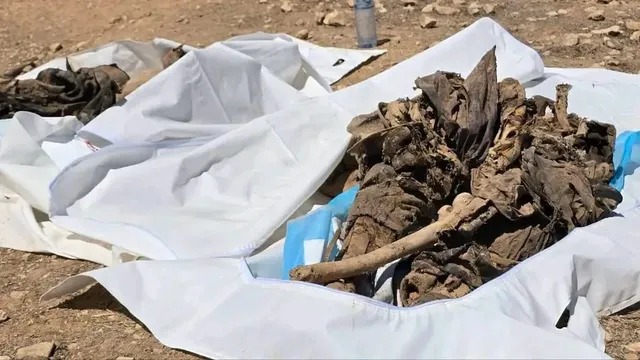
In the wake of Bashar al-Assad’s downfall, a torrent of harrowing revelations has swept across Syria. Testimonies, unearthed documents, and exhumed archives have laid bare a regime of extraordinary cruelty, exposing a calculated campaign of crimes against humanity. Central to this revelation is the regime’s ruthless “scorched earth” policy—designed to extinguish the Syrian Revolution’s call for freedom by burying it in fire and fear.
Mass Graves Reveal a Legacy of Atrocity
In the months following the regime’s collapse, mass graves have been discovered across Syria—from Daraa and Damascus to the ravaged heart of Homs. These burial sites, grim reminders of the regime’s brutality, hold the remains of countless civilians—victims of state-sanctioned violence. Each uncovered body tells a story of vanished hope and final moments drowned in fear.
Families of the missing, many of whom spent years clinging to uncertain hope, often resorted to paying bribes to regime intermediaries for information—only to be met with silence. Now, as the graves are opened, the truth emerges from the soil: a stark, silent demand for justice from the earth itself.
Secret Prisons and Torture Chambers Unveiled
Alongside these discoveries, official records—retrieved from abandoned prisons and hospitals—have surfaced, revealing the names of detainees who died under torture. One of the most chilling revelations is a clandestine prison discovered beneath Homs—a subterranean facility five metres deep, used to detain civilians in total darkness, their cries muffled by concrete and neglect.
Survivor Testimonies Illuminate Systemic Torture
Across social media and digital platforms, survivors of Assad’s prisons have begun to speak out. Their testimonies form a devastating mosaic of pain: brutal beatings, starvation, disease, psychological degradation, and exposure to freezing conditions. These were not isolated cases of mistreatment—they were deliberate instruments of control and dehumanisation.
Faces of the survivors, haunted by the past, bear witness to trauma beyond words. Their voices form an urgent record of the regime’s cruelty, chronicling a system that prioritised repression over any semblance of justice or humanity.
Prisons as Tools of State Terror
These mounting testimonies and records amount to a comprehensive indictment of Assad’s rule. The Syrian state, under his command, was not governed by law but by fear. Prisons, once intended to hold criminals, became tools of mass suppression. Entire communities were cowed into silence, while dissenters were swept into a vast machinery of arrest, torture, and execution.
This system of governance was not simply authoritarian—it was predatory. The judiciary, security services, and penal institutions were co-opted into a single apparatus of domination, operating to maintain absolute control through collective punishment.
A National Mandate for Justice
Today, as Syria emerges from the long shadow of dictatorship, its people demand justice—not revenge, but accountability. They call for Bashar al-Assad and all complicit in these atrocities to face fair and transparent judicial proceedings.
This reckoning is not just about historical closure—it is about moral clarity. For the families of the disappeared, the survivors of torture, and the memory of the dead, justice is the foundation of healing. It is the only path by which Syria can forge a future liberated from the ghosts of tyranny.
In demanding accountability, the Syrian people seek to reaffirm a core principle: that no leader, no official, and no system stands above the universal rights of human dignity and the rule of law.
This article was translated and edited by The Syrian Observer. The Syrian Observer has not verified the content of this story. Responsibility for the information and views set out in this article lies entirely with the author.