
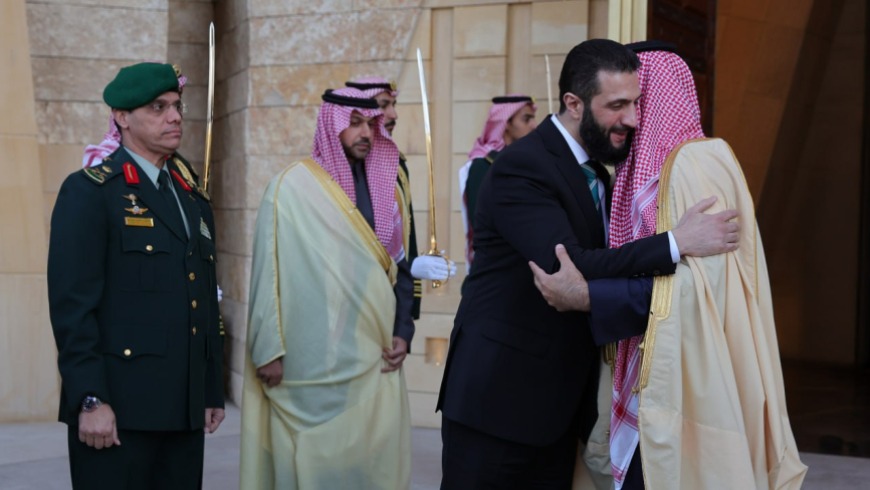
Since Ahmad al-Sharaa assumed leadership of Syria’s transitional government in early 2025, the Arab region has witnessed a measured shift in its approach toward Damascus, ending over a decade of diplomatic estrangement. This recalibration has opened the door to renewed Arab and Gulf engagement with Syria—seen by some as a symbolic return to Arab fold, and by others as a cautious maneuver shaped by evolving political calculations.
Mohammed al-Yamani, a researcher in international relations, told 963+ that the period between 2023 and 2025 marked a delicate phase of diplomatic recalibration. Syria’s reinstatement to the Arab League in 2023, he noted, was “a critical testing moment for Gulf capitals to explore the feasibility of reintegrating Damascus into the regional order after years of isolation.”
According to Yamani, Gulf positions evolved incrementally. Saudi Arabia championed Syria’s return under a policy of “containment through integration.” The UAE pursued economic engagement, while Qatar maintained a conditional posture tied to political reform. Kuwait, for its part, opted for restraint and observation.
Gulf Rapprochement: From Isolation to Tentative Reconnection
Al-Sharaa’s rise to power triggered a wave of Gulf overtures—most notably from Saudi Arabia, the UAE, and Bahrain. His February 2025 visit to Riyadh marked the first clear Gulf endorsement of Syria’s transitional phase, aligning with Saudi Arabia’s strategy of “containment over isolation.” The UAE emphasized Syria’s territorial unity and its role in reconstruction, while Bahrain voiced support for restoring state institutions.
This momentum culminated in a Gulf Cooperation Council summit in Mecca and a high-profile visit by al-Sharaa to Abu Dhabi in July 2025, accompanied by the gradual reopening of embassies.
Yet by mid-2025, the pace of engagement slowed. Yamani attributes this to Syria’s limited internal reforms, persistent Western sanctions, the eruption of the Gaza war, and diverging Gulf approaches to the Syrian file.
Saudi Arabia: Strategic Support Within Clear Parameters
From the outset, Saudi Arabia welcomed the transitional government, emphasising Syria’s unity and the rejection of foreign interference. In an August 2025 statement, Riyadh framed the success of Syria’s transition as a cornerstone of Arab security.
Yamani underscored Saudi Arabia’s “pivotal role in advocating Syria’s return to the Arab League,” noting that deeper cooperation depends on Damascus’ ability to rein in armed groups, curb Iranian influence, and preserve institutional cohesion.
Ibrahim Kaban, director of the Geostrategic Studies Network, told 963+ that Saudi and Gulf support is “not rooted in ideological alignment but in shared strategic interests.” He described the relationship as “pragmatic and conditional,” shaped by realpolitik rather than affinity.
The UAE: Engagement Tempered by Security Calculations
While publicly supportive of Syria’s transitional leadership, the UAE has adopted a cautious, interest-driven approach. Expert assessments suggest that Abu Dhabi prioritizes managed stability, wary of empowering unpredictable actors or triggering internal volatility. Economic cooperation is contingent on administrative reform and anti-corruption measures.
Kaban noted that “the UAE proceeds carefully, mindful of strategic competition with Saudi Arabia and Qatar for influence in Damascus.” He added that Abu Dhabi seeks equilibrium between internal Syrian stability and its own economic and security interests.
Bahrain, by contrast, has taken a more forthright stance, emphasizing national reconciliation and institutional rebuilding. In May 2025, Manama hosted al-Sharaa, reaffirming its commitment to Syria’s recovery and reintegration.
Wider Arab Engagement: Egypt, Jordan, Iraq, and Lebanon Reengage
Beyond the Gulf, regional actors such as Egypt, Jordan, Iraq, and Lebanon have begun coordinating efforts to restore Syria’s Arab standing. Yamani described their engagement as “cautiously optimistic,” viewing developments in Damascus as tentative steps toward stability despite enduring challenges.
Egypt has focused on counterterrorism and limiting destabilizing influences, while maintaining limited governmental engagement. Jordan has prioritized border security and refugee management, activating bilateral cooperation. Iraq has expressed interest in joint border security and counterinsurgency efforts. Lebanon, facing economic collapse, sees cooperation with Syria as a lifeline for its northern regions.
Still, Kaban observed that many Arab states are “waiting for clearer signals from Saudi Arabia, Qatar, the UAE, and Egypt before committing,” underscoring the strategic interdependence of Arab diplomacy.
The Maghreb: Reserved Postures and Conditional Outreach
North African states have largely adopted a wait-and-see approach, tying normalization to internal Syrian stability. Morocco has yet to reopen its embassy but initiated low-level contacts, affirming support for Syria’s unity and sovereignty. Algeria has maintained its traditional stance of non-interference, advocating peaceful resolution while withholding full engagement. Tunisia remains preoccupied with the issue of returning Tunisian fighters, conditioning any diplomatic opening on regional coordination.
Yamani emphasized that Gulf and Arab recalibrations are “not absolute shifts but rather incremental moves shaped by a matrix of security, political, and economic interests.”
Security as the Common Denominator
Across the Arab world, security concerns dominate the calculus. From armed militias and cross-border smuggling to refugee flows and humanitarian deterioration, these issues shape the contours of engagement with Damascus.
Professor Hassan Abdullah al-Daaja told 963+ that “security threats—particularly arms and drug trafficking and militia proliferation—are central to Gulf-Syria relations.” These concerns, he said, serve as litmus tests for trust and cooperation.
He added that the relationship is “a complex interplay of security, political, and economic interests,” with convergence or divergence hinging on a web of strategic calculations.
Support Tied to Reform: Conditions for Deeper Engagement
Arab and Gulf states have outlined clear conditions for sustained engagement with Syria’s transitional government. These include disbanding non-state armed groups, respecting national sovereignty, ensuring transparency in reconstruction aid, implementing political reforms for inclusive governance, and advancing national reconciliation.
Yamani noted that Gulf initiatives “aim to manage influence rather than forge a strategic alliance.” Al-Daaja echoed this, stating, “It’s premature to speak of a full alliance,” and framing current coordination as a trust-building phase.
Between Hope and Hesitation
While early 2025 was marked by optimism, recent months have seen a cooling of enthusiasm. The war in Gaza, Turkish-Iranian tensions, and Syria’s sluggish reform pace have tempered expectations. Nonetheless, diplomatic channels remain open, and Arab support—though cautious—persists.
Kaban reiterated that Gulf support for Damascus is “not ideological but strategic,” shaped by internal Syrian dynamics and regional power balances. “Damascus is no longer isolated,” he said, “but it has not been fully embraced either.”
As of October 2025, Arab-Syrian relations remain suspended between cautious openness and strategic restraint. For the Gulf, Syria represents a potential partner in regional recalibration and counterbalancing Iran. For others, the transitional experiment is a test of outcomes over promises.
Experts agree: the Arab-Syrian relationship is symbolic, conditional, and under constant review—an evolving equation of pragmatism, security, and political realism.