
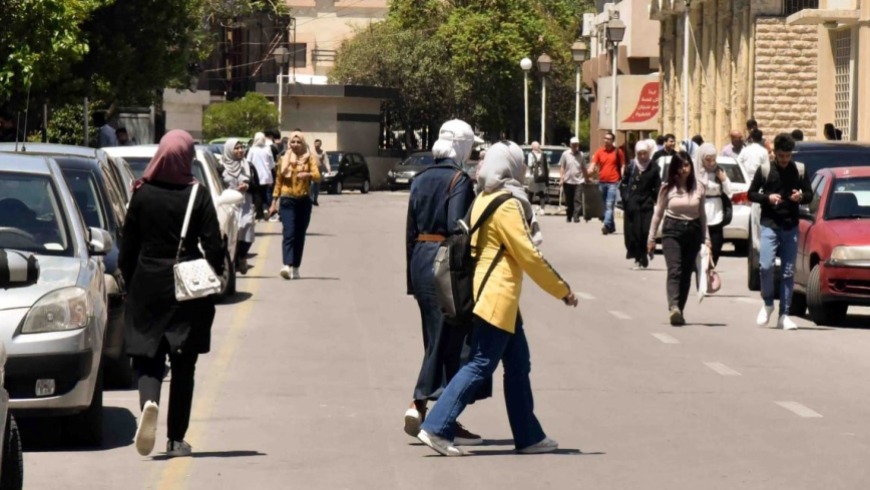
As students across Syria return to universities, those who had enrolled in recent years at the University of Damascus – Suweida branch – now find themselves in a difficult situation. The Syrian Ministry of Higher Education has yet to offer practical solutions or respond to their appeals.
Several students told Syria TV that they were forced to drop out after being displaced from Suweida to their home provinces during the bloody events that shook the governorate, which led to the university’s indefinite closure.
Mohammad al-Bandqaji, a third-year student in the Faculty of Electrical Engineering in Suweida, returned to Damascus in July and has been unable to continue his studies since the second semester of 2025 due to the university’s closure.
“The ministry lives in a world completely detached from reality,” Mohammad told Syria TV. “We can’t even enter Suweida to obtain the required documents for transferring. And if we do, the university is devastated—there is no administrative staff or functioning equipment.”
According to the regulations of the Ministry of Higher Education, students are entitled to transfer from one university to another by submitting an official hosting request, which must include the dean’s approval and a certified transcript from the original university.
However, these once-simple procedures have now become an impossible obstacle under the current security situation in Suweida.
Mohammad tried to find a way out of this deadlock by contacting his faculty dean in Suweida, who verbally approved his transfer to Damascus University. But when he submitted the request to the student affairs office in Damascus, it was rejected because the “official documents were incomplete,” he said.
“We need realistic solutions. It’s unreasonable to ask us to go to a dangerous area or to a half-destroyed university to fetch papers that don’t even exist,” Mohammad added.
Students Caught Between Displacement and Neglect
Mohammad’s story is far from unique — dozens of students from various provinces who had been studying in Suweida are now facing the same fate.
Amjad al-Masri, a fourth-year agriculture student at Suweida University, is one of them.
He was forced to return to his family home in rural Damascus last June after the clashes that broke out in the city, finding himself suddenly excluded from the educational system.
Speaking to Syria TV, Amjad recounted his repeated visits to the student affairs offices at Damascus University, seeking an exception or special facilitation. Each time, however, he was met with rejection or indifference.
“I lost an academic year, and I might lose my entire education,” he said. “The student affairs office at Damascus University is being obstinate, and the ministry doesn’t care. They ask for official documents from Suweida as if they don’t follow the news or know what’s happening there.”
He added, “A group of us recently went to the student affairs office at Damascus University, asking for special approval or an exception, but the official told us to simply reapply through the general admission process — as if our previous years of study never existed.”
An Absent Ministry and Students Outside the Education System
Since mid-2025, with the escalation of armed clashes in Suweida and the evacuation of student dormitories for those coming from other provinces, classes have been suspended in most faculties. Several university buildings have also sustained significant material damage.
Although the Ministry of Higher Education has issued brief statements reaffirming its “commitment to following up on students’ situations,” no concrete measures have been taken to provide alternatives or open hosting centres for displaced students.
Several students told Syria TV that their attempts to establish contact between faculty deans in Suweida and their counterparts in other provinces have yielded no results, as universities continue to refuse admission to students lacking official documents or formal “administrative correspondence” from their home university.
The students also submitted a proposal to the Ministry of Higher Education, suggesting the issuance of an exceptional decree allowing each displaced student to enrol at the university in their current province, based on electronic approvals instead of paper ones issued by Suweida University’s student affairs office. Yet, no response was received.
With the start of the new academic year, these students face an uncertain reality — unsure whether they are still officially enrolled or have been pushed entirely out of the educational system.
According to several students interviewed by Syria TV, most now feel they have become victims of Syria’s deteriorating security and political situation. With no clear plan from the Ministry of Higher Education to address their plight, students see no sign of returning to their studies anytime soon.
This article was translated and edited by The Syrian Observer. The Syrian Observer has not verified the content of this story. Responsibility for the information and views set out in this article lies entirely with the author.
