
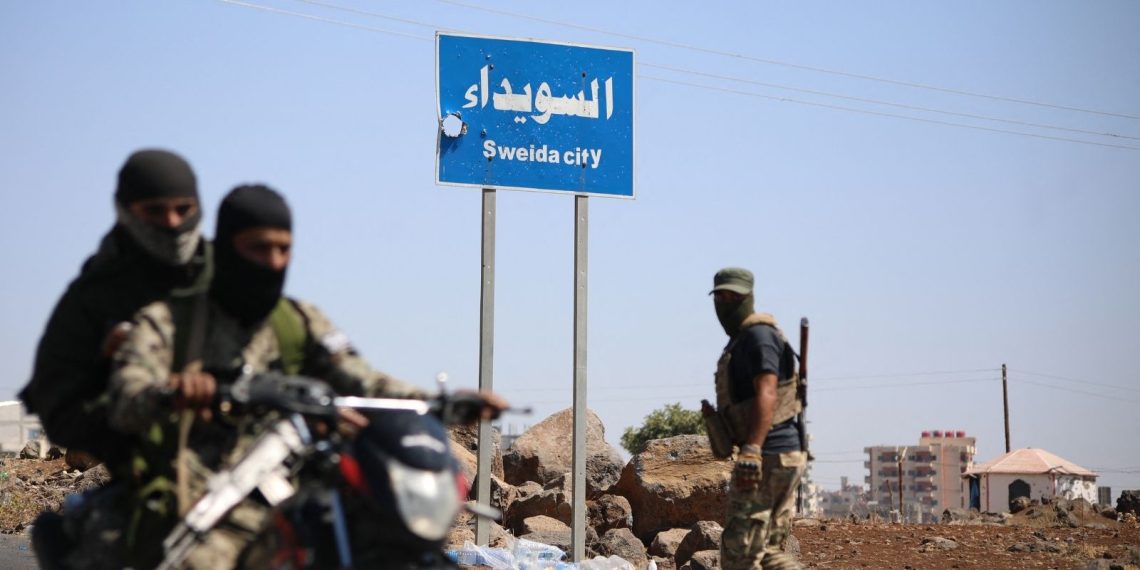
The Independent International Commission of Inquiry on Syria, chaired by Paulo Pinheiro, announced on Tuesday that it has opened an investigation into the violent events that shook Suweida province in July 2025.
The commission noted that the human rights situation in Syria remains precarious, despite a decline in systematic violations compared to the era of the ousted regime.
Pinheiro said the commission’s latest report documented the killing of more than 1,400 members of the Alawite community in March 2025, including some at the hands of the transitional Syrian government’s internal security forces. He welcomed the transitional government’s pledges to hold perpetrators accountable but urged it to take transparent and concrete steps to deliver justice and redress for victims.
Regarding the Suweida events, Pinheiro confirmed that the commission has launched its own probe and requested access to the province during its recent visit. He noted that the involvement of certain tribal forces in the clashes highlights the fragility of security in the region.
The commission also condemned ongoing Israeli airstrikes on Damascus, Homs, Latakia, and Palmyra, which have caused extensive destruction and civilian casualties. It stated that Israel has occupied new territories south of the disengagement line along the Syrian-Israeli border, while also arbitrarily detaining civilians.
Pinheiro further pointed out that the March 10, 2025, agreement between the transitional government and the Syrian Democratic Forces (SDF) continues to face significant implementation challenges.
The commission pledged to keep monitoring developments in Syria, urging the protection of human rights and the pursuit of justice across all conflict-affected areas.
Report on Atrocities in Syria’s Coastal Region
A joint report released Tuesday by Human Rights Watch, Syrians for Truth and Justice, and the Syrian Archive concluded that “the crimes committed on the Syrian coast were part of a centrally coordinated military operation overseen by the Ministry of Defense.”
The report criticized the transitional government for offering only minimal transparency about whether its investigation into the coastal events has addressed the role of senior military or civilian leaders, or what measures it intends to take to ensure accountability.
Titled “You Are Alawite: Identity-Based Targeting During Syria’s Transitional Phase,” the report highlighted widespread violations by transitional government forces, affiliated armed groups, and armed volunteers. Documented abuses included arbitrary executions, destruction of property, and mistreatment of detainees.
Drawing on more than 100 interviews with victims, witnesses, fighters, and journalists, as well as verified audiovisual material and satellite imagery, the report detailed violations across 24 towns, villages, and neighborhoods between March 6 and 10, 2025. These included home raids, looting, arson, and identity-based targeting.
Although no direct orders for atrocities were uncovered, the report concluded that the Ministry of Defense played a central role in mobilizing and coordinating the deployment of units. Fighters told investigators that orders were transmitted through ministry-linked channels, including instructions to hand over “secured” areas to the Ministry of Interior’s General Security forces.
Hiba Zayadin, a senior Syria researcher at Human Rights Watch, said: “The government’s acknowledgment of the atrocities is a step forward, but it falls short of delivering justice for senior officials who enabled or failed to prevent these crimes. Failing to hold leaders accountable risks fueling further cycles of retaliatory violence in Syria.”
Damascus–Suweida Road Reopens
More than a month after being closed by the July clashes, the Damascus–Suweida highway has reopened, enabling aid convoys to reach the province via the main route for the first time. The closure, sparked by fighting among Druze factions, Bedouin tribes, and government forces, had deepened humanitarian strains across the area.
This article was translated and edited by The Syrian Observer. The Syrian Observer has not verified the content of this story. Responsibility for the information and views set out in this article lies entirely with the author.
