
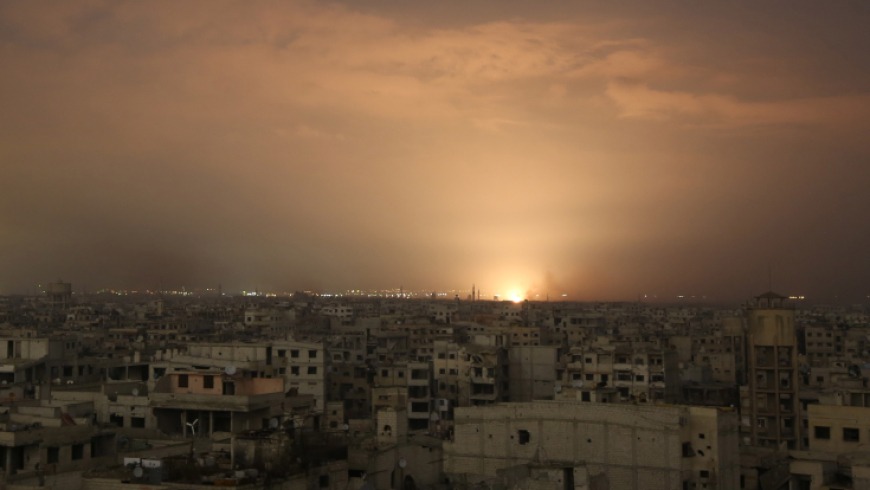
In the early hours of 21 August 2013, forces loyal to the deposed Syrian regime unleashed the deadliest chemical weapons assault in the nation’s history, targeting Eastern and Western Ghouta in the Damascus countryside. The coordinated rocket attacks, carrying sarin gas, were part of a systematic campaign to deploy chemical weapons against civilian populations, deliberately designed to terrorise communities—particularly women and children—in a brutal show of control.
A report released by the Syrian Network for Human Rights (SNHR) to mark the 12th anniversary of the massacre states that the commemoration comes at a pivotal juncture in Syria’s history. The country is entering a transitional phase characterised by increased cooperation with the Organisation for the Prohibition of Chemical Weapons (OPCW), offering what the SNHR describes as a genuine opportunity for justice, full disclosure, and accountability for those responsible.
The Ghouta Chemical Massacre: A Calculated Assault
Regime forces under Bashar al-Assad launched four simultaneous chemical strikes on populated areas in Eastern and Western Ghouta, including the town of Moadamiyat al-Sham. At least ten rockets were fired, containing an estimated 200 litres of sarin gas.
Launched from designated platforms shortly after midnight, the attack exploited weather conditions that kept the toxic gas close to the ground—maximising casualties among sleeping civilians. The operation was clearly premeditated, aimed at punishing a population demanding political reform. The chemical onslaught compounded an existing siege imposed since late 2012, which had already blocked fuel, medicine, and vital medical supplies—deepening the humanitarian catastrophe, according to the SNHR.
The network reports that nearly 80 per cent of Syria’s chemical attack victims perished in the Ghouta massacre. It documented 1,144 deaths by asphyxiation—accounting for 76 per cent of all chemical fatalities in regime attacks between December 2012 and May 2019. Among the dead were 1,119 civilians, including 99 children and 194 women, underscoring the indiscriminate nature of the attack. An additional 25 armed opposition fighters were killed, and some 5,935 individuals—mostly civilians—suffered respiratory failure and suffocation due to exposure.
The Day the Air Turned Deadly
Anas Mohammad Ali, a resident of Kafr Batna in Eastern Ghouta, recounted his experience of the 2013 massacre to Syria TV. “It’s the day when even your own breath becomes a burden—when you see people desperately gasping for air,” said Ali, who worked as a citizen journalist in the region from 2011 to 2018.
“In those early hours, people didn’t understand what was happening. Suddenly, mosque loudspeakers blared, ambulances roared through the streets, and residents rushed to the nearest hospital,” he recalled. “For the first time, Kafr Batna Hospital was overwhelmed—even outside its gates. Bodies and victims lined the roads, and civilians helped carry them in, trying to wash away the toxins with water.”
As a photographer with the Kafr Batna Coordination Committee, Ali described the attack as a “massacre without blood.” “We saw no blood—it felt strange. By then, we’d grown used to seeing blood in every massacre. This time, there were only bodies everywhere, with no visible wounds. By 7 a.m., regime forces began shelling hospitals and shelters.”
This escalation prompted immediate mass burials, driven by the sheer number of fatalities and fears that corpses retained chemical residues. Identifying the dead proved difficult, particularly for unknown victims. Media crews and photographers stepped in, capturing images to aid future identification by relatives.
Ali noted that Zamalka was the primary target, with surrounding areas such as Jobar, Ain Tarma, and Hazza also affected. Victims, however, were buried across Ghouta’s towns.
The fear lingered long after the attack. “I remember my mother sleeping fully dressed—in her coat and hijab—fearing she’d have to flee at any moment,” Ali said. “After that day, many of us in Ghouta lost faith in international justice. That was the moment Assad should have been held accountable.”
Having fled to France, Ali took two paths: he anonymously testified in a case against Assad and senior regime officials, submitting digital evidence to French courts; and he joined an art project recreating the massacre through abstract imagery. “I wanted to carry the memory with me through Paris, linking it to Ghouta using yellow—the colour of toxic warnings.”
The Psychology of Remote Killing
Unlike bullets or bombs, the Assad regime opted for sarin nerve gas—a silent, insidious weapon that suffocates without sound. For the survivors, the attack left deep psychological scars. The very air became a source of terror, with long-term effects on mental health and a lasting erosion of personal safety.
Psychiatrist Dr Mohammad al-Dandal told Syria TV that survivors often suffer from post-traumatic stress disorder (PTSD), their lives disrupted by flashbacks and panic triggered by even the mention of chemicals. “It was unprecedented—breath itself became lethal, amid scenes of mass death and suffocation,” he said. “Unlike shelling, which allows the possibility of evasion, chemical attacks offer no escape—especially at dawn, when cool, heavy air traps the gas. Most survivors require extended psychological care, which remains unavailable to many due to a shortage of specialists. Only a few receive treatment; the rest carry their trauma in silence.”
Dandal added that the regime’s use of chemical weapons reflects a form of remote killing that severs killers from their victims. “It’s just the push of a button. They don’t witness the suffering, so it becomes easier to repeat,” he explained. “The victims become statistics, their humanity erased by regime media blackouts and denial.”
Remote killing, he argues, represents the pinnacle of dehumanisation—warfare reduced to a video game-like experience. French philosopher Paul Virilio warned that modern military technology severs cause from effect, stripping conflict of meaning and enabling atrocity. “You press a button, people die, but you see no blood, hear no screams. The violence is not only physical—it also kills empathy,” Dandal said.
Traditional forms of violence, brutal as they are, still involve confrontation, which might stir conscience. Remote killing numbs that response, offering a false sense of moral absolution.
Philosophically, this method transforms victims into abstract coordinates—mere targets on a map. Hannah Arendt referred to this phenomenon as the “banality of evil”, where atrocity becomes bureaucratic rather than personal.
Chemical weapons violate the most basic human rights: the right to breathe, to sleep safely, to exist in peace. The Assad regime didn’t merely kill; it attacked the essence of life.
In the 1980s, Harvard law professor Roger Fisher proposed a radical idea: instead of storing nuclear launch codes in briefcases, implant them in capsules near a volunteer’s heart. To access them, a president would need to kill the volunteer personally—forcing a moment of reckoning before ordering mass death. “Blood should first be spilled in the White House,” he argued—an effort to restore the gravity of such decisions.
This article was translated and edited by The Syrian Observer. The Syrian Observer has not verified the content of this story. Responsibility for the information and views set out in this article lies entirely with the author.