
The latest findings of the International Commission of Inquiry on Syria function as a multilateral mirror, reflecting the early contours of President al-Sharaa’s first year in power. Yet, like much of the United Nations’ documentary tradition, the report offers only a partial image. It illuminates key fragments of reality while leaving others in deliberate shadow. It must therefore be read not only as a human-rights ledger, but as a political text—one defined as much by its explicit judgments and subtle insinuations as by the subjects it avoids.
The Redistribution of Violence
The report’s central conclusion is stark: Syria has not yet crossed the threshold from a repressive state to a state governed by law. What has occurred is not the dismantling of the machinery of violence, but its redistribution. The country has shifted from a centralized apparatus of state terror to a fractured landscape in which violence is shared among local militias and armed networks. The mentalities and mechanisms that produced decades of violations remain intact; only the terminology and political packaging have changed.
The report’s weight derives from its extensive evidentiary base—more than five hundred interviews, supported by forensic analysis of satellite imagery and digital archives. This foundation allows the Commission to construct a composite portrait of the new administration: one in which modest institutional progress is persistently undermined by the continued pulse of violence on the ground.
Progress Overshadowed by Atrocity
The Commission acknowledges several early steps: the creation of national committees for transitional justice and the missing, the initiation of investigations into systemic abuses, and the issuance of arrest warrants for senior figures of the former regime. It also notes a relaxation of certain civil restrictions, the return of millions of displaced Syrians, and the first stirrings of judicial and security reform. These gestures signal an initial political will to confront a dark legacy.
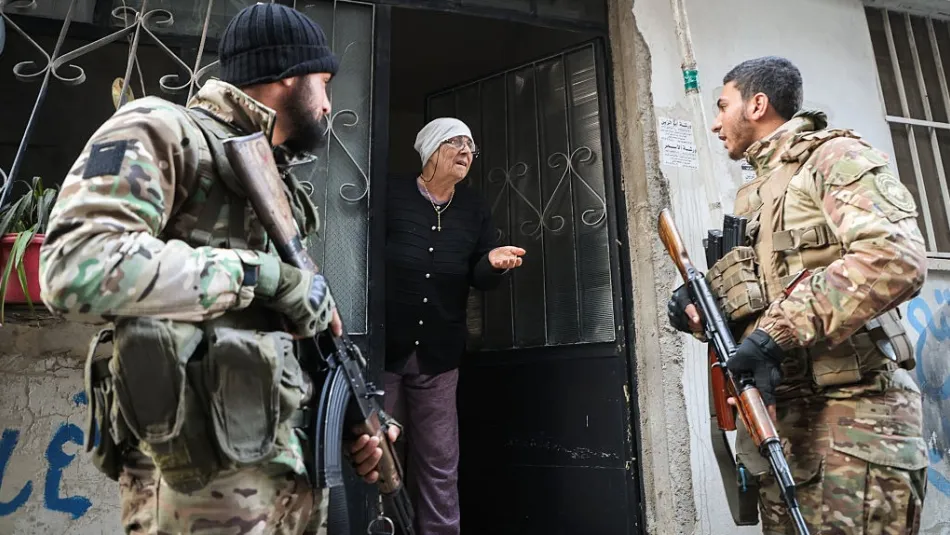
Yet they are eclipsed by a far heavier conclusion: grave violations continue in Homs, Hama, Lattakia, and Tartus. This continuity stems largely from the failure to properly vet and integrate former opposition fighters into the new security services. The report documents extrajudicial killings, torture, enforced disappearances, deaths in custody, and widespread predation on property and land rights. Many of these abuses have targeted communities perceived as loyal to the former regime or belonging to specific minority groups.
Most damningly, the Commission links the waves of violence in March and July 2025—which claimed more than 2,900 lives among Alawite, Druze, and Bedouin communities—to clear sectarian and ethnic animus. The documented patterns of summary executions, pillaging, and forced displacement may rise to the level of war crimes or crimes against humanity.
A Landscape of Hybrid Insecurity
Structurally, the Commission offers three critical insights into the nature of the current Syrian state:
- A Hybrid Security Apparatus:
Instead of building professional institutions grounded in human rights, the state absorbed entire armed factions into the army and police without individual vetting. The result is a patchwork security structure defined by fractured loyalties and beholden to local influence and the “weapons economy” rather than to any coherent chain of accountability. - No Monopoly on Force:
Sovereignty remains elusive. Tribal groups and nominally integrated factions retain their autonomy and arsenals. Combined with the unconsented military movements of external powers—Israel, Turkey, and Coalition forces—the notion of state control becomes aspirational. This disorder sustains an economy of violence rooted in smuggling and territorial racketeering. - A Fragile Justice System:
Despite modest salary increases for judges and the dissolution of certain specialized courts, the judiciary remains too weak to prevent recidivism. Accountability is often selective or limited to lower-level actors, while those in command positions remain shielded.
The Silence of the Commission
Some of the report’s most consequential elements lie in what it omits. The Commission avoids the central sovereign question: Who truly governs Syria today? Is authority held by the transitional government, by commanders of integrated factions, or by a web of internal and external actors who bypass both? Without confronting this, judicial reform remains theoretical.
The report also skirts the political economy of violence. While it references pillaging and “protection taxes,” it does not examine how instability has become profitable for certain influential networks, creating a system in which conflict itself becomes a renewable resource for wealth and power.
Finally, although it notes delays in legislative formation and the absence of women in political structures, it avoids the deeper structural debate: What kind of social contract is being drafted? What are the limits of decentralization? These are not peripheral questions—they are the core of the transition.
Conclusion: From Documentation to Discourse
The Commission has formalized a truth long familiar to Syrians: violence did not end with the fall of Assad, and the new state has not yet become a state of law. While the report offers a rigorous diagnosis of hybrid security and fragile justice, its silences must now move to the center of national debate.
The responsibility of Syrian intellectuals, jurists, and activists is not merely to receive UN documentation, but to transform it into a sustained political and ethical discourse about citizenship and sovereignty in the post-Assad era. Only by confronting the questions the UN avoided can Syria begin its true journey toward the map of hope.
This article was translated and edited by The Syrian Observer. The Syrian Observer has not verified the content of this story. Responsibility for the information and views set out in this article lies entirely with the author.