
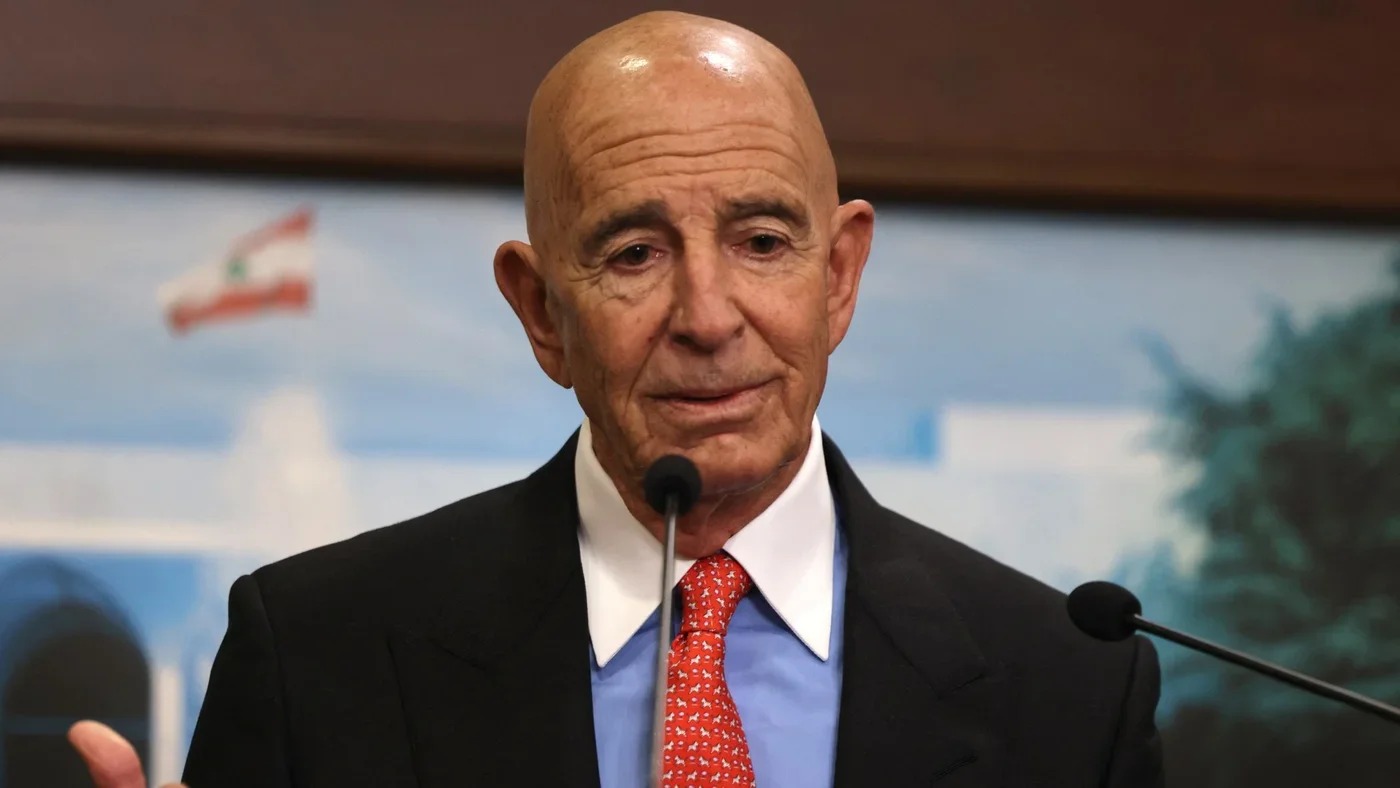
In a decisive attempt to extinguish a rapidly escalating diplomatic controversy, United States Special Envoy to Syria Tom Barrack has unequivocally rejected allegations that Washington is encouraging a Syrian military intervention in Lebanon. The claims—suggesting that the United States had urged Damascus to deploy forces into eastern Lebanon to support the disarmament of Hezbollah—were dismissed by Barrack on Wednesday as “demonstrably false and inaccurate,” a direct effort to dismantle a narrative capable of destabilizing an already fragile regional balance.
The uproar was triggered by a Reuters report citing five informed sources who claimed that Washington had invited Damascus to consider a kinetic role in Lebanon. According to those accounts, the proposal was framed as part of a broader U.S.–Israeli strategy to weaken Iran’s regional influence by dismantling Hezbollah’s military infrastructure. The report coincided with a landmark announcement from Beirut, where the Lebanese government declared a sweeping ban on all security and military activities linked to Hezbollah—an unmistakable signal of its intent to reclaim state sovereignty.
Yet despite the alleged American overtures, Damascus appears to be approaching the situation with marked caution. Sources within the transitional government describe a leadership unwilling to be drawn into a neighboring conflict, prioritizing internal stabilization over regional entanglement. In coordination with its Arab partners, Syria has reportedly adopted a posture of defensive restraint, concluding that national interests are best served by remaining outside the active theater of confrontation.
A senior Syrian official underscored the risks of any direct confrontation with Hezbollah, warning that such an operation would almost certainly provoke retaliatory missile strikes from Tehran and could reignite sectarian tensions within Syria itself. The transitional government, still consolidating its authority, is acutely aware that a miscalculation could unravel its fragile domestic gains.
While Damascus has expressed rhetorical support for Lebanon’s efforts to reassert state authority and curb the influence of non-state actors, the gulf between diplomatic endorsement and military action remains vast. Syrian officials recognize that Hezbollah’s deep entrenchment within Lebanon makes any forced disarmament a perilous undertaking—one that could easily escalate into a regional conflict for which the new Syrian leadership is neither prepared nor willing to assume responsibility.
For now, both Washington and Damascus are publicly emphasizing de-escalation, even as the underlying pressures for a broader realignment of regional power continue to intensify.
This article was translated and edited by The Syrian Observer. The Syrian Observer has not verified the content of this story. Responsibility for the information and views set out in this article lies entirely with the author.