
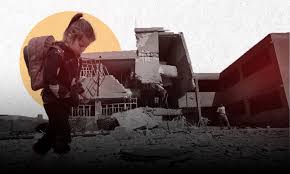
What is unfolding in Suweida strikes at the very foundation of society: education. In the absence of a coherent rescue plan and a secure environment for learning and transition, the question arises: is this merely a consequence of a security breakdown, or part of a broader strategy of collective punishment?
Omar al-Hadi, an architectural engineering student from Suweida enrolled at Damascus University, was on the verge of completing his studies and submitting his graduation project. However, the massacre in Suweida last July and the subsequent siege severed his connection to the university, leaving him stranded in his village, unable to reach the campus.
He recounts: “We are now stuck in frontline villages, while our classmates continue their academic lives. This takes me back to the summer of 2018, when our education came to a complete halt after an ISIS attack on the village of al-Shabaki near my home. What we’re experiencing now is no different—if anything, it is more widespread and more severe.”
Omar’s concerns go beyond violence and siege. The road to Damascus, as he describes it, has become perilous: “After the events in Jaramana and Sahnaaya, culminating in the Suweida massacre, travelling to Damascus has become a gamble. Roads are blocked, checkpoints inspect belongings, phones and conversations, and incidents of kidnapping and assault are recurring. Just days ago, four young men were abducted at a security checkpoint near the Conference Palace at the entrance to Damascus. Some classmates risk the journey with Red Crescent teams to complete their studies, but no one can guarantee their safety.”
Omar is one of many students whose return to universities and schools has been thwarted by the violence that swept through Suweida, culminating in an economic and administrative blockade of the governorate. The irony was only deepened by images from graduation celebrations in northern Syria, where students managed to complete their education. Notably, Syrian President Ahmad Sharaa appeared alongside his wife, Latifa al-Droubi, at the graduation ceremony for the “Victory and Liberation” class at the Faculty of Arts and Humanities at Idlib University.
“Suweida: Illiteracy-Free”
In 2008, Suweida was listed among the governorates “free of illiteracy.” Today, that image has reversed: schools are closed, exams have been halted or cancelled, and thousands of students are displaced or unable to access basic educational services—while any clear plan from the Ministry of Education regarding the academic year in the governorate has vanished.
Even educational slogans have become entangled in the ongoing tension. Activists circulated footage of security forces threatening residents after misreading an old banner that read “Suweida Without Illiteracy,” interpreting it instead as “Without Umayyads”—a sectarian slip that distorted an educational slogan into a politically charged accusation. For many, the incident symbolized a further deterioration in relations between the central authorities and the local community—even in the realm of basic rights such as education.
Student Testimonies: Interrupted Studies and Pursuits Beyond the Governorate
Noor al-Andari, a baccalaureate student from Suweida, described the sudden halt of his academic year: “After submitting only the first subject, the exams stopped abruptly. It felt as though our lives had been suspended—as if the dream we had pursued since childhood was snatched away in an instant. We felt deep injustice and regret, as though we were denied the joy afforded to students in other governorates.”
He added: “What saddens me most is that students elsewhere sat in their classrooms, safe and secure, while we sat under the threat of bullets and fire. We have been deprived of our natural right to fair and safe education. But abandoning our studies is not an option, because we believe knowledge is like dignity—we cannot live without it. What hurts the most is that years of effort and sleepless nights were taken from us in a moment filled with the whizz of bullets and the roar of explosions.”
The crisis is not confined to Suweida. Jawad Shalghin, a student at the Annual Compensations Institute in Latakia, said a dispute with a teacher over sectarian social media posts led to his expulsion and threats of enforced disappearance: “It wasn’t an isolated incident. The threats extended to other friends from Suweida, prompting them to abandon their studies and return home for fear of escalation.”
Other students reported that a fellow student from Suweida was arrested in his university dormitory in Latakia over a post about events in the governorate. He was reportedly subjected to torture and forced to sign 13 political charges before being released following intervention by an international organization.
Aghid Bou Faour, a pharmacy student at the private al-Sham University, said that a solidarity post with Suweida was labelled “sectarian” by the university administration, resulting in his expulsion.
These testimonies reveal a broader pattern of harassment that follows Suweida’s students even beyond their governorate, adding another layer of danger to the existing challenges of mobility and access.
Contradictory Directives and Closed Schools
Since 30 April, a series of fragmented and contradictory decisions has disrupted the academic process. Tenth and eleventh-grade students were unable to sit their exams, and baccalaureate students sat only one subject on 12 July, just before violence erupted.
A chemistry teacher, speaking anonymously, described what happened as “no coincidence, but a direct targeting of education and an attempt to spread illiteracy.” She highlighted the closure of Saraya School—one of the governorate’s most reputable institutions: “When a school with exceptional outcomes and distinguished staff is shut down, the message is clear: education is under attack.”
In the face of this vacuum, volunteer initiatives have emerged in displacement centres: young women offering basic literacy lessons to children, and free revision sessions for baccalaureate students. However, as the teacher notes, “These efforts cannot replace formal schooling. At best, they offer about 20% of what students need. Education requires structured classes, daily commitment, and continuous follow-up.”
Official assurances remain vague. Rumors persist that UNICEF will oversee the baccalaureate exams, but no clear plan has been announced. “Every week they tell us the exam is imminent… then they withdraw. Students are living in a fog of contradictory promises,” she said.
Success Lists Become Obituaries
The tragedy has extended beyond academic disruption. When the results of the intermediate certificate were released, Tala Hussam al-Shoufi—aged just 14—was named among the top achievers nationwide with a score of 3090 out of 3100. Yet, Tala had been killed in one of the July massacres. Similarly, Anas Amjad Shahib, who scored 2696, was announced as a top performer before being killed alongside family members on the al-Thaala road. Muayin Marwan al-Halabi was martyred with his family during displacement. In Suweida, certificates of excellence have become documents of mourning, marking the absence of their recipients rather than opening doors to the future.
The targeting has not been limited to closures and disruption. A report by Amnesty International, dated 2 September, documented extrajudicial executions carried out by government forces and allied groups against 46 Druze men and women on 15 and 16 July last year. The crimes took place in civilian spaces—public squares, homes, an official school, and the National Hospital.
One testimony collected by the organization described a man being executed inside a school after being questioned about his religious affiliation. Diana Semaan, Amnesty’s Syria researcher, stated: “When civilians are killed in schools and hospitals, these are extrajudicial executions that constitute crimes under international law.”
Runaway Security or Collective Punishment?
From Omar al-Hadi’s stalled graduation to the students stranded across the country, from shuttered schools and suspended curricula to the honor rolls that now read like obituaries, the situation in Suweida reveals more than a temporary disruption. The educational crisis appears systematic, striking at one of the most vital functions of society.
In the absence of a secure learning environment and a viable recovery plan, the question lingers: is this the consequence of uncontrolled insecurity, or a calculated act of collective punishment?
Regardless of the answer, the cost is plain to see: a generation deprived of opportunities—in education, employment, and public life. As political and military developments continue to unfold, the right to education—in safe classrooms, through accessible exams and open universities—remains the simplest measure of justice, and the first essential step toward recovery.
This article was translated and edited by The Syrian Observer. The Syrian Observer has not verified the content of this story. Responsibility for the information and views set out in this article lies entirely with the author.