
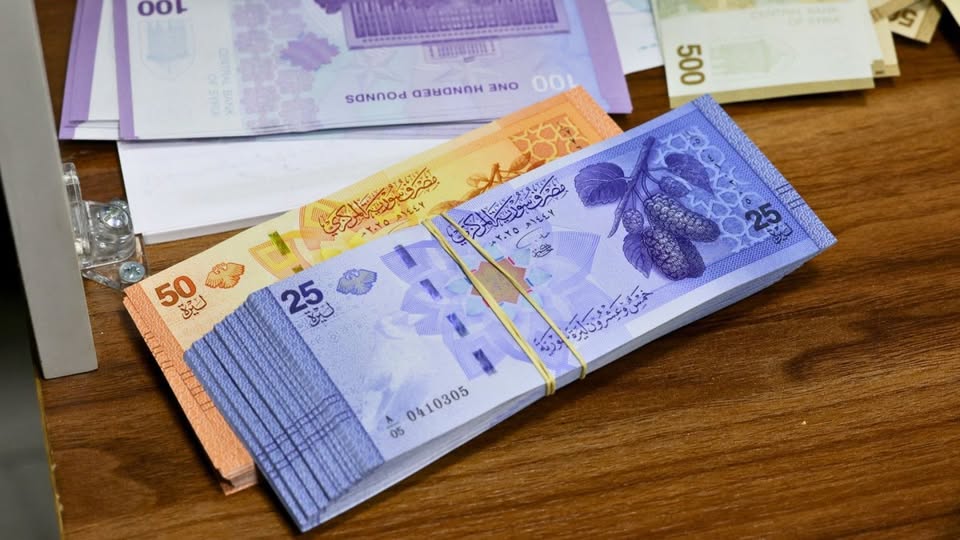
The Central Bank of Syria denied, on Thursday, the existence of counterfeit notes of the new Syrian currency, following rumors circulated on social media platforms.
The Governor of the Central Bank of Syria, Abdul Qader Hasriya, stated that no official report has been received by the Bank so far from any bank, financial institution, or individual regarding the detection of counterfeit cases involving the new currency.
He added, “It is customary for the Bank to be notified by a bank or financial institution of a counterfeiting case, which is then handled directly in cooperation with the relevant authorities at the Ministry of Interior,” according to the official Syrian News Agency (SANA).
Hasriya confirmed that all information circulating on social media platforms or in public discourse remains, so far, mere unsubstantiated rumors stemming from misunderstanding, fear, or confusion related to dealing with a newly issued currency.
He emphasized that verifying information is everyone’s responsibility, and urged the public not to be drawn into unreliable news, relying only on information issued by the Central Bank of Syria.
The Governor of the Central Bank also called for the necessity of reporting any cases of counterfeiting of the new Syrian currency so that they can be addressed immediately by the concerned institutions.
At the beginning of January, the Central Bank of Syria announced the start of circulation of the new currency by citizens after distributing it to the Bank’s branches in the provinces.
Mukhles Al-Nazer, First Deputy Governor of the Central Bank under Abdul Qader Hasriya, said in a post on platform “X”: “The process of replacing the Syrian pound effectively begins today after months of diligent preparatory work.”
He added, “Since early morning, representatives of private banks and exchange companies have been flocking to the Central Bank branches in the provinces to receive the new currency,” as reported by the Syrian “Al-Ikhbariya” channel.
In late December last year, the Governor of the Central Bank of Syria, Abdul Qader Hasriya, confirmed that 59 institutions with more than 1,500 branches had been designated to exchange the old currency for the new one.
During a press conference in Damascus regarding the executive instructions for the replacement process, Hasriya stated that “during the coexistence period of the old and new currencies, which is indefinite, shops will be obligated to accept either one or both together.”
He explained that the exchange standard involves removing two zeros, so that every 100 old Syrian pounds equals 1 new pound, but without changing its purchasing power, according to a report by “963+” correspondent.
He indicated that exchange operations will be conducted only within Syria, with no exchanges taking place abroad, noting that official bulletins for the exchange rates of both currencies will be issued to prevent discrimination and speculation.
He mentioned that the volume of the printed money supply aims to replace about 42 trillion Syrian pounds within the specified period, clarifying that communication was made with English and German companies and an agreement was reached on the printing process, though without disclosing the country where it took place.
This article was translated and edited by The Syrian Observer. The Syrian Observer has not verified the content of this story. Responsibility for the information and views set out in this article lies entirely with the author.