
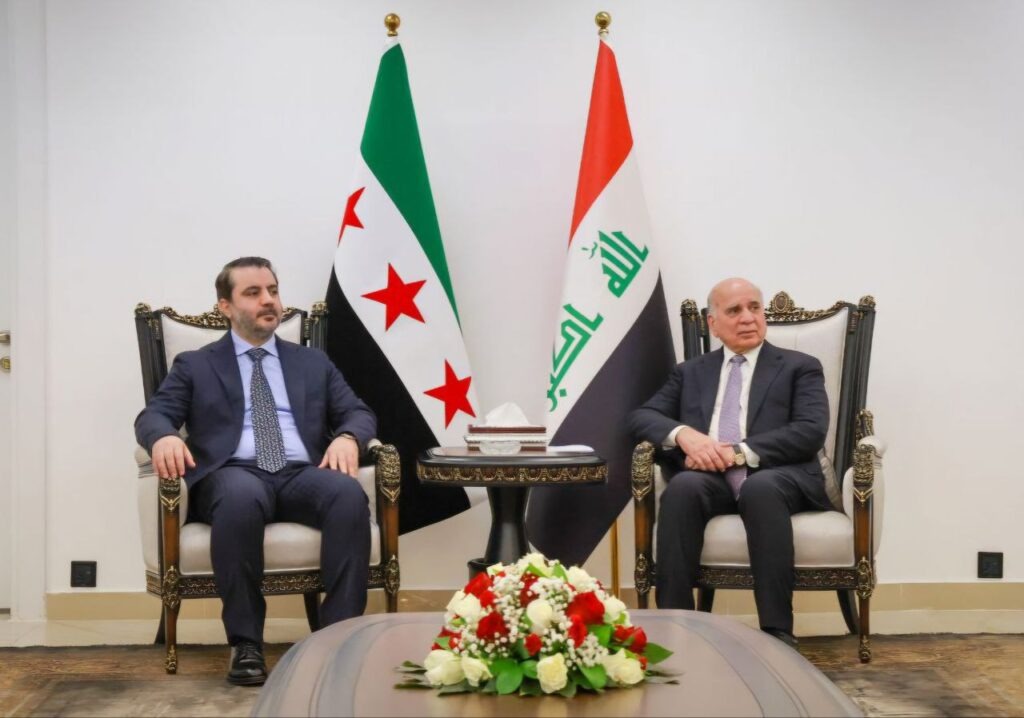
Syria and Iraq appear to be entering a new phase in their relationship, shaped by overlapping security priorities, economic pressures, and shifting political dynamics in both capitals. With a shared border stretching more than 600 kilometers, the stability of each country remains closely tied to the other. Geography has long forced interdependence; recent developments suggest a growing political willingness to turn that reality into structured cooperation.
Security First: Borders, ISIS, and Mutual Stability
Security coordination has become the most immediate and tangible area of progress. In recent months, Damascus and Baghdad have stepped up efforts to secure their shared border, exchange intelligence, and confront the lingering threat posed by ISIS. One notable development has been their cooperation in transferring ISIS detainees from prisons in northeastern Syria to Iraqi custody—an indication of their shared interest in preventing the group’s resurgence.
Direct communication between Syrian President Ahmad al-Sharaa and Iraqi Prime Minister Mohammed Shia al-Sudani has reinforced this direction. Both leaders have emphasized the importance of safeguarding Syria’s territorial integrity, strengthening border security, and expanding institutional cooperation. These efforts reflect a recognition in both capitals that security coordination is the foundation on which broader political and economic ties can be built.
Economic Stakes and Political Calculations
Beyond security, economic considerations are taking on greater weight. Iraq’s oil revenues and agricultural capacity could support Syria’s slow recovery, while Syria offers Iraq geographic connectivity and a potential gateway for regional trade. Reopening border crossings, expanding commercial exchange, and cooperating in the energy sector have all been identified as areas with significant potential.
At the same time, Iraq’s internal political landscape may influence the trajectory of the relationship. The possible return of former Prime Minister Nouri al-Maliki introduces both uncertainty and opportunity. A polarizing figure associated with sectarian tensions and close ties to Iran, al-Maliki has nonetheless recently adopted a more conciliatory tone toward Syria’s new leadership. His shift suggests an awareness of Syria’s renewed regional relevance and the strategic value of maintaining functional ties.
Still, analysts warn that rhetoric alone will not shape the future. The durability of any rapprochement will depend on concrete steps: mutual political recognition, sustained dialogue, economic integration, and a willingness to shield bilateral relations from broader regional rivalries.
For Syria, strengthening ties with Iraq fits into a wider strategy of regional outreach aimed at consolidating stability and accelerating recovery after years of conflict. For Iraq, closer relations with Damascus offer economic benefits and reinforce its role as a bridge between competing regional spheres.
Ultimately, shared geography, intertwined security interests, and economic necessity give both countries strong incentives to move forward. While political uncertainties remain, the current momentum suggests that Damascus and Baghdad may be laying the groundwork for a more stable and mutually beneficial partnership—one shaped less by the burdens of the past and more by the demands of an increasingly interconnected future.
This article was translated and edited by The Syrian Observer. The Syrian Observer has not verified the content of this story. Responsibility for the information and views set out in this article lies entirely with the author.
