
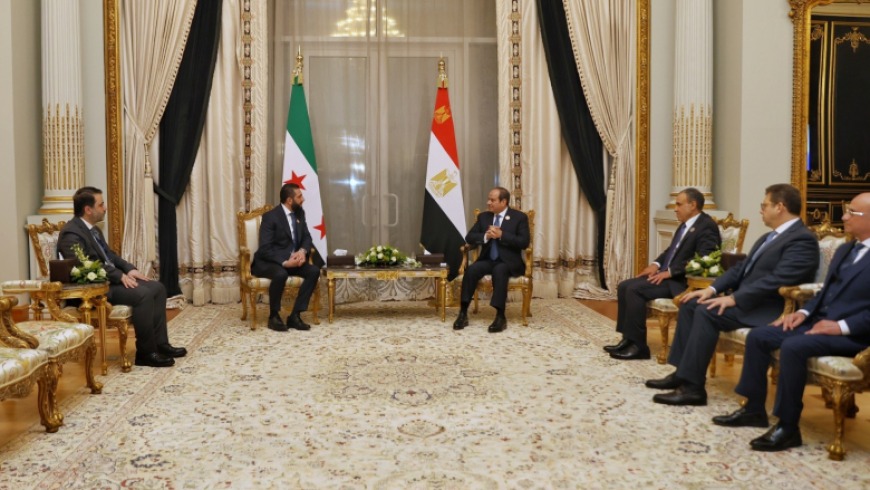
Egyptian-Syrian relations are undergoing a measured recalibration in early 2026, shifting from years of cautious disengagement toward a more deliberate political and economic repositioning. After Cairo imposed entry restrictions on Syrians in early 2025—reflecting security concerns and domestic and regional pressures—Egypt now appears increasingly inclined to reopen channels of cooperation through a pragmatic reading of the region’s evolving dynamics.
Economy as the Gateway to Renewed Presence
The recent visit of an Egyptian economic delegation to Damascus in January signaled a practical shift. Discussions focused on restarting idle factories, contributing to infrastructure rehabilitation, and expanding trade in energy, construction materials, and logistics services.
This approach fits within a broader Egyptian vision that sees Syria’s economic reintegration as essential to stabilising the Arab Mashreq while creating external investment opportunities for Egyptian companies facing domestic economic constraints.
For nearly two years, Cairo approached the Syrian file with a careful balance between national security priorities and regional equilibrium. But recent diplomatic and economic developments—especially the renewed engagement of regional powers in Syria—have encouraged Egypt to adopt a less hesitant posture. Participation in restarting production lines or reconstruction projects is viewed not only as economic activity but also as a form of soft political presence, granting Cairo influence during Syria’s state-rebuilding phase.
Egyptian officials increasingly frame economic cooperation as a tool of regional stability, arguing that investment in Syria is an investment in reducing cross-border disorder, from irregular migration to parallel-economy networks. This reflects an Egyptian approach that places economic development at the heart of collective security.
Cairo Delegation Lays the Groundwork
In mid-January, Damascus hosted an Egyptian delegation representing industrial unions, chambers of commerce, and business leaders—a visit described as foundational for reactivating long-dormant cooperation channels. Meetings focused on restarting struggling factories, securing raw materials, and rehabilitating production networks in cement, food industries, and pharmaceuticals, sectors where Egyptian companies hold significant export experience.
The delegation also conducted field visits to partially halted industrial facilities, underscoring that the initiative goes beyond political symbolism toward assessing real investment feasibility. Both sides spoke of “shared economic opportunity,” with discussions about gradually increasing trade over the next two years if logistical and banking obstacles can be resolved.
Days later, Damascus hosted the first Syrian-Egyptian economic forum in years, bringing together business figures and representatives from transportation, energy, and infrastructure sectors. The forum explored mechanisms to facilitate Egyptian entry into the Syrian market, including local partnerships and technology-transfer arrangements.
Gradual Engagement
Egyptian foreign policy analyst Mohamed Kamal told Syria TV that reactivating the Egyptian-Syrian track reflects a calculated move in a region where the rules are shifting.
“Egypt is not seeking a showy role in Damascus,” Kamal said. “It aims to mitigate potential burdens related to migration, the parallel economy, and smuggling networks—issues that transcend borders and directly affect Egypt’s internal stability.”
Kamal argues that the delegation’s visit reflects recognition that the vacuum in Syria will not remain empty. “Participation in restarting factories or rehabilitating infrastructure grants Cairo a practical presence in reshaping the Syrian economy. This presence is not politically costly if framed as technical cooperation, but it builds points of contact that later allow influence in more sensitive files.”
He notes that Egypt is watching closely the evolving relationship between Damascus and its regional partners, wary of being left outside a rapidly forming equation. Cairo therefore moves in short, cautious steps, avoiding heavy political commitments. In Kamal’s view, Egypt recognises that broad engagement before Syria’s internal stability becomes clearer could leave it exposed, preferring to test the ground economically before moving toward deeper arrangements.
Regional Calculations Between Washington and Ankara
Despite this renewed openness, Egyptian-Syrian relations remain shaped by a regional rhythm still in formation. While Western sanctions no longer define the ceiling of engagement, the network of international and regional understandings around Syria continues to evolve, prompting Cairo to operate within carefully calculated margins.
Egypt recognises that rapprochement with Damascus unfolds in a landscape where Arab and regional interests intersect—from energy to reconstruction to security arrangements. The recent trajectory of Egyptian-Turkish rapprochement also imposes a pattern of tacit coordination on files of shared sensitivity. Cairo does not view Damascus as an arena for competition but as part of broader balances being recalibrated across multiple channels. It therefore advances gradually, seeking to secure a durable presence without generating unnecessary friction, and prioritising sustainable practical interests over premature political commitments.
Within this framework, Egypt’s engagement in Syria can be read as part of a wider strategy for managing Eastern Mediterranean dynamics, where energy, maritime security, and reconstruction intersect. Cairo aims to consolidate its position as a regional mediator capable of communicating with diverse actors, leveraging its extensive network of relationships.
This article was translated and edited by The Syrian Observer. The Syrian Observer has not verified the content of this story. Responsibility for the information and views set out in this article lies entirely with the author.
