
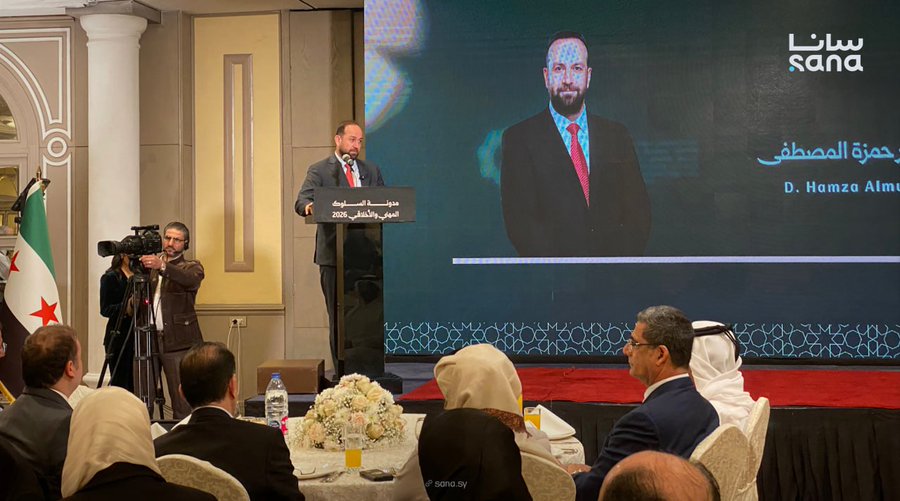
Syria’s Ministry of Information on Saturday unveiled the Professional and Ethical Code of Conduct for the media sector, introducing what officials described as a comprehensive framework for regulating journalism and content creation under the slogan “Professional Media… Responsible Word.”
The launch event, held at the Dama Rose Hotel in Damascus, drew senior officials and media professionals, marking what organisers framed as a foundational step in shaping the future of Syrian journalism.
A Framework for Self-Regulation
Speaking at the ceremony, Ali Eid, representative of the National Independent Committee for the Professional and Ethical Code of Conduct for Journalists and Content Creators, stressed that the document is intended as more than a symbolic declaration.
“The code embodies a clear commitment and the beginning of a serious attempt to protect freedom,” Eid said, calling for “free, accurate, and fair media that respects humanity and restores society’s trust.”
He underscored that the code is designed as a self-regulatory tool rather than a substitute for legislation. “Self-regulation represents the highest form of freedom protection,” he noted. “Freedom without standards descends into chaos. True independence in media work requires responsibility and professionalism.”
Eid also pointed to the mounting challenges of the digital age, arguing that artificial intelligence and the speed of information circulation have amplified both the influence and the risks of the written and spoken word.
A National Vision for Media Development
Omar Al-Haj Ahmed, Director of Press Affairs at the Ministry of Information, described the initiative as the beginning of “a new phase toward national media grounded in responsible freedom, elevated language, and self-regulation as the governing standard for freedom of expression.”
He framed the code as part of a broader state vision to build “professional media capable of navigating the transitional period with confidence and responsibility.”
Minister of Information Hamza Al-Mustafa announced that the code is one of the region’s most extensive media initiatives, the product of contributions from more than one thousand journalists over fifteen months.
“This is a starting point, not a passing document,” Al-Mustafa said, confirming that the code applies to all Syrian journalists. He also revealed plans for an annual conference where journalists will review and update the code in response to rapid changes in the media landscape.
The Minister emphasised that “constructive and responsible journalism during the transitional phase is essential for media success,” citing global literature on post-conflict media development.
Growing International Interest
Al-Mustafa added that dozens of press institutions are preparing to open offices in Syria, reflecting what he described as rising interest in the country’s media market following the end of the previous era.
“This signals a media environment moving toward controlled openness within a comprehensive national framework,” he said.
He warned that media activity without clear standards “will inevitably descend into chaos,” arguing that ethical and professional reference points have become a necessity amid accelerating technological change.
The ceremony concluded with the heads of official media institutions signing the Professional and Ethical Code of Conduct. Al-Mustafa described the act as “a clear expression of national media’s commitment to the code and a practical translation of its principles at the institutional level.”
Controversy and Criticism
The launch has also sparked criticism. Journalists and social media users voiced objections, arguing that professional codes of conduct should be drafted by independent syndicates rather than government bodies.
Satirist Muhammad Al-Salloum, who received an invitation to the event despite their critical stance, wrote on Facebook:
“Every code of conduct issued by the authorities is rejected. Professional codes are the work of syndicates, not the work of the authorities — a real syndicate, not the Ba’ath Party syndicate that pleases you and that you follow.”
The post continued:
“Your code is rejected even if you claim a million journalists participated in sessions that lasted a million years. This is not your role, and it reflects a poor understanding of journalistic work and media freedom.”
The criticism underscores ongoing tensions surrounding media regulation and freedom of expression in Syria’s evolving political landscape.
The code takes effect in 2026, though the Ministry of Information has yet to announce implementation mechanisms or oversight procedures.
This article was translated and edited by The Syrian Observer. The Syrian Observer has not verified the content of this story. Responsibility for the information and views set out in this article lies entirely with the author.