
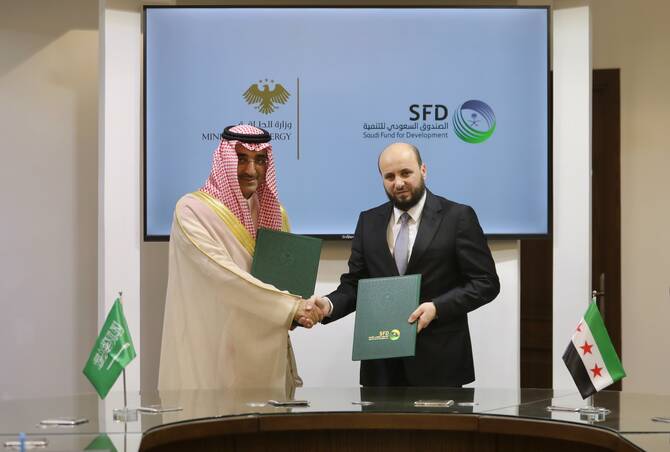
Syria’s long-struggling economy received a major jolt on Friday as Saudi Arabia and Syria unveiled a sweeping package of strategic investment agreements worth billions of dollars. The announcement came as Syrian oil officials held parallel talks with major American energy companies, signaling a potential broad reopening of the Syrian market to international capital after more than a decade of isolation.
Saudi Arabia Launches a High-Stakes Investment Drive
Saudi Investment Minister Khalid bin Abdulaziz Al-Falih, speaking in Damascus, announced the launch of a “new investment cooperation track” with Syria—describing it as a “qualitative leap” in bilateral relations. At the heart of the initiative is the activation of the Elaf Investment Fund, designed to finance large-scale, long-term projects across key sectors.
“These agreements represent the foundation of a long-term economic partnership aimed at supporting economic recovery and enhancing quality investments in Syria,” Al-Falih said.
The agreements span several critical infrastructure domains:
- Aviation:
A Saudi consortium led by the Bin Dawood Investment Group will build a new Aleppo International Airport and upgrade the existing facility, with total Saudi investment reaching 7.5 billion riyals ($2 billion). The new airport is expected to handle 12 million passengers annually. A separate agreement establishes a new Saudi-Syrian airline, Nas Syria, headquartered in Damascus. - Digital Infrastructure:
Saudi telecom giant stc secured a competitive tender for the “Silk Link” project—one of Syria’s largest digital infrastructure undertakings. It includes laying fiber-optic cables and constructing data centers to position Syria as a regional data-transit hub. - Water Security:
In what Al-Falih described as “the largest water agreement in the world” between the two countries, ACWA Power will conduct feasibility studies for a massive seawater desalination plant with a capacity of 1.2 million cubic meters per day, along with a major water-pipeline project. - Industry & Training:
Additional agreements include the management and development of the Modern Syrian Cable Company and the creation of a national vocational-training platform in partnership with Saudi firm Semanoor.
Syrian officials hailed the deals as transformative. Aleppo Governor Azzam Gharib said the airport project would make Aleppo a “vital regional economic center,” while Communications Minister Abdulsalam Haykal said the telecom initiative would leverage Syria’s geography to create an “international corridor for data.”
Parallel Engagement with U.S. Oil Giants
In a separate but strategically significant development, the Syrian Petroleum Company (SPC) held talks with representatives of American firms Hunt Oil and Baker Hughes to explore cooperation in rehabilitating oil wells and developing fields in eastern Syria, particularly east of the Euphrates.
According to SPC, discussions focused on “rehabilitating oil wells and investing in fields… to raise production rates,” as well as transferring expertise and modern technology. The talks follow an MoU signed earlier in the week with Chevron and Power International Holding for offshore oil and gas exploration in Syrian territorial waters.
SPC CEO Youssef Qablawi emphasized the importance of these engagements, noting that many fields had suffered “sabotage” before being retaken by government forces.
A Complex Economic Reopening
The convergence of Saudi investment and American energy-sector interest suggests a deliberate Syrian strategy to reinsert itself into regional and global economic networks. The Saudi commitments represent one of the largest external investment packages Syria has received since the conflict began.
Yet the economic push unfolds amid domestic tensions. Earlier on Saturday, the Syrian Journalists’ Association rejected a government-proposed “Professional Code of Conduct,” calling it an attempt to “reproduce custodianship and censorship.” The dispute highlights the persistent friction between state authority and civil society, even as the government courts international partners.
The scale of the new agreements points to a significant geopolitical and economic realignment. Their success, however, will depend on stability, security, and the resolution of outstanding sanctions and political disputes—factors that continue to shape Syria’s uncertain path to recovery.
This article was translated and edited by The Syrian Observer. The Syrian Observer has not verified the content of this story. Responsibility for the information and views set out in this article lies entirely with the author.