
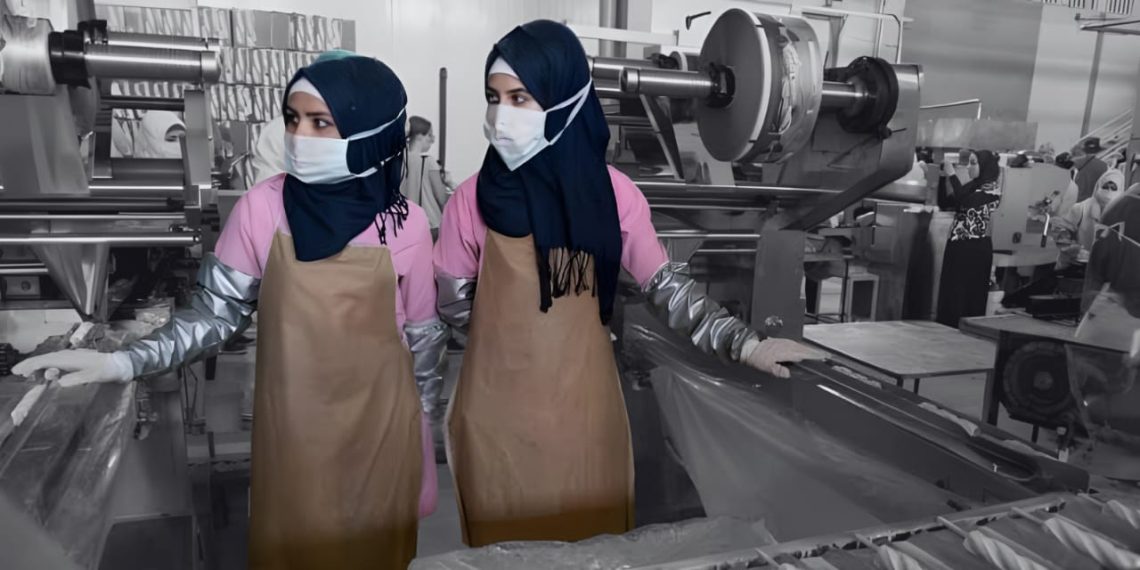
In today’s Syria, the sight of women at work is no longer an emblem of gradual social change. It is a daily calculation of survival.
After years of war, displacement, and economic collapse, Syrian women have moved from the margins of the labor market to its center. Millions of young men have left the country, joined armed formations, disappeared, or lost their livelihoods. In countless households, women have become the primary – and often the only – breadwinners. Yet this expanding economic role has not translated into legal protection, reliable income, or real influence over economic decision-making.
This raises a question that is rarely asked with sufficient bluntness: has the Syrian woman become a genuine economic actor, or merely a social safety valve in a broken economy?
A labor market reshaped by war – with women at its core
Before 2011, women’s participation in Syria’s workforce was limited but comparatively stable. Employment was concentrated in education, healthcare, and the public sector, offering predictable wages and a minimum level of legal safeguards. It was not a model of equality, but it provided structure.
War dismantled that structure. As jobs vanished and family incomes collapsed, women entered the labor market in unprecedented numbers, not through deliberate empowerment policies but through economic compulsion. According to the economist Maryam al-Qadri, this shift was not the outcome of strategic planning or institutional reform. It was the brutal consequence of a deteriorating reality in which survival required women’s labor.
Women did not enter a growing economy. They entered a shattered one: an informal labor market defined by low wages, weak bargaining power, and little to no protection. In this environment, their work has functioned as an “economic sponge”, absorbing the shocks of inflation that has reportedly exceeded 100 per cent annually.
The paradox is striking. Women’s contribution is expanding, yet it remains largely invisible in official indicators and largely absent from formal contracts.
The numbers reveal an economy that relies on women – without recognizing them
Despite the scale of women’s labor, formal participation remains low. UN reporting cited in the article suggests that around one in three Syrian households is now supported by a woman, while women’s participation in the formal labour market does not exceed 13–15 per cent. More than 70 per cent of working women reportedly labor without contracts, and the wage gap between men and women is estimated at roughly 30 per cent.
Economically, this points to a harsh reality: women are working more, earning less, and shouldering risks that the state and the formal economy have outsourced to the most vulnerable.
Syria’s economy has increasingly become an economy of informality – and this is precisely where women have been absorbed at the highest rates. In working-class neighborhoods, rural areas, and displacement camps, women work in home kitchens, small workshops, seasonal agriculture, retail stalls, domestic services, and micro-businesses. These activities can provide fast income, but they are unstable, uninsured, legally exposed, and often open to exploitation.
In that sense, the story is not one of empowerment alone. It is a story of fragility.
Breadwinners, yet still treated as temporary workers
The sociologist Siham Marwan offers a sobering interpretation: many communities still view women’s work as a temporary response to crisis rather than a long-term professional path. The economy increasingly depends on unregulated labour, low wages, and absent social protection – an environment that women enter in disproportionate numbers, not because they are empowered, but because they are more likely to accept harsher conditions in order to keep their families afloat.
Under the banner of “women’s economic empowerment”, dozens of small initiatives are funded, but on the ground the reality is stark: no contracts, no minimum wage guarantees, no social security, no meaningful protection against arbitrary dismissal or abuse. The development discourse itself can become a cover for normalising precarious work instead of confronting it.
Marwan warns that the absence of serious policy does not merely harm women; it reproduces poverty across generations. When women work without stability or protection, they may not exit poverty – they manage it. The result can be early child labour, interrupted education, and a cycle of deprivation that becomes structural rather than temporary.
And beyond paid labour lies another invisible pillar: women’s unpaid work – childcare, elder care, caring for the sick, and household management. This labour is excluded from GDP calculations, yet without it, social life would not hold.
Stories of necessity: work as endurance, not ambition
The lived reality behind the statistics is captured in the testimonies of women interviewed in the report.
Fadwa, 42, from Rural Damascus, became her family’s sole provider after her husband was injured. She started a small home-based jam-making business. Her words are direct: she is not seeking empowerment, only her children’s daily bread.
Samira al-Jum‘a, 36, from Homs, works ten hours a day in sewing and selling products in local markets after her husband disappeared during the war. The income is insufficient, she says, but there is no alternative.
Others have found narrow openings through technology. Haifa, 28, runs an online shop through Facebook Marketplace after learning digital marketing in a training course. The internet created a new entry point, but the work remains precarious without regulations or support for small enterprises.
These stories illustrate a common thread: women’s labor is sustaining households, but the economic system offers them little security in return.
A new household balance of power – and a crushing double burden
Hiba Masalama, a women’s rights advocate, argues that this “forced” economic role has created a reality that cannot simply be reversed. Even if necessity was the driver, financial autonomy has altered household dynamics and shifted the internal balance of power, giving many women a stronger voice than they previously had.
Yet this comes at a cost. Syrian women now face what many describe as a “double burden”: they are the backbone of household income, and at the same time the managers of daily crisis – securing food, coping with power cuts, navigating water shortages, and improvising services in a collapsing infrastructure.
This produces severe psychological and physical burnout. The same culture that accepts women’s work as “help” during hardship may still resist their authority as economic leaders in times of stability.
If women’s labour continues to be treated as an emergency substitute for men’s absence, the country risks building an economy of exhaustion rather than recovery.
Reconstruction: a turning point, or a return to exclusion?
As discussions of reconstruction intensify, a decisive question emerges: will women be partners in the new economy, or marginal beneficiaries of it?
The economist Dr Hassan Murad points to a central contradiction. Women are deeply present in everyday economic activity, yet they remain largely absent from chambers of commerce, business unions, and decision-making institutions. The economy is still managed through a traditional mindset, while women bear the consequences of decisions they did not shape.
A reconstruction process that excludes women from contracts, financing, and planning will not produce a fairer economy. It will rebuild old inequalities with new materials.
Murad also warns against celebrating “women’s resilience” as a substitute for real policy. Praising endurance without structural reform turns suffering into virtue and hides governance failure behind moving individual stories. Syrian women are operating in an economy of necessity, not an economy of opportunity. They did not rescue the economy; they carried the weight of its collapse.
The task now is not to debate whether women are part of Syria’s economy. They already are. The question is how their participation will be governed: will it remain in the shadows, without protection and without horizons, or will it become a genuine driver of recovery?
The answer does not depend on women alone. It depends on political and economic will – and on whether the state and its partners treat women’s economic inclusion as a national investment, not a marginal social concern.
This article was translated and edited by The Syrian Observer. The Syrian Observer has not verified the content of this story. Responsibility for the information and views set out in this article lies entirely with the author.
