
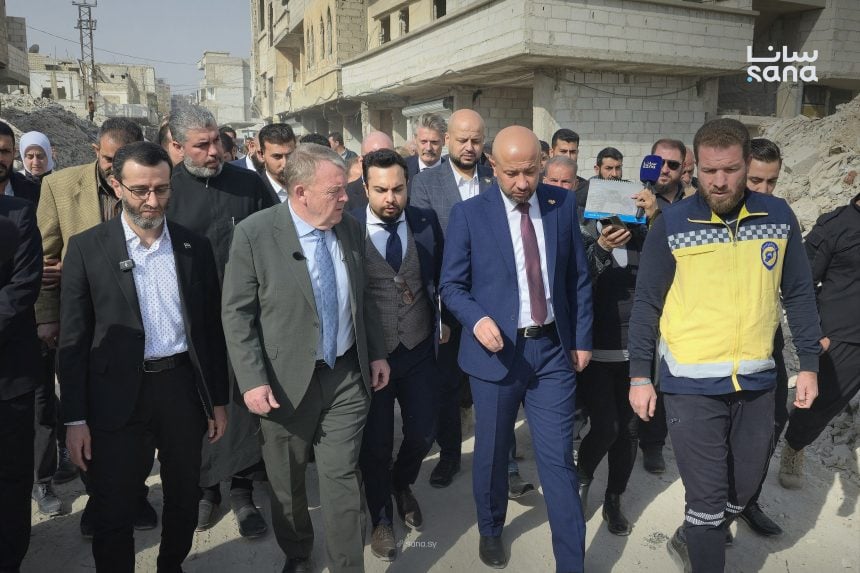
In a move weighted with the promise of a new chapter, Danish Foreign Minister Lars Løkke Rasmussen arrived in Damascus today—the first Western foreign minister to set foot in the Syrian capital since the fall of Bashar al-Assad. Beneath the winter sun glinting off the shattered façades of the Tishreen neighbourhood, Rasmussen stood beside Syria’s Minister for Emergencies and Disaster Management, Raed al-Saleh, surveying the skeletal remains of a district once devastated by the former regime’s barrel bombs.
At the ensuing press conference, the tone was one of cautious yet unmistakable optimism. Rasmussen declared Denmark’s readiness to transition from partnership to full-fledged support for the Syrian people. “We have already provided financial assistance,” he stated, “and we now stand prepared to increase it significantly.” He spoke of Danish firms eager to explore investment opportunities in a country striving to rise from the ashes, and expressed hope that sanctions would soon be lifted to create a more conducive environment for reconstruction and commerce.
The centrepiece of the visit, however, was the issue of refugees. Rasmussen noted that many of the 35,000 Syrians currently residing in Denmark are eager to return once conditions allow. A special committee, he revealed, has been established to examine individual cases ahead of detailed discussions with the transitional government. “Syria’s new leadership,” he emphasised, “has made clear its desire for the return of all its sons and daughters without exception.”
Syrian Foreign Minister Asaad al-Shaibani welcomed the Danish overtures, lauding Copenhagen’s longstanding support in the UN Security Council and its respect for Syria’s unity and sovereignty. The talks, he disclosed, also covered the swift exchange of ambassadors and the launch of a Syrian-Danish business council, with a particular invitation extended to Danish companies specialising in renewable energy.
Rasmussen concluded by announcing that he would depart tomorrow for Israel, where he will underscore the regional benefits of stable relations between Damascus and Tel Aviv—an outcome, he said, that “would be good for everyone.”
A Wider European Impulse
The Danish initiative forms part of a growing European trend. In Leipzig today, German Interior Minister Alexander Dobrindt told a regional conference of the Christian Democratic Union that Berlin is intensifying the deportation of convicted criminals among Syrian and Afghan asylum seekers. “Society expects that those who have served their sentences do not simply return to our streets,” he declared, pledging both chartered and scheduled flights to ensure “regular, consistent removals.” When asked about the morality of returning individuals to countries still marked by conflict, Dobrindt responded without hesitation: “I would feel remorse if I failed to do everything in my power to deport criminals who threaten our society.”
Though voluntary returns remain limited—Britain’s Telegraph reported earlier this month that, despite Danish incentives of up to €27,000 per adult and €6,700 per child, uptake remains low—today’s diplomatic choreography in Damascus suggests that Europe’s long period of caution toward Syria may be giving way to a more proactive stance: one involving reconstruction aid, investment, and, above all, the organised return of a diaspora whose homecoming is now framed in European capitals as both a humanitarian imperative and a political opportunity.
This article was translated and edited by The Syrian Observer. The Syrian Observer has not verified the content of this story. Responsibility for the information and views set out in this article lies entirely with the author.
