
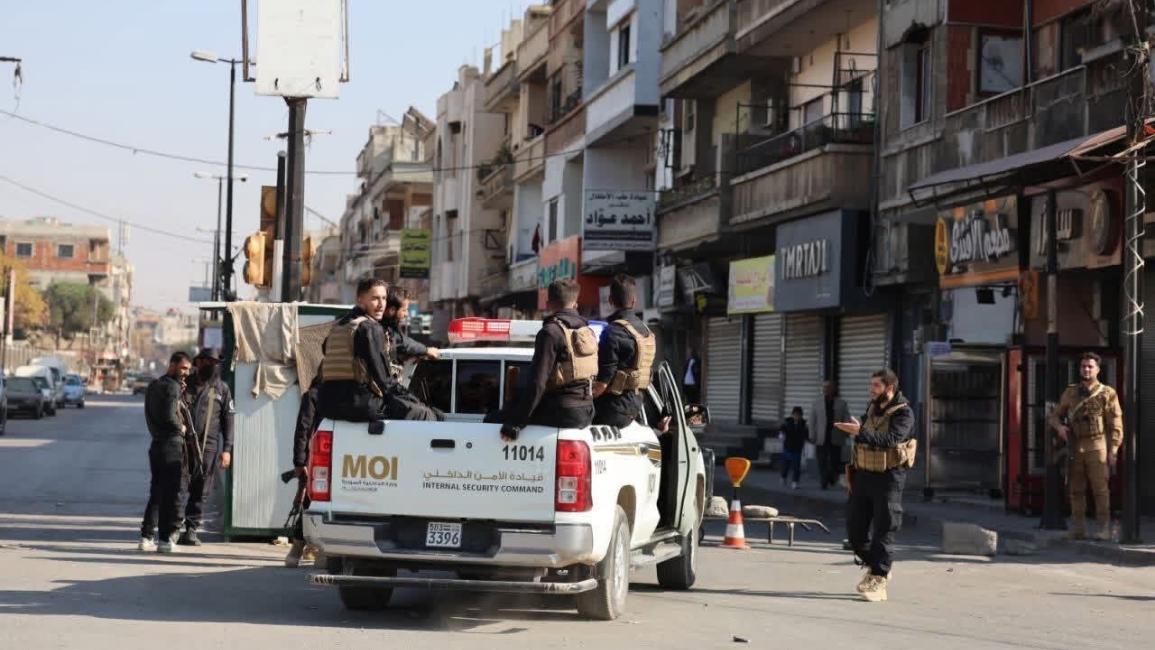
Authorities in Homs imposed a sweeping curfew on Sunday evening following a gruesome double murder in the village of Zaidal that triggered armed reprisals, sporadic gunfire, and acts of vandalism across several southern neighbourhoods. The city was plunged into one of its most serious security crises in months.
The curfew, effective from 5:00 PM Sunday to 5:00 AM Monday, was accompanied by the deployment of heavy military police and internal security contingents, particularly along the volatile 60th Street and in the districts of Al-Arman, Al-Bayyada, Al-Sabil, Al-Zahra, and Al-Abbasiyya.
A Crime Designed to Ignite Sectarian Fire
The incident began in Zaidal, south of Homs, where a man from the Bani Khalid tribe and his wife were murdered in their home late Saturday or early Sunday. Local sources report that the husband was stoned to death and the wife burned alive. Walls of the house were smeared with blood-written sectarian slogans and explicit threats of further atrocities — a clear attempt to provoke communal violence.
Enraged tribesmen from Bani Khalid moved toward southern neighbourhoods of Homs, firing indiscriminately and damaging shops and vehicles. Security forces intervened quickly, preventing a broader escalation, though intermittent gunfire continued to echo across parts of the city well into Sunday afternoon.
Security Chief: ‘A Calculated Attempt to Sow Fitna’
In a televised address, Colonel Murhaf al-Naasan, head of Homs Internal Security, confirmed that sectarian inscriptions were found at the crime scene. He described the killings as a “deliberate attempt to incite fitna (civil strife)” and destabilise the city.
An emergency meeting — chaired by the provincial governor and attended by senior army officers, tribal dignitaries, clergy, and community representatives — underscored the need for unified communal and official action to preserve civil peace. Schools were ordered closed on Monday as a precaution.
Bani Khalid Tribe Condemns Killings and Subsequent Chaos
The Bani Khalid tribe moved quickly to dissociate itself from the violence. In a video statement circulated widely on social media, tribal leaders condemned the “heinous crime” committed against Abdallah al-Abboud and his wife, demanded that the perpetrators be held accountable, and pledged cooperation with state authorities.
“We stand with the state and reject any attempt to drag our sons into fitna,” the statement read.
Echoes of an Earlier Killing: Two Alawite Cousins Stoned to Death
The murders in Zaidal came just days after another chilling incident. On Friday, 21 November, two young Alawite cousins — Wissam Dahir al-Ali (23) and Mohammed Saleh al-Ali (24) — were abducted while heading to work in Homs’ Al-Zahra district. Their bodies were later found in Al-Waer Hospital; both had been stoned to death in what sources described as a sectarian-motivated execution.
A Rising Tide of Extrajudicial Violence
According to monitoring groups, at least 1,157 civilians have been killed across Syria since the beginning of 2025 in extrajudicial and revenge attacks.
Homs province accounts for 379 deaths — the highest of any governorate — including 240 cases explicitly linked to sectarian motives.
The rapid succession of such atrocities has revived deep fears of a return to the communal bloodletting that ravaged Syria during the height of the civil war.
Despite repeated government pledges to enforce the rule of law and dismantle extremist cells, many residents complain that impunity and the widespread availability of light weapons continue to fuel cycles of vengeance.
A City Holding Its Breath
As darkness settled under curfew, Homs — a city that has endured too many nights of fire and sorrow — stood tense and silent. Residents waited anxiously, hoping the fragile threads of coexistence would hold, and that yet another spark would not plunge the city back into the abyss of sectarian violence.