
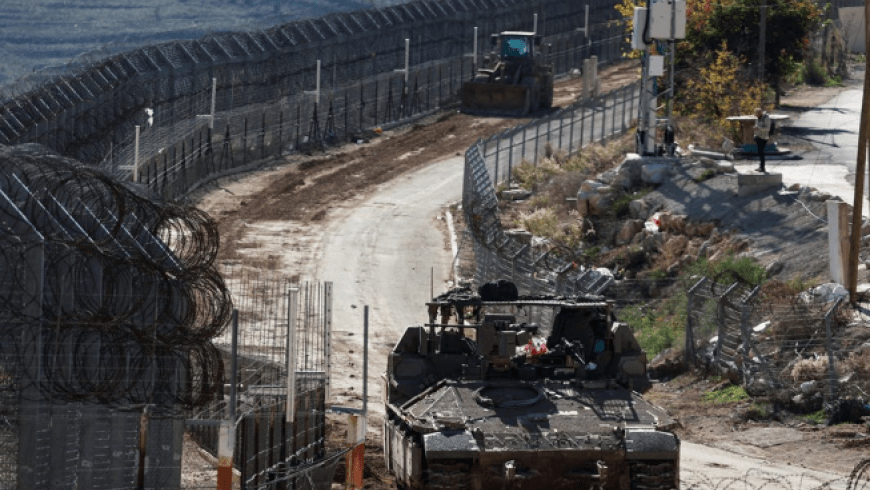
The swift denial issued last Friday by the Israeli Broadcasting Authority, distancing itself from the explosion in Damascus’s Mazzeh 86 district, was notable for its urgency. It reflected a clear Israeli desire to avoid any suggestion of military escalation, particularly at a time when relations with Washington are under close scrutiny. For more than a month, Israeli violations have been limited to the southern governorates of Daraa and Quneitra — a period that coincides precisely with Washington’s deepening engagement with President Ahmead al-Sharaa’s administration.
This operational restraint has been offset by a sharp escalation in rhetoric. Senior Israeli officials have sought to undermine the growing regional and international legitimacy Damascus has gained over the past two months. Knesset member Avigdor Lieberman, for instance, declared that the situation in Lebanon and Syria illustrates Hezbollah’s increasing power in the former and al-Qaeda’s in the latter, stating: “There is no Assad regime in Syria any longer; there is an al-Qaeda regime. There are no Iranians, only Turks.”
At the centre of Israel’s position are three non-negotiable demands, laid out by Prime Minister Benjamin Netanyahu as the minimum conditions for any confidence in Syria’s new leadership. These demands, by implication, diminish the significance of the trust already extended by the United States, most visibly symbolised by Sharaa’s visit to the White House.
Netanyahu’s conditions are well known: the complete elimination of jihadist elements from Syria’s armed forces; agreement on a demilitarised zone in south-western Syria adjacent to the occupied Golan Heights; and permanent guarantees for the Druze minority. Of these, the buffer zone remains the main obstacle in the stalled indirect negotiations. Israel insists that its withdrawal from territory seized following Assad’s fall is conditional upon the creation of such a zone.
Israel’s concept of this buffer zone is far-reaching. It would encompass all of southern Syria, including the governorates of Sweida, Daraa and Quneitra, extending as far as the southern outskirts of Damascus. This configuration would effectively sever the M5 international highway — a crucial north–south corridor linking Turkey to Jordan and positioning Syria as a transit hub between Europe, Turkey and the Gulf. This economic vision, championed by Ankara and particularly Riyadh, underpins wider regional connectivity plans.
President Sharaa has firmly rejected the proposal. In a recent interview with The Washington Post, he presented two arguments: first, that a demilitarised zone would create a vulnerable flank liable to infiltration by hostile actors, including those threatening Israel itself; and second, that such a measure constitutes an unacceptable encroachment on Syrian sovereignty — in effect, a land grab in disguise.
As a result, Israel now finds its strategic options increasingly constrained. Ongoing diplomatic support from Turkey and the Gulf, along with Damascus’s successful containment of internal unrest — notably the Sweida unrest in mid-July — has accelerated the momentum of a Turkish–Saudi-backed vision for a unified, economically connected Syria. This approach has clearly influenced the Trump administration, which now publicly supports Sharaa’s leadership. Syria’s accession to the U.S.-led Global Coalition against terrorism, and tangible security cooperation on the ground, have further diminished Israel’s freedom to act unilaterally.
What remains of Israel’s leverage is largely rhetorical: repeated insinuations regarding the Syrian leadership’s past ties to jihadist factions and professed concern for the Druze community. Yet these arguments carry less weight with each week of increasing stability and expanding international engagement.
To sustain and extend the current trajectory, Syria must remain consistent on three strategic fronts:
- Maintain active soft-power diplomacy, particularly through Turkey and Gulf partners — notably Saudi Arabia — to ensure continued U.S. investment in a sovereign, stable Syria.
- Prevent a recurrence of internal instability such as the Sweida incident, which could be used to challenge the government’s legitimacy.
- Deepen operational security collaboration with the United States and its allies, making any Israeli military action diplomatically costly.
The contest in Syria is no longer confined to bilateral tensions with Israel. It has evolved into a broader competition between two visions: one, a Turkish–Gulf project aligned with Syrian aspirations for reconstruction and regional integration; the other, an Israeli vision that relies on fragmentation and long-term instability. The decisive factor will be the Syrian government’s ability to manage internal dynamics through inclusive governance rather than coercion alone.
If Damascus stays the course — expanding its international recognition and preserving internal cohesion — Israel’s room for manoeuvre will continue to shrink. Even its most resolute efforts may ultimately fail to counterbalance the strategic alignment between Washington’s priorities and the growing regional influence of Syria’s new partners. Patience, discipline and responsive governance remain Syria’s most effective tools for translating short-term diplomatic gains into long-term strategic strength.
This article was translated and edited by The Syrian Observer. The Syrian Observer has not verified the content of this story. Responsibility for the information and views set out in this article lies entirely with the author.
