
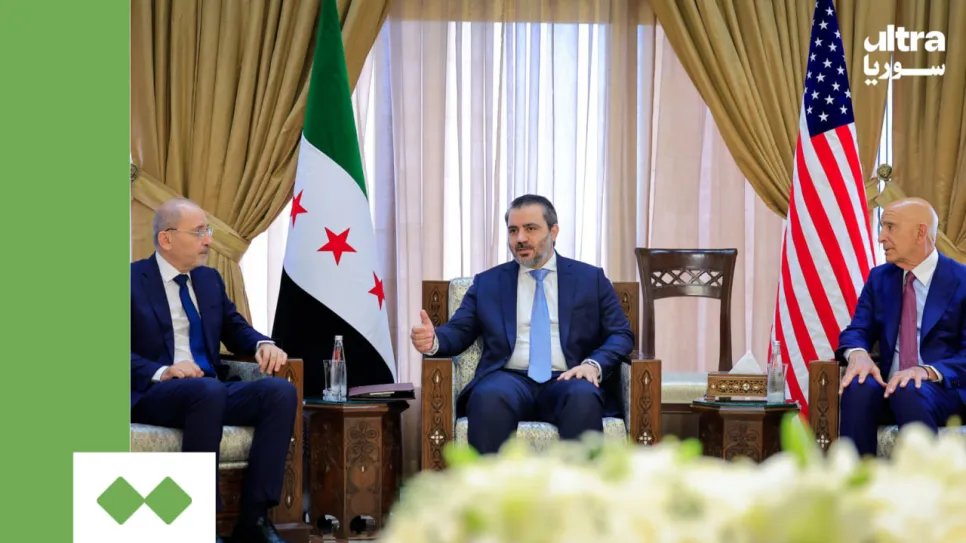
Syrian Foreign Minister Asaad al-Shibani has announced that the Syrian government has reached a tripartite agreement with Jordan and the United States on a comprehensive roadmap for Suweida province, aimed at establishing a unified vision for the region and facilitating the return of displaced persons.
The announcement was made during a joint press conference in Damascus, attended by Jordan’s Deputy Prime Minister and Foreign Minister, Ayman al-Safadi, and the US Special Envoy to Syria, Thomas Barrack. The three officials reviewed the practical steps agreed to restore stability to Suweida in the wake of recent unrest.
Shibani stated that the Syrian government has drawn up a detailed plan to ensure justice, protect rights, promote community reconciliation, and begin the process of national healing. He emphasised that the roadmap is underpinned by practical measures supported by Jordan and the United States. These include holding accountable those responsible for attacks on civilians and property, in full coordination with United Nations mechanisms for investigation and inquiry. Additional steps involve the unimpeded delivery of humanitarian and medical aid, compensation for affected individuals, reconstruction of damaged towns and villages, the facilitation of return for the displaced, and the restoration of essential services to enable a return to normality.
The minister added that the plan also provides for the deployment of local forces from the Ministry of Interior to secure transport routes and safeguard the movement of people and goods. It includes efforts to determine the fate of the missing, ensure the release of detainees and abductees from all sides, and launch a reconciliation process involving all components of Suweida’s diverse society.
Shibani concluded by affirming that Suweida belongs to all its people and that the government is fully committed to restoring stability and unity in the province.
For his part, al-Safadi reiterated that Syria’s unity, security, and stability are fundamental to the wider region’s security. “We want Syria to stabilise, recover, and rebuild after years of destruction and suffering endured by the Syrian people,” he said, “and to begin practical steps toward a brighter future for all Syrians.”
Al-Safadi described the recent events in Suweida as tragic and stressed the importance of overcoming them through accountability for human rights violations and the provision of humanitarian aid. He noted that the security of southern Syria is directly linked to Jordan’s own national security and condemned Israeli attacks on Syrian territory, calling for their cessation.
The Jordanian minister affirmed that the Syrian–Jordanian–American plan to address the situation in Suweida aligns with broader efforts to safeguard Syria’s unity and stability. He added that Israel remains the only actor seeking to fragment Syria and prevent its recovery. Rejecting the division of Syria, he said, is a shared Arab and international position, and a unified, stable Syria is essential to the region’s long-term security.
Meanwhile, Barrack reaffirmed the United States’ commitment to supporting the Syrian government’s efforts to restore peace and stability. He noted that Washington had worked in coordination with Damascus and Amman to develop the Suweida roadmap, and commended the Syrian government’s recent actions to promote civil peace. He stated that long-term stability in Syria must be achieved through trust-building, cooperation, and tolerance among all Syrians.
The press conference builds on earlier meetings held in the Jordanian capital, Amman, which focused on consolidating the ceasefire in Suweida and establishing a crisis response framework for southern Syria. The announcement follows deadly sectarian clashes in July 2025 that left more than 2,000 people dead, including civilians from Druze and other communities. The violence involved local factions, government forces, tribal fighters, and external actors.
A joint Syrian–Jordanian–American mechanism will be established to oversee implementation of the roadmap, alongside a United Nations-led investigation into the July violence. Officials hailed the agreement as a historic step towards stability and reconciliation in the region.
This article was translated and edited by The Syrian Observer. The Syrian Observer has not verified the content of this story. Responsibility for the information and views set out in this article lies entirely with the author.