
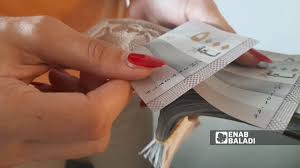
Syria is preparing to introduce a new series of banknotes in December, slashing two zeros from its battered pound in what the Central Bank describes as part of a “broader reform program” aimed at restoring public confidence, easing daily transactions, and stabilising the financial system.
Yet the announcement has sparked heated debate among economists and the wider public. Critics warn that the move may prove largely cosmetic unless accompanied by sweeping structural reforms to address inflation, liquidity shortages, and the broader collapse of production and trust in the country’s institutions.
A Symbolic but Risky Step
The Central Bank said on Saturday that it had reached “advanced stages” of a plan to replace the Syrian pound with a new note series, printed abroad to the “highest international technical standards.” Officials insist the move will not affect monetary balance or the real value of the currency but will instead simplify payments, reduce handling costs, and modernize cash circulation.
However, experts caution that history shows removing zeros is no silver bullet. “This is a technical and superficial remedy,” said Samir Aita, president of the Arab Economists Forum and former editor of Le Monde Diplomatique’s Arabic edition. “What matters is whether the underlying problems – inflation, deficits, lack of trust – are being addressed.”
Expert Criticism: Missing the Bigger Picture
In an interview with Enab Baladi, Aita raised a series of pointed questions: Was the decision motivated by a desire to erase the image of the ousted President Bashar al-Assad still printed on some banknotes? Was it simply a response to the inconvenience of citizens carrying wads of 5,000-pound bills, now worth only a few U.S. cents? Or is it intended to curb hyperinflation and restore liquidity?
For Aita, the answers lie elsewhere. He argued that Syria’s chronic liquidity crisis – despite recent shipments of printed notes from Russia – reveals deeper structural flaws. “Where do the street money changers get their cash? What is the real volume of currency in circulation, in vaults, and outside the banking system?” he asked.
He further noted that Syria’s trade balance remains negative, production has largely collapsed, sanctions remain in place, and more than 80 percent of the population lives in poverty according to UN figures. Without credible reforms in fiscal policy, wage structures, and foreign reserves, “removing zeros will change nothing,” Aita said. “Economic reform is the medicine; deleting zeros is just cosmetic packaging.”
Between Hope and Fear: Lessons from Abroad
Other economists acknowledge potential short-term benefits. Financial expert Fadi Deeb suggested that, if managed properly, redenomination could ease daily transactions and restore some psychological confidence. He pointed to Turkey’s successful 2005 reform, when six zeros were cut from the lira amid a broader stabilisation program that sharply reduced inflation.
But he also cautioned against repeating the failures of Zimbabwe, where successive currency revaluations in the mid-2000s collapsed under the weight of runaway inflation and lack of structural fixes, eventually forcing a switch to the U.S. dollar.
Deeb stressed that Syrians must be reassured their savings will not be eroded. He proposed a 6–12 month transition period during which citizens can exchange old notes for new ones through banks and mobile field offices, with deposits automatically converted by the Central Bank. “The key is to guarantee that one million old pounds becomes one thousand new pounds without any loss of value,” he said.
He emphasized the need for transparency, extensive public education campaigns, and a stable exchange-rate platform to prevent manipulation. Above all, he argued, success depends on restoring the Central Bank’s independence from political interference and rebuilding trust in Syria’s fragile financial system.
Experts: Reform Beyond Redenomination
Echoing these concerns, economist Ibrahim Qushji and Damascus University professor Yasser al-Mashaal both described the measure as largely symbolic. While it may ease accounting and reduce risks of error or money laundering, “without comprehensive reform – from production growth to deficit control – it remains a palliative gesture,” al-Mashaal warned.
They pointed to the need for updated salary tables, revised pricing mechanisms, and legal guarantees to protect purchasing power. More broadly, they argued that the real challenge lies in reviving production, stabilizing inflation, and restoring faith in banks battered by years of war and mismanagement.
A Fragile Gamble
The Central Bank has pledged to launch a nationwide awareness campaign before the December rollout, insisting that the redenomination is part of a carefully designed monetary strategy rather than a desperate measure.
But with inflation still in double digits, foreign reserves depleted, and the economy struggling under sanctions and weak exports, many fear that the move risks becoming another symbolic gesture in a country where trust in institutions has already collapsed.
As Aita concluded: “France in 1958 and Turkey in 2005 removed zeros after building reserves and stabilizing their economies. Syria is doing the reverse. Without real reform, this will not cure the disease – it will only change the patient’s clothes.”
This article was translated and edited by The Syrian Observer. The Syrian Observer has not verified the content of this story. Responsibility for the information and views set out in this article lies entirely with the author.
