
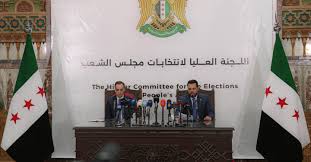
In just a few days, Syria is set to hold what is nominally a legislative election. Yet the signs are unmistakable: this is not a representative process, but a rebranded mechanism of appointment—unfit, unfree, and unworthy of the name. In the absence of a safe environment, amid the collapse of state institutions and the fragmentation of national identity, the notion of free and fair elections becomes less a democratic foundation than a performative fiction. What is being prepared is not a transition, but a recycling of loyalty—a repackaging of old regime tools under new names.
As the date approaches, the true nature of the process is laid bare: baseless legal challenges, mass withdrawals, and questionable appointments. These are not isolated irregularities—they are symptoms of a deeper malaise. What is needed now is not passive observation, but a principled national stand to halt this charade before it calcifies into accepted reality.
Most alarming is the weaponisation of electoral appeals as a tool for political elimination. Verified testimonies reveal that candidates have been disqualified solely on the basis of statements by two witnesses, without any legal evidence. This loophole has been exploited by rival candidates to sideline opponents, as seen in Daraa and Quneitra, where Nasser Hariri was removed from the race without access to his file or the right to appeal. Even more troubling, candidates were denied the right to know who filed the complaints against them—exposing a judicial framework incapable of safeguarding basic rights.
In Quneitra, marginalisation has evolved from sentiment to collective action. Seven members of the electoral body have resigned in protest, including Dr Khadija Hael Al-Mohammad, Dr Marwa Othman and Bayan Shanwan. Their withdrawal was a response to what they described as “the falsification of will” and “the sidelining of revolutionaries.” In her statement, Dr Khadija wrote: “I refuse to be a prop in a play so poorly written it insults the dignity of Syrians. We are not seekers of office—we are soldiers in a process of change towards a brighter future. The least we expect is respect for the people’s will and dignity.” Local sources confirm that most of those who withdrew are prominent figures of the revolution.
In Homs, the controversy has taken on a more complex form. Activist Silva Kourieh published a public testimony detailing her submission of six appeals—three of which were supported by strong evidence and accepted, while the remainder lacked sufficient documentation. She noted that the three-day window was insufficient to gather proof, and that some approved candidates were known for incompetence, opportunism, and corruption. Her critique was not merely a denunciation—it was a call to build coalitions within the electoral body to support clean, capable candidates worthy of Homs and its sacrifices. Despite her reservations, she argued against boycotting the process, urging instead a strategic effort to elevate those who deserve to serve.
In Saqba, a town in rural Damascus, manipulation reached the very composition of the electoral body. The election committee removed two members without legal justification, replacing them with a man and his nephew. This act provoked outrage and threats of mass withdrawal unless the original members were reinstated. The incident reeks not only of favouritism—it reveals a logic of familial appointment that strips the electoral body of independence and transforms it into a vessel of loyalty rather than representation. The insertion of kinship ties into the structure of political representation revives networks of patronage and erodes public trust in the entire process.
Public reaction has not been confined to withdrawals and appeals. Social media has become a platform for biting satire and widespread discontent. Lawyer Firas Abdeen posted: “The way Syria’s parliamentary elections are being run is among the worst in the world—perhaps unique on this planet. Electoral bodies are selected through favouritism and connections. Candidates are chosen by regime clerics and provincial political committees. Political money plays a decisive role. And 70% of MPs will be appointed directly by the presidency. Elections and democracy—utterly transparent!” Beneath the sarcasm lies a sobering truth: what is unfolding is not genuine representation, but a reassertion of appointment and allegiance, draining the process of its foundational meaning.
These developments point not to a passing flaw, but to a structural crisis in the very mechanism of representation. The call to halt the elections is not a rejection of democratic principle—it is a recognition of the danger in reproducing exclusion under a veneer of legitimacy. If the structural dysfunction is now undeniable, an equally grave issue lies in the widespread misunderstanding of the legislature’s role. Many candidates treat parliamentary office as a platform for local service delivery, revealing a distorted view of its constitutional function. The legislature is not an executive body—it is a lawmaking and oversight institution, tasked with drafting, amending, or repealing legislation and holding the government accountable—not dispensing promises.
Faced with this dual impasse—both in the mechanism and the mission of representation—critique alone is insufficient. Nor can we rely on partial reform. In a context where free and comprehensive elections are not feasible, what is urgently needed is a guarantee that those who do reach the legislature are genuinely equipped to fulfil its mandate. Individuals with real expertise in law, economics, public administration, and sociology—capable of transforming the parliament from a symbolic stage into a functional constitutional authority.
This approach does not bypass popular will—it seeks to protect it. By adopting a merit-based appointment mechanism rooted in competence, experience, and specialisation, we can avoid the failures of past initiatives—most notably the National Dialogue Conference, which reduced the Syrian people’s voice to a two-hour session and produced outcomes unworthy of their sacrifices. Reproducing artificial representation will only deepen division and distrust, reviving the logic of guardianship that Syrians rose up against.
Cancelling this electoral process and establishing a temporary legislature through a transparent foundational mechanism is not merely a rational choice—it is a national and moral imperative.
To call for a provisional council formed through a fair and credible process is not to retreat from public life—it is a serious attempt to rebuild the instruments of representation on foundations worthy of Syria’s sacrifices. It is a shift from passive spectatorship to active participation. Either we reconstruct representation anew, or we reproduce exclusion under different names. The true test lies not in appearances, but in our ability to forge legitimacy rooted in competence, animated by courage, and anchored in respect for the people’s will.