
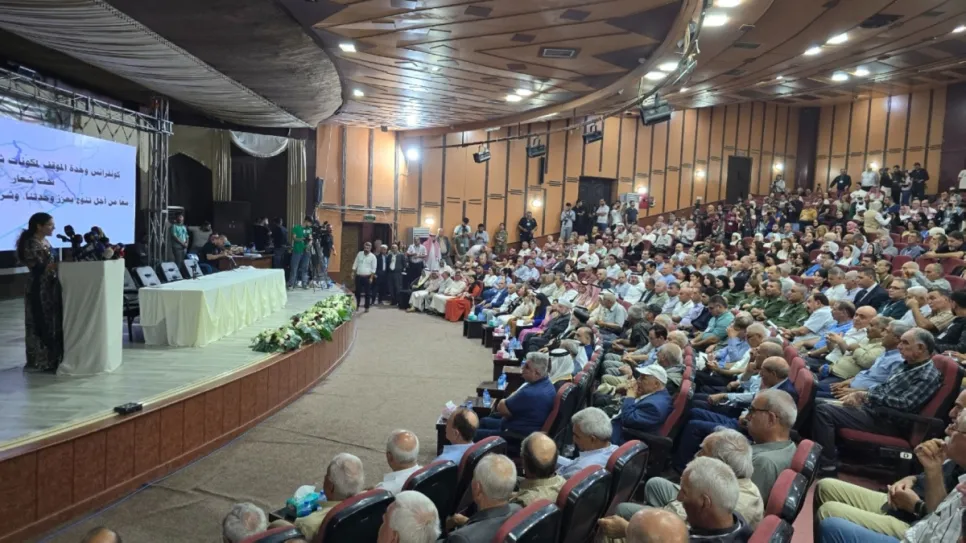
Eight months after the fall of the Assad regime, a conference titled Unity of Position (Wihdat al-Mawqif) was held in al-Hassakeh. Dubbed by some as the “minorities’ conference”, the gathering may not mark a decisive shift in relations between Damascus and the Syrian Democratic Forces (SDF), but it carried considerable political weight. The event was viewed as a symbolic escalation by the Autonomous Administration of North and East Syria, with its long-term repercussions yet to unfold.
In parallel, the Syrian government announced it would no longer participate in negotiations with the SDF. It also boycotted planned talks in Paris—organised under French and American auspices to discuss the implementation of the 10 March agreement between the two sides—citing the al-Hassakeh conference as a “blow to ongoing negotiation efforts”.
While Damascus acknowledged the right of “religious or national groups to express their political views, hold meetings, and establish parties within a national legal framework”, it strongly condemned the event for “hosting separatist figures involved in hostile acts”. It deemed the conference a clear breach of the March agreement and placed full responsibility for its consequences on the SDF leadership. The government urged international mediators to relocate all future negotiations to Damascus, describing the capital as the “legitimate and national venue for dialogue among Syrians”.
The article’s author, Syrian journalist Faisal Aloush, argued that the government’s position was weak—particularly its insistence that the form of the state should be determined by a permanent constitution approved by popular referendum, with “all citizens participating equally”. Aloush questioned how genuine equality of participation could be guaranteed and pointed out that “ballot boxes are for voting, not for dialogue”.
A Deeper National Crisis
According to Aloush, the greatest challenge facing any authority in Syria is managing the country’s complex mix of religious, sectarian and ethnic communities. He writes that the core disagreement between the conference participants and the government concerns the nature of the future state. Will it be a state of law and institutions representing all communities, or one that treats them with suspicion, authoritarianism, or sectarian bias? He warns that the latter would inevitably lead to disasters threatening Syria’s social and territorial cohesion.
The recent deadly unrest in Suweida, Aloush contends, starkly illustrates the depth of national disunity. Fuelled by sectarian incitement and the absence of a shared national identity—legacies of the previous regime—the crisis underlines the urgent need for a comprehensive national reconciliation initiative. Such a project should create a new social contract guaranteeing the rights of all communities and minorities, free from coercion or foreign interference.
Aloush suggests that sectarian violence in Suweida and earlier incidents in the coastal region have deepened the sense of vulnerability among Kurds and other communities, pushing them closer together. This may explain the broad representation at the al-Hassakeh conference, which brought together figures from various religious, sectarian and tribal backgrounds, signalling tribal support for the SDF.
A Call for a Genuine National Conference
The final statement of the al-Hassakeh conference called for “a comprehensive and inclusive Syrian national conference to formulate a unifying identity and build a democratic state”. It urged the drafting of a new constitution enshrining national, cultural and religious diversity, and establishing a decentralised state. It also stressed the need for transitional justice based on truth-telling, accountability and reparations.
Aloush argues that for these goals to be achieved, the government must adopt an open, inclusive approach—addressing concerns, building trust, and moving beyond accusations of treachery. He calls for a genuine national conference, unlike the hastily convened “dialogue conferences” of the past, bringing together representatives from all Syrian communities. He likens this to the Great Syrian Conference of 1919, which united national figures from across the country under the slogan: “Syria is a homeland for all Syrians.”
He warns that vague promises and uncoordinated steps—such as politically motivated inquiry committees or rushed constitutional declarations—have lost credibility among both Syrians and the international community. Finally, he asks whether, in dismissing the al-Hassakeh conference participants as a “fifth column”, the government might resort to military force to bring them into line. Such a move, he cautions, could spark a protracted civil war that would be far easier to enter than to resolve.
This article was translated and edited by The Syrian Observer. The Syrian Observer has not verified the content of this story. Responsibility for the information and views set out in this article lies entirely with the author.