
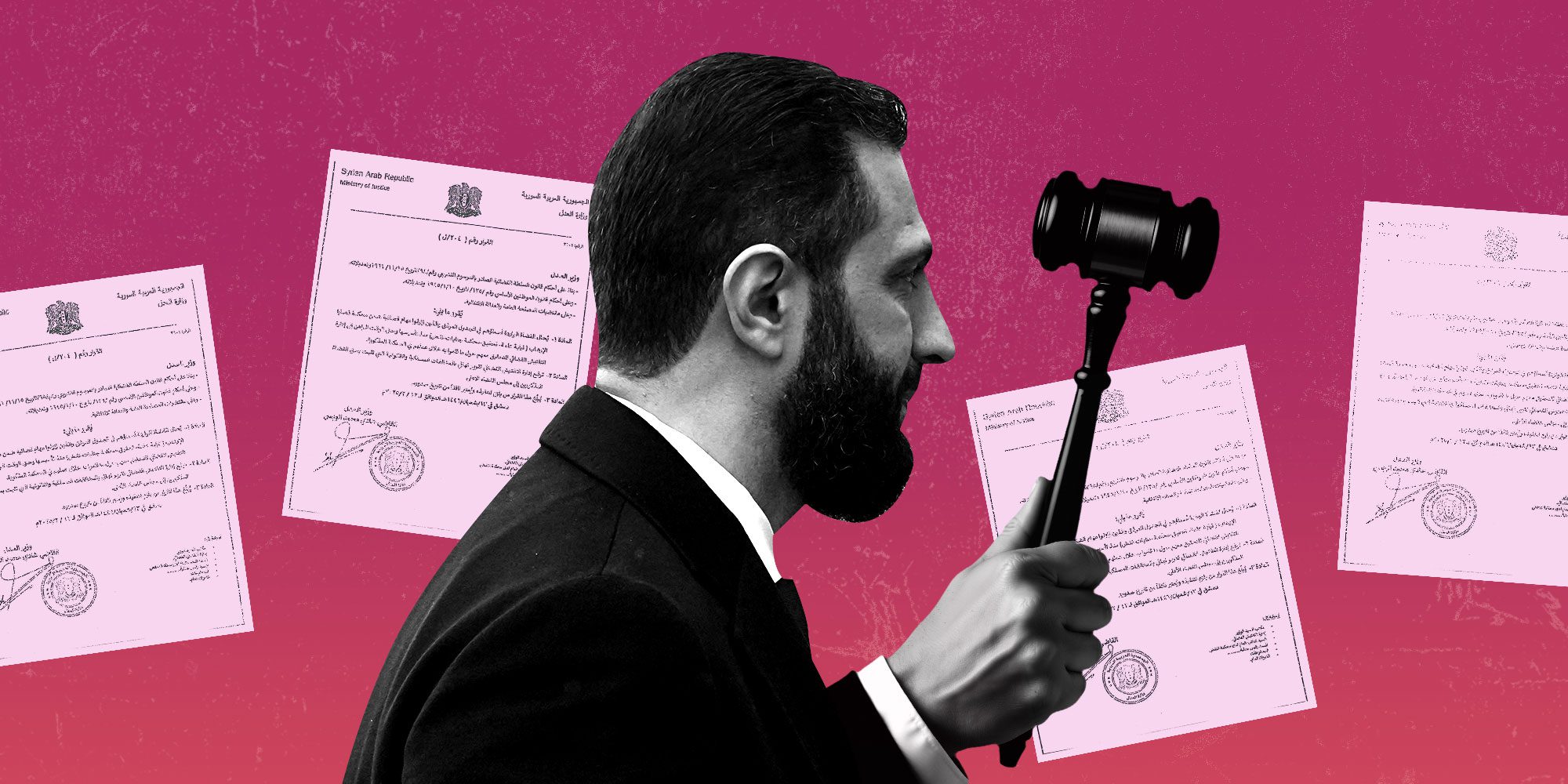
In post-Assad Syria, the judiciary has received far less media attention than other institutions—such as the economy, the reorganization of the armed forces, and the structures of political authority. While extensive reporting has examined attempts to reshape these other domains, this account aims to document the key measures and decrees issued since 8 December 2024. These have dismantled judicial independence, hollowed out constitutional protections, and constructed a judiciary based on loyalty over merit—a painful echo of the Assad era’s own treatment of the third branch.
Pre-Constitutional Declaration: Illegal Dismissals and Appointments
On 8 January 2025, the Minister of Justice in the transitional government issued Decree No. 40, dismissing 14 judges across various governorates. Citing “public interest” as the rationale, the decree contravened the Judicial Authority Law, which reserves the power to appoint or remove judges to the Supreme Judicial Council.
Three weeks later, on 29 January, Decree No. 89 appointed 14 graduates from Islamic Sharia faculties to newly minted posts of “chiefs of justice” in several governorates. Around the same time, Decree No. 43 (15 January) retired eight judges, and Decree No. 194 (12 February) removed 43 more—each decree justified by the same vague invocation of “public interest” without any legal basis.
Soon after, graduates from Sharia faculties were appointed to senior judicial roles: Anas Mansour al-Sulaiman was made president of the Court of Cassation despite lacking a law degree—openly defying Article 70 of the Judicial Authority Law, which stipulates both legal qualification and seniority. Similarly, Ibrahim Shashou was appointed head of the Judicial Inspection Department with no legal credentials, his Sharia diploma deemed sufficient.
These appointments effectively upended the judicial hierarchy, shifting authority to direct political nomination from the executive branch.
Abolition of the Supreme Constitutional Court: An Unprecedented Move
On 13 March 2025, the transitional government issued a Constitutional Declaration abolishing the Supreme Constitutional Court—the highest judicial body responsible for reviewing the constitutionality of legislation and decrees.
This decision delivered a serious blow to the separation of powers. No alternative body was designated to review laws or electoral disputes, leaving the executive branch free from judicial oversight.
At the same time, Abdul Razzaq al-Kadi was appointed president of the Council of State and granted the title of “judge”, despite not meeting the legal requirement of being either a member of the council or a vice-president of the Court of Cassation. Ibrahim al-Hassoun was appointed dean of the Higher Institute for the Judiciary, although he held neither a law degree nor the judicial rank required for the role.
These appointments were based squarely on political and sectarian loyalty—rather than legal competence.
Mass Dismissals of Judges
By mid-2025, Syria had witnessed the removal of more than sixty per cent of its judicial workforce.
On 18 August, a decree summarily dismissed 40 judges—many of whom received only verbal notification, without formal documentation or legal process. Dismissed judges from Latakia, Homs, and Damascus reported being told they had been removed for “failing to join the revolution” or “refusing to defect” from the Assad regime. Some were threatened directly by the Supreme Judicial Council: either resign or face criminal investigation.
In certain cases, dismissals turned into arrests—judges were detained during court sessions without prior authorization, a clear violation of Article 115 of the Judicial Authority Law, which requires approval from the general assembly of the Court of Cassation before prosecuting a judge.
These events marked the total collapse of judicial independence—judges now risked sanctions merely for disobeying government orders.
Exclusionary Criteria in New Judicial Appointments
On 19 August 2025, the provisional government issued Decree No. 1455 to regulate recruitment for judicial vacancies. The decree introduced widely criticised criteria, including ineligibility for anyone who had served in the military or held official posts in the previous regime after 2011.
Though framed as a means of purging remnants of the old regime, the decree violated Article 10 of the Constitutional Declaration, which guarantees equality of rights and duties. It also bypassed the Judicial Authority Law, which gives the Ministry of Justice and the Supreme Judicial Council oversight of appointments. Instead, the new system handed nomination powers to the Bar Association.
The outcome: large segments of qualified law graduates were excluded, and judicial appointment became a political test of loyalty rather than professional merit.
Interference in Supreme Judicial Council Decisions
One of the year’s most egregious legal violations came with Decree No. 924, issued on 19 June, which annulled the training of fourth-year students at the Higher Institute for the Judiciary.
These students had been formally appointed through irreversible Supreme Judicial Council resolutions in late 2023 and early 2024, granting them legal status. Nonetheless, the Ministry of Justice formed an inspectorate to re-examine the appointments—conducting interviews without legal representation or formal documentation.
When the affected students appealed to the Administrative Judiciary Court in Damascus later that June, the court—acting under orders from the president of the Council of State—refused to register the case, violating the constitutional right to legal redress.
In doing so, administrative justice was paralysed—transformed from a safeguard for the aggrieved into a tool of executive arbitrariness.
Illegitimate Investigative Commissions and Legal Violations
On 31 July, the Ministry of Justice formed a commission to investigate events in Suwayda Governorate. The body included civilian judges and unqualified lawyers—even though the relevant offences clearly fell under military judicial jurisdiction.
This action breached established rules of jurisdiction under the Code of Criminal Procedure, rendering the commission’s work legally void.
After the arrest of former regime officials—such as security figures Atef Najib, Mohammed Ibrahim al-Shaar, Ibrahim Hweija, and former Mufti Ahmad Badr al-Din Hassoun—the resulting investigations disregarded core legal protections. Article 70 mandates confidentiality during preliminary inquiries, and Article 69 guarantees the right of defense—both of which were openly violated.
This article was translated and edited by The Syrian Observer. The Syrian Observer has not verified the content of this story. Responsibility for the information and views set out in this article lies entirely with the author.