
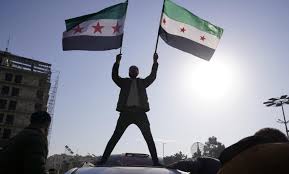
Amid rising sectarian tensions in post-revolutionary Syria, clashes erupted overnight from Tuesday to Wednesday in parts of Lattakia and Homs—two pivotal cities anchoring the country’s western and central heartlands. The violence pitted pro-regime demonstrators from Damascus against protesters demanding the release of detainees. Riot police were swiftly deployed to contain the unrest, underscoring the fragility of the transitional period.
Field sources told The New Arab that anti-riot forces blocked regime supporters from entering Homs’ al-Nuzha and al-Zahra neighbourhoods—both focal points of Tuesday’s demonstrations calling for decentralisation and the liberation of detainees. Security units ordered the dispersal of the rallies, preventing further escalation into the predominantly Alawite areas.
Meanwhile in Lattakia, opposing protests took place late into the night in response to earlier rallies prompted by Sheikh Ghazal Ghazal, head of the Supreme Islamic Alawite Council in Syria and the Diaspora. Those demonstrations had echoed demands for federalism and the release of political prisoners, fuelling fears of renewed divisions in a coastal region long associated with the former Assad regime.
Sources further reported that the al-Zira’a neighbourhood in Lattakia was placed under heightened security after Internal Security Forces came under sporadic gunfire. Reinforcements were deployed to deter direct confrontations. This flare-up follows a series of volatile incidents, including the killing of a Bedouin couple in Homs and the discovery of mass graves in al-Karm al-Zaytoun—events that have sparked retaliatory attacks between Bedouin and Alawite communities.
Coastal Trials: Justice or Theatre?
In a statement to the Syrian Arab News Agency (SANA), Brigadier General Abdul Aziz Hilal al-Ahmad, head of Internal Security in Lattakia Province, characterised the unrest as sectarian provocation masked as civil protest. “What began as calls for reform quickly devolved into orchestrated incitement, fuelled by expatriate media propagating hate speech and communal division,” he said.
General al-Ahmad accused protesters of shielding war criminals and condemned attacks on police and emergency services. He confirmed that two security officers and several civilians were injured in al-Zira’a after protesters opened fire and set security vehicles ablaze.
“The law will hold to account all those who attack our forces or incite sectarian strife,” he said, calling on residents to “embrace reason and resist the schemes of the disreputable.” His comments come as the much-anticipated coastal trials—designed to prosecute crimes committed under Assad—face criticism from within Alawite communities, who claim they are being selectively targeted under the guise of transitional justice.
SDF Detains Suspect in Deir ez-Zor with Coalition Support
Elsewhere, the Syrian Democratic Forces (SDF), with support from the US-led International Coalition, carried out a late-night operation east of Deir ez-Zor, arresting an alleged ISIS affiliate.
According to North Press, a media outlet affiliated with the SDF, troops conducted airborne insertions and raided two houses in the al-Zalzala quarter of Marat town. The primary suspect, Sadiq Yusuf al-Zughayr, was detained along with an associate. A third target reportedly escaped across the Euphrates into regime-controlled territory.
However, Deir ez-Zor native and political commentator Jassim al-Alawi challenged the official account in comments to The New Arab. He claimed that al-Zughayr, recently released by the SDF, was detained not for jihadist links but for tribal activism critical of Kurdish dominance. “The SDF is using the ISIS label as a pretext to crack down on dissent across Deir ez-Zor and Raqqa,” he warned, raising concerns about increasing political suppression disguised as counterterrorism.
Signs of a Fragile Transition
These developments come in the shadow of March’s horrific Alawite massacres, which, according to the Syrian Observatory for Human Rights, left more than 1,700 dead. While recent protests have remained largely peaceful—featuring chants such as “The Syrian people are one; the Alawite spirit shall not kneel”—they have increasingly devolved into violent altercations, wounding dozens and evoking painful echoes of the 2011 uprising.
With curfews now imposed in Tartus and Homs, and more than 120 arrests made in Homs alone, the Syrian government’s handling of detainee demands and federalist calls may determine whether the revolution’s promise of unity can endure—or whether sectarian fissures will reopen in bloodshed.
As the Sharaa administration navigates transitional justice and minority inclusion, the coastal unrest is emerging as a litmus test for the viability of Syria’s fragile new order.
This article was translated and edited by The Syrian Observer. The Syrian Observer has not verified the content of this story. Responsibility for the information and views set out in this article lies entirely with the author.