
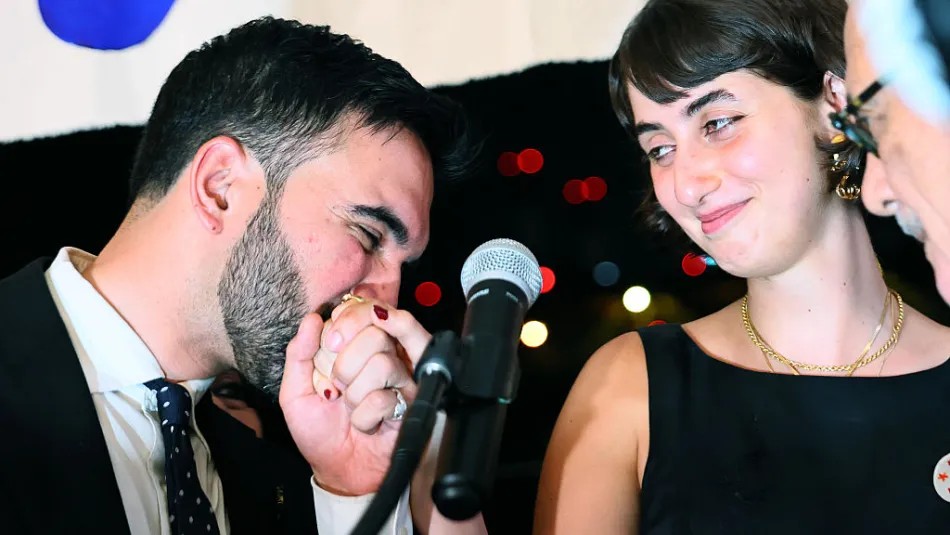
Zahran Mamdani’s election as mayor of New York stands as a powerful testament to the notion that plural identities do not threaten the state—they enrich it, when anchored in justice and equality. What this young politician has offered is not merely a fleeting electoral victory, but a model worthy of reflection for Syria, Lebanon, and all societies fractured by division: a way out of chronic political paralysis that rebuilds the social contract not through fear or factionalism, but through trust and inclusive participation.
Politics from the Ground Up
At the heart of Mamdani’s experience is a redefinition of politics—not as a distant or abstract notion, but as a collective practice rooted in neighbourhoods, unions, and direct engagement. He espoused the belief that democracy is not a gift handed down from above, but a right earned through everyday action and community involvement.
This is precisely what Lebanon lacks: a political system stifled by patronage and sectarianism. And it is what Syrians have long been denied, in a state where authority became a force above society, rather than a service within it.
In both cases, the bond between state and citizen has been ruptured. In Lebanon, sectarian identity was enshrined as the basis of citizenship; in Syria, allegiance to the regime replaced national belonging. Mamdani’s example is a reminder that a sustainable state cannot be built on exclusion. Rather, it must embrace diversity within public decision-making. Justice, he shows, is not a mere slogan—it is the institutional capacity to turn equality into lived reality.
Lebanon and Syria: Parallel Failures
Beirut faltered by making sectarianism the cornerstone of political life. Damascus failed when it treated civic identity as subordinate to political loyalty. In the former, pluralism was twisted into a mechanism for dividing spoils; in the latter, diversity was suppressed as a threat.
Mamdani, by contrast, turned his own layered identity into a source of strength and legitimacy—demonstrating that multiple affiliations can coexist within a just and functioning system.
When Mamdani said in his victory speech, “This is your city, and this democracy is yours too,” he was addressing New York’s immigrant communities. Yet, perhaps unknowingly, he was also speaking to Syrians and Lebanese who have been denied the right to see politics as an inclusive tool rather than a mechanism of repression or sectarian apportionment.
In our region, difference is still viewed with suspicion, loyalty is still judged by affiliation, and meritocracy remains an elusive ideal.
A Moral and Political Reminder
Mamdani’s win is a reminder that democracy is not merely about ballot boxes, but about trust—trust built through transparency, accountability, and collective engagement. In societies like Syria and Lebanon, where trust between ruler and ruled has collapsed, that relationship must be rebuilt from the ground up. Politics must be reclaimed as the art of listening—not as an instrument of control.
His experience affirms that a society with a genuine voice does not need a saviour—it needs institutions that empower people to shape their own future. Reform, he teaches, does not begin with declarations from above, but by restoring dignity to the citizen and affirming their role in shaping collective destiny.
Toward a Narrow Passage
In two nations exhausted by war, authoritarianism, and sectarianism, Mamdani’s message is more than symbolic—it is a call to rebuild the social contract from below. It points toward a narrow but vital passage between a capable state and a free society—where power does not become fate, and freedom does not descend into disorder.
As he has demonstrated, politics is not the preserve of elites or the battleground of militias—it is the daily practice of dignity, justice, and shared responsibility.
From his platform in the West, Mamdani has offered a vision of what politics in the East might one day become: a means of forging the common good, not fracturing it; a bridge between society and state, not a trench that divides them.
And when he said in Arabic, “I am of you and for you,” his voice may have echoed from afar—but it carried a quiet message to every Syrian and Lebanese citizen: politics can be human again, if we begin from below—not above.
This article was translated and edited by The Syrian Observer. The Syrian Observer has not verified the content of this story. Responsibility for the information and views set out in this article lies entirely with the author.