
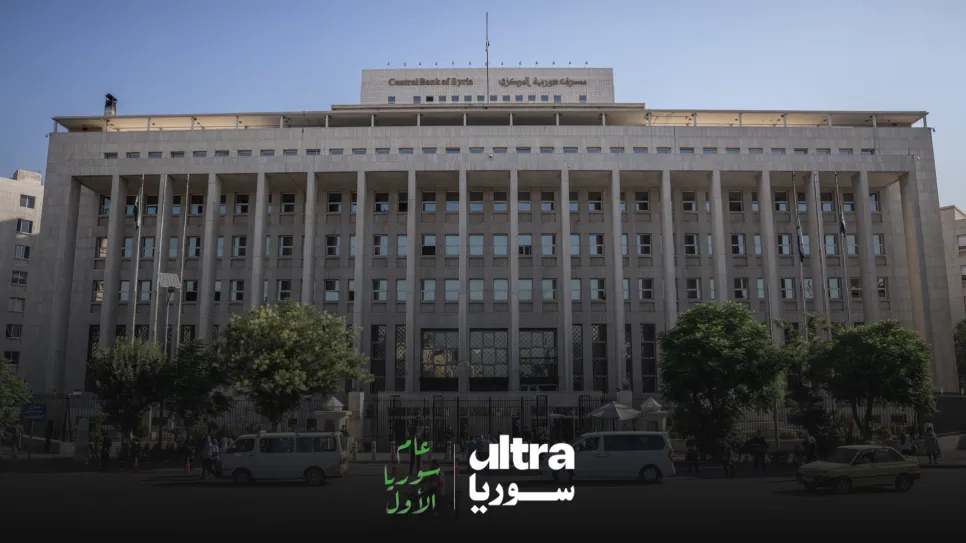
For many Syrians, the prospect of suspending or dismantling the Caesar Syria Civilian Protection Act has generated a wave of optimism. Commentators speak of billions poised to flow into reconstruction, and some officials suggest that the end of the sanctions regime will trigger a rapid economic turnaround. Yet Syria’s economic crisis runs far deeper than one punitive statute. Removing a legal obstacle does not, on its own, rebuild a collapsed institutional system or restore confidence in a financial sector that has been deteriorating for more than a decade.
- The Shift in Washington’s Approach: From Punishment to Conditional Monitoring
Recent legislative moves in the U.S. Congress do not amount to a full repeal of Caesar. Instead, they introduce a model of tight oversight. Sanctions relief will be conditional, tied to Syria’s adherence to eight political, security, and humanitarian benchmarks, including counterterrorism cooperation, removal of foreign fighters from state institutions, protection of minority rights, and implementation of agreements such as the March 10, 2025 arrangement with the SDF.
Compliance will be reassessed every 180 days over a four-year period.
This shift suggests a move away from “automatic punishment” toward behaviour-linked engagement, but it does not amount to a blank cheque. Potential capital flows will remain tied to political performance.
- The Illusion of a Reconstruction Windfall
Expectations of an immediate economic boom ignore Syria’s structural constraints. UN and World Bank estimates place reconstruction needs at $216 billion, nearly ten times Syria’s projected GDP for 2024. Even if all sanctions evaporated tomorrow, there is no infrastructure—financial, administrative, or security-related—capable of absorbing such massive capital.
A persistent misconception frames sanctions as the primary cause of Syria’s economic collapse. In reality, institutional breakdown, corruption, and systemic dysfunction long predate Caesar. Lifting one legislative barrier cannot reverse decades of erosion.
- The Financial Sector’s Crisis of Credibility
Even if capital becomes available, the Syrian banking system is ill-equipped to handle it. Structural problems include:
- Multiple exchange rates
- Central bank financing of fiscal deficits
- Weak regulatory oversight
- Widespread cash transactions outside the banking system
- A decade-long rupture of international banking relations
A system operating under these conditions cannot provide reliable credit, manage large inflows, or guarantee secure transactions. Without banking reform—including restoring the central bank’s independence and re-establishing international compliance standards—any injection of liquidity risks fueling currency shocks, inflation, and speculative bubbles.
- Sanctions Relief Is Not Enough: Deeper Obstacles Remain
Caesar is only one piece of a wider sanctions architecture. Even if suspended, Syria remains subject to:
- The Syria Accountability and Lebanese Sovereignty Act (2003)
- The Syria Human Rights and Civilian Protection Act (2012)
- EU, U.S., and UN sanctions targeting individuals, entities, and networks
Removing Caesar does not resolve these. Nor does it solve the country’s entrenched problems of corruption, weak governance, fragmented territories, and declining production capacity.
- Preconditions for Real Recovery
Experts interviewed in the article identify three foundational requirements:
(a) Restoring confidence in state institutions
Transparent governance and accountability are essential to attract investment. Without institutional reform, no financier—domestic or foreign—will deploy significant capital.
(b) Reconnecting Syria to the global financial system
Syria must rejoin SWIFT, normalize international transfers, and enable reliable trade financing. Without this, industrial and commercial sectors cannot recover.
(c) Establishing secure conditions for economic activity
Safety of goods, capital, and labor is a prerequisite. Persistent insecurity or fragmented local authority undermines all forms of investment.
- What Growth Might Look Like
A realistic scenario imagines slow transition from severe contraction toward modest, fragile growth:
- 2026: 1–2 percent growth, driven by initial investment in energy and telecommunications
- 2027–28: Potential rise to 3–5 percent if security stabilizes and Gulf investment materializes
- Downside risks: Inflation, instability, or incomplete reforms could shrink growth to 1 percent
This is not a “boom,” but a tentative, uneven recovery.
- Reform Priorities: Banking, Infrastructure, and Governance
The article highlights four urgent reform tracks:
- Legislative overhaul—replacing obsolete financial, administrative, and economic laws dating back to the mid-twentieth century.
- Banking reconstruction—expanding ATM networks, upgrading outdated systems, digitising payments, and ensuring currency convertibility.
- Digital transformation—automating public services, enabling e-governance, and reducing bureaucratic bottlenecks.
- Local administration reform—empowering elected governors under the Local Administration Law 107 to deliver responsive governance.
Together, these form the legal and administrative scaffolding needed for reconstruction to begin in earnest.
- Infrastructure: The Hidden Bottleneck
Even with money and laws in place, the economy cannot recover without electricity, transport networks, and production capacity. Syria requires massive investment in gas and solar power, rehabilitation of transport corridors, and revival of agriculture and industry.
Without reliable power and logistics, factories cannot operate and supply chains cannot be restored.
- Social Costs and the Politics of Reform
Reforms will force Syria to confront painful trade-offs. Steps such as lifting subsidies, liberalising prices, and restructuring the currency (including the proposal to redenominate by removing two zeros) may stabilise the macroeconomy but will increase hardship for a population where over 90 percent live below the poverty line.
Targeted social protection will be essential to prevent further social deterioration.
Conclusion: Lifting Caesar Is Only the Beginning
Syria’s path to economic recovery will not be determined by a single decision in Washington. Real change hinges on the Syrian state’s ability to rebuild credibility, reform institutions, reconnect to global finance, and secure a stable environment for investment.
Sanctions relief opens a door, but what lies behind that door depends entirely on domestic reform, political will, and institutional reconstruction.
In the absence of these, the end of Caesar may generate headlines—but not a functioning economy.
This article was translated and edited by The Syrian Observer. The Syrian Observer has not verified the content of this story. Responsibility for the information and views set out in this article lies entirely with the author.
