
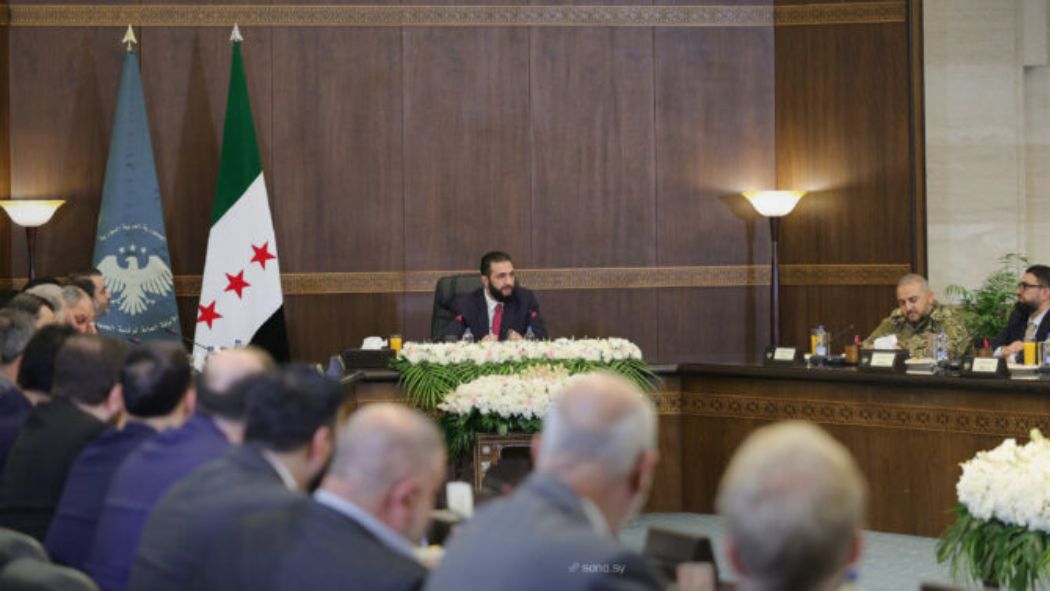
Transitional Syrian President Ahmad al-Sharaa chaired an expanded cabinet meeting on Sunday, October 12, bringing together ministers, heads of public agencies, and governors to review recent political, security, and military developments, as well as what participating ministers described as “achievements” across various sectors, according to the Syrian Arab News Agency (SANA).
Foreign Minister Asasad al-Shibani said Syria had “transformed from a country once viewed with pity into a national success story,” noting that President Sharaa’s repeated participation in international summits and forums has “enhanced Syria’s regional and international standing.”
Shibani added that his ministry had achieved “tangible progress” on the issue of external sanctions through the launch of a “balanced diplomacy” plan and the signing of agreements and memoranda of understanding with states that had not previously maintained official contact with Damascus. He pointed to the development of ties with China and the “activation of Syria’s membership in Mediterranean nations.”
Regarding relations with the United States, Shibani spoke of “gradual improvement,” stressing the importance of leveraging the current international openness to support reconstruction efforts. He also referred to the resolution of several pending consular issues and noted that some countries were preparing to send new ambassadors to Damascus.
Shibani further explained that “the Suweida file has been brought back within the national framework,” strengthening domestic unity.
Interior Minister Anas Khattab said his ministry had succeeded in “maintaining relative calm” in Suweida. He reported that the ministry had issued over 450,000 passports during the past period, lifted more than five million travel bans, and achieved a 90% reduction in drug smuggling thanks to enhanced inter-agency coordination. He also announced the opening of a complaints center in Damascus, with plans to establish four additional centers in the provinces.
Defense Minister Maj. Gen. Marhaf Abu Qasra underscored “the importance of military educational institutions in training personnel and strengthening defense readiness.” Emergency Management and Disaster Response Minister Raed al-Saleh reviewed his ministry’s performance in tackling fires and natural disasters, emphasizing the preparedness of rapid response teams.
Governors and heads of government institutions presented reports on their respective sectors’ “achievements” and the challenges facing public services and development work. Syrian Development Fund Director Safwat Raslan discussed how financial resources are being distributed according to criteria reflecting the level of damage and population in each province.
The meeting concluded with directives from President Sharaa stressing the need to “enhance coordination among state institutions and integrate government efforts to serve citizens and support national development,” according to the state news agency.
This article was translated and edited by The Syrian Observer. The Syrian Observer has not verified the content of this story. Responsibility for the information and views set out in this article lies entirely with the author.