
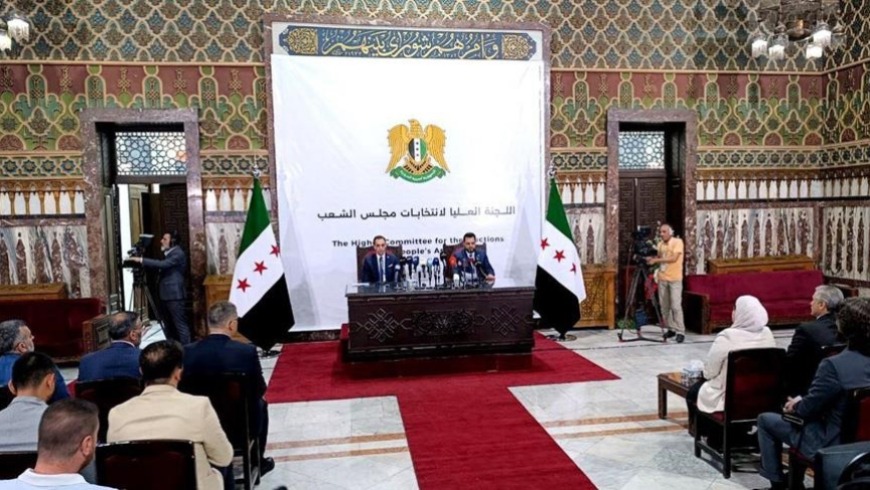
Syria is preparing to establish its first parliamentary assembly since the ousting of former President Bashar al-Assad, a step described as a milestone in the country’s political transition.
On Sunday, the Supreme Committee for People’s Assembly Elections announced that October 5, 2025, has been set as the date for electing assembly members in designated electoral districts across the provinces.
The decision is based on the Constitutional Declaration issued by the Syrian government on March 13, which outlined a dual mechanism for selecting assembly members:
- Two-thirds of the members (140 out of 210) will be elected through local electoral bodies.
- The remaining third (70 members) will be appointed by the President of the Republic to ensure what the declaration describes as “fair representation and competence,” per Article 24.
Why This Electoral System?
The Constitutional Declaration adopted this hybrid system instead of universal suffrage due to the lack of reliable population data and the displacement and exile of millions of Syrians since 2011.
The electoral process will be managed by an 11-member body appointed by the Syrian President in June. This body, in turn, appointed regional subcommittees to select members of local electoral bodies after local consultations.
According to the preliminary list, approximately 6,000 voters are competing for 140 seats distributed across 60 electoral districts.
To run for a seat in the People’s Assembly, the Supreme Committee set the following conditions:
- Syrian citizenship held before March 2011 and at least 25 years of age.
- Full legal capacity (not under guardianship, not convicted of a dishonorable offense, and not suffering from a mental illness).
- Registered in the electoral district’s civil registry (with consideration of residents prior to 2011).
- Not a member of the military or security forces (unless officially resigned).
- Not holding a position in central or regional election committees or executive roles (e.g., minister, governor, deputy).
- Good conduct and reputation, aligned with the general sentiment of the revolution (not a supporter of the ousted regime, not advocating for separatism, and not seeking foreign intervention).
How and Where Will the Elections Take Place?
The Supreme Committee issued executive instructions for the presidential decree on the temporary election law, detailing the distribution of electoral districts, the formation of committees and electoral bodies, candidacy procedures, voting processes, and the first session of the People’s Assembly.
The committee will announce the start of voting at least two days in advance. Voting will occur on a single day across all districts, beginning at 9:00 AM and lasting three hours, with the possibility of extension if voters are still present at polling stations.
Challenges to the election results can be filed within three days, with decisions resolved within five days, after which final results will be announced.
Parliamentary elections will not take place across all of Syria. Authorities have postponed elections in areas controlled by the “Autonomous Administration” in northeastern Syria and in Suweida province in the south, meaning approximately 12 seats allocated to these regions will remain vacant for now.
Concerns and Criticisms
Syrian civil society organizations and activists have criticized the electoral process, describing it as centralized and lacking clear eligibility criteria.
A statement by 15 civil society organizations noted that the process “paves the way for the executive authority to dominate an institution that should be independent and reflect the people’s will.”
Political researcher Radwan Ziyada told Reuters that the elections amount to “a selection process that may exacerbate the legitimacy crisis by failing to provide genuine representation.” He added, “Critics will say it’s neither democratic nor free, though the state has never claimed it to be a democratic process.”
In earlier remarks to The Economist, Syrian President Ahmad al-Sharaa emphasized support for democratic governance, stating: “If democracy means the people decide who governs and represents them in parliament, then Syria is moving in that direction.”
What Powers Will Deputies Have?
The Constitutional Declaration, approved by the Syrian government in March, grants the People’s Assembly limited powers, and the government is not required to secure a vote of confidence from the Assembly.
Article 24 stipulates that the People’s Assembly will assume legislative authority until a permanent constitution is adopted and new legislative elections are held. The Assembly’s term will last 30 months, subject to renewal.
Under Article 30, deputies will undertake tasks including proposing and passing laws, amending or repealing existing laws, ratifying international treaties, approving the state budget, and granting general amnesties.
This article was translated and edited by The Syrian Observer. The Syrian Observer has not verified the content of this story. Responsibility for the information and views set out in this article lies entirely with the author.